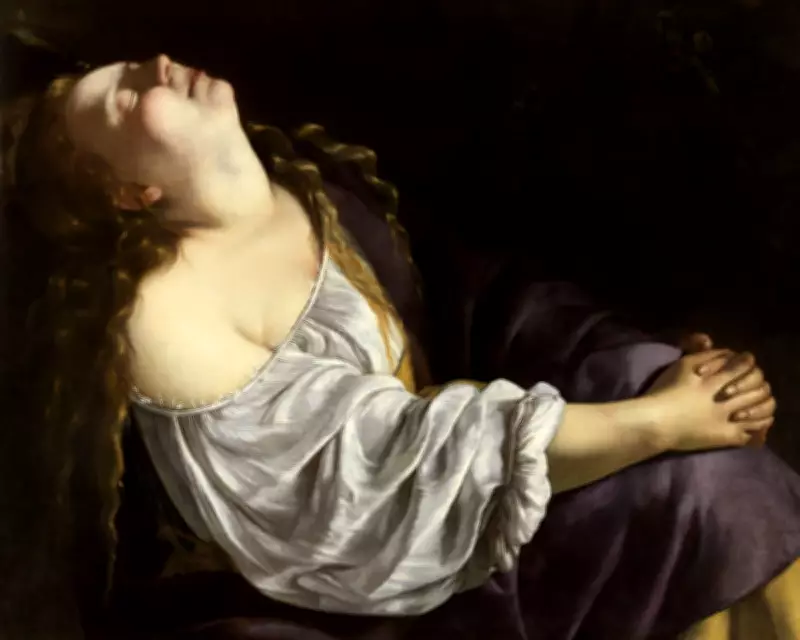
Artemisia Gentileschi's Revolutionary Mary Magdalene Arrives at National Gallery
Artemisia Gentileschi's electrifying painting "Mary Magdalene in Ecstasy" will soon captivate visitors at the National Gallery of Art in Washington, DC, marking a monumental shift in how this biblical figure has been represented throughout art history. The Italian Baroque artist's work, acquired recently by the institution, portrays Mary Magdalene not as a shamed or repentant sinner but as a woman experiencing profound spiritual ecstasy.
A Vision of Spiritual Awakening
The painting, created in the early 1620s, shows a woman with flushed cheeks, closed eyes, and golden hair glowing in a dark room. Her lace-trimmed chemise slips from her shoulder, revealing porcelain skin, while heavy yellow and purple fabrics drape around her. This Mary Magdalene exists in a state of sublime freedom, completely unaware of any viewer's presence, lost in her own spiritual experience.
Curator Letizia Treves emphasizes that this depiction shows the saint "neither repentant nor suffering"—a radical departure from centuries of artistic tradition that had shaped Magdalene's image through patriarchal interpretations. As scholar Diane Apostolos-Cappadona notes, Mary Magdalene has been "the most flexible female figure in Christian art," subject to countless reinterpretations by male artists and theologians.
Centuries of Misrepresentation
For nearly fifteen hundred years, Mary Magdalene's story has been distorted by powerful institutions and artists. Pope Gregory the Great's sixth-century sermon confused her with Mary of Bethany and an unnamed sinner, effectively creating the myth of the repentant prostitute. Medieval theologians and artists further cemented this narrative, with her "seven demons" from the Gospels becoming associated with the seven deadly sins.
Artistic representations followed this distorted path: Donatello's emaciated wood-carved Magdalene clasping her hands in penitence, Caravaggio's drained and deathly version, Rubens' semi-nude figure held up by angels, and Titian's strategically exposed breasts hidden behind shimmering hair. These depictions consistently sexualized and denigrated Mary Magdalene, using her story to warn women against sexual transgression while providing artists with an excuse to paint nudity under the guise of piety.
A Female Artist's Transformative Perspective
Artemisia Gentileschi, renowned for her powerful depictions of mythological and biblical women, offers a completely different vision. Her Mary Magdalene sports rosy cheeks and appears "passionately alive ... in the throes of ecstatic rapture," according to Treves. Eve Straussman-Pflanzer, curator of Italian and Spanish paintings at the National Gallery, observes that Gentileschi "endows Mary Magdalene with an electrifying vitality."
As Apostolos-Cappadona explains, this represents "a moment of spiritual encounter ... described sometimes as if it's the finest sexual encounter ... the greatest orgasm she could ever have. It's aesthetic, it's physical, it's sexual, it's spiritual. You are raised outside yourself to a higher level." This holistic experience—engaging head, body, spirit, and heart—contrasts sharply with previous depictions that reduced Mary Magdalene to either suffering or sexualization.
Broader Implications for Art and Society
The acquisition of Gentileschi's painting represents more than just adding a significant work to the National Gallery's collection. It signals a fundamental shift in how institutions approach gender representation in art. When women artists depict biblical or mythological women, they frequently show them as active, complex individuals with agency rather than passive, sinful, or subordinate figures.
This artistic shift parallels institutional changes within the Catholic Church, which in 1969 recognized Magdalene's canonical definition as a faithful follower rather than a sinful repenter. In 2016, Pope Francis elevated her to "apostle to the apostles," designating July 22 as her feast day. While one institution begins to include more female perspectives, another re-evaluates its historical interpretations.
Gentileschi's Mary Magdalene exists free from patriarchal gaze, not performing for viewers, not weeping or repenting, not dictating moral lessons. She represents a woman experiencing spiritual ecstasy for herself alone. This acquisition contributes to a broader movement toward gender equality in art interpretation and institutional representation, challenging centuries of misrepresentation while offering new ways to understand both biblical figures and the female experience.
The painting will be on view free of charge at the National Gallery of Art in Washington, DC, beginning February 24, inviting visitors to reconsider not just Mary Magdalene's story but how artistic representation shapes our understanding of women throughout history.