Curran Hatleberg's Photographic Exploration of America's Fringes
Guided by pure instinct and intuition, acclaimed photographer Curran Hatleberg traverses the diverse landscapes of the United States, seeking out images that tell their own compelling short stories. His work captures moments ranging from a boat filled with dead alligators to teenagers fearlessly diving forty feet off a decaying bridge into a river below.
The Genesis of Blood Green
Hatleberg explains that his latest project, Blood Green, emerged directly from the completion of his previous book, River's Dream. "Finishing up my book River's Dream a few years ago, I just couldn't shake the thought that there was something I had left behind – that there was something I left unsaid," the photographer reveals. In this sense, Blood Green serves as a continuation, picking up precisely where River's Dream concluded, available for purchase through TBW Books.
During the editing process for River's Dream, Hatleberg began to recognize that numerous photographs simply did not fit within that particular narrative framework. "They felt different, and so they ended up on the cutting room floor," he notes. These discarded images ultimately formed the foundation of Blood Green, which shifts focus toward the primal, often raw connection between humanity and the natural world, moving away from depictions of domestic gatherings in outdoor settings.
Encounters in the Swamp
One particularly memorable encounter during the creation of Blood Green involved a man who spent extensive time deep within the swamp. This individual shared a haunting perspective: "if he went too deep into the tangle, he knew that the swamp would take him for good." Paradoxically, this very danger only heightened the allure of the dark thickets and meandering waterways for him. The man demonstrated a genuine love for the swamp, depicted in one image kneeling in a stream bed with his catch. He described how deeper excursions led to fewer human encounters and more frequent meetings with water moccasins, bull alligators, and enormous prehistoric reptiles and amphibians.
Moments of Youth and Recklessness
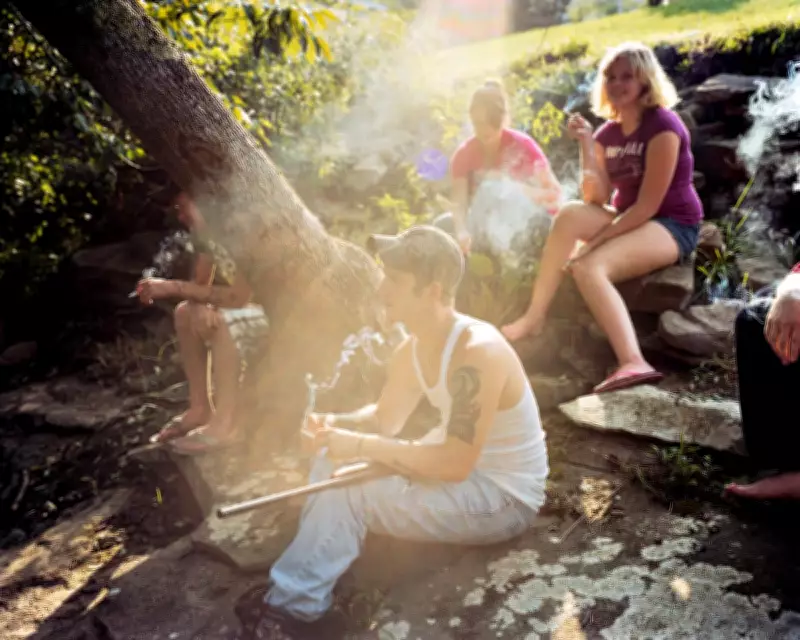
The collection also includes scenes of youthful abandon, such as young adults relaxing near a creek with a smoking gun and cigarettes. Another powerful image captures teenagers preparing to jump forty feet off a dead bridge into a river. Hatleberg reflects, "This picture makes me think of carefree, reckless leisure. It makes me think of those infinite summer afternoons of youth when there are no responsibilities and there's no one to answer to." He muses on the feeling of invincibility at that age, where everything seems possible and pain is a distant concept.
The Lost Coast Narrative
Hatleberg's iconic debut monograph, Lost Coast, presents an episodic narrative centered on Eureka, California. The photographs seamlessly transition between intimate portraits and the surrounding landscape, balancing moments of shared connection with instances of quiet dislocation. The title not only references the remote stretch of California's northern coast but also evokes a deeper sense of disappearance – of lives lived on the margins, dreams cast aside, and overlooked beauty.
"For me, the Lost Coast region of California feels like the far-flung edge of the world, like a rugged place of no return," Hatleberg admits. He describes a persistent sensation while living there that he could simply vanish without a trace. Many of the individuals he photographed and spent time with eventually disappeared, leaving town without warning or notice, gone forever from his perspective.
The Heart of the Work: Family and Community
At its core, Hatleberg's photographic practice is profoundly about family and the search for understanding what family and community truly mean. "So many times in my life I've been lost or adrift, searching for connection and love – the way we all do – and it is not at all a stretch to say the people I spend time with and photograph are, and have been, family to me," he confesses. He has lived with numerous subjects, shared meals, worked alongside them, and performed daily tasks together. The photographs themselves are merely traces of these deeper, more significant relationships.
Each image in both collections functions as a self-contained short story, rich with intricate detail and layered ambiguity. Together, they construct a multifaceted portrait of places shaped equally by natural grandeur and the gradual erosion of economic promise, offering a unique window into contemporary American life.