Catherine Opie's Groundbreaking Exhibition 'To Be Seen' Arrives in London
The National Portrait Gallery in London is preparing to host Catherine Opie's first major museum exhibition in Britain, titled To Be Seen. This comprehensive showcase features key works spanning from the 1990s to the present, offering a profound exploration of queer American life through the lens of one of photography's most significant contemporary artists.
A Career Dedicated to Queer Representation
For over three decades, Catherine Opie has devoted her artistic practice to documenting the lives of gay, lesbian, and queer Americans who have been historically excluded from mainstream art history. The 64-year-old photographer, who taught at the University of California, Los Angeles for 27 years, has consistently challenged her students to demonstrate bravery through their work. To Be Seen embodies this philosophy, presenting some of Opie's most courageous and iconic images.
The exhibition includes her celebrated portraits from Los Angeles's 1990s leather dyke scene, featuring figures like the androgynous Pig Pen who stares coolly at the viewer, daring them to define identity. Her Being and Having series presents thirteen butch lesbians wearing stick-on facial hair in an absurdist performance of masculinity, while Dyke captures her friend Steakhouse with the word "dyke" tattooed across her neck in ornate script.
The Infamous Self-Portrait/Cutting
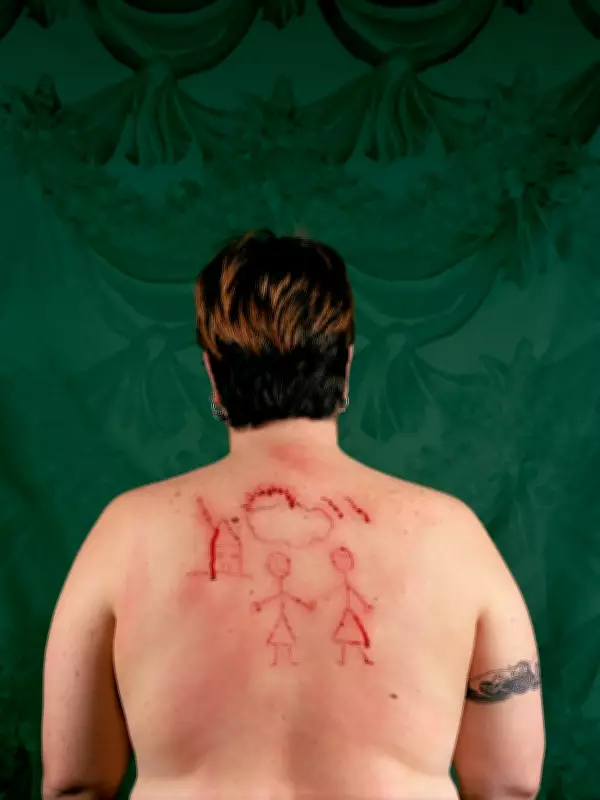
Perhaps Opie's most famous work, Self-Portrait/Cutting from 1993, shows the artist with her back to the camera, bearing the bloody outline of a child's drawing of a house and family scored into her skin. Created in collaboration with artist Judie Bamber, this powerful image references the relationship between queer domestic life and a homophobic society. Opie emphasizes that her intention was never simply to shock, but rather to provoke meaningful conversation about representation and family.
"I say in the audio guide, 'Why don't you ask them, 'Oh wow, huh, what do you think the artist meant by drawing a house with smoke coming out the chimney? Why do you think the sun is coming out of the cloud?''" Opie explains regarding how to discuss the work with children. "When you engage a child in those kinds of questions of representation, they're not going to think it's bad that it's blood. They're only going to think it's bad that it's blood if you teach them that."
Personal Narratives and Expanding Perspectives
The exhibition also features deeply personal works, including Self-Portrait/Nursing, which shows Opie breastfeeding her infant son Oliver while bearing scars from previous artwork. Another series, In and Around Home, captures Oliver as a toddler wearing a pink tutu, challenging Opie's own assumptions about gender and parenting.
"Because, out of my butchness, I had wanted him to be a boy-boy," Opie recalls. "I didn't want a girl because I didn't know how I would talk to her about femininity. And with my son, here I was grappling with wanting him to toss a football with me in the back yard because that's what I had always dreamed of - and he just wanted to play My Littlest Pets with the doll house. He was not a masculine boy. He was the pink-tutu boy. And now he's come out and he's still the pink-tutu boy."
Beyond Queer Portraiture
In the late 2000s, Opie expanded her focus beyond queer subjects, creating portraits of school football players across America. This series emerged from her fascination with the symbolic weight of adolescent masculinity and her desire to explore broader American landscapes through photography.
"People were asking me, 'Cathy, you only make portraits of queer people. Are you trying to empty the world of everybody but queers?'" Opie notes, highlighting the double standards in artistic representation. "Not a question straight artists focusing on straight subjects have ever been asked. No. Right. These are the questions I get. I'm dying for the day when every single heterosexual child has to come out to their parents as heterosexual."
Commercial Success and Artistic Integrity
Despite her academic background and theoretical training at San Francisco art schools in the 1980s, Opie has maintained a successful commercial career alongside her fine art practice. She has shot campaigns for major brands including Gucci's 2025 autumn collection and worked extensively in editorial photography.
"I loved making my toolbox as large as it could be," Opie says of her commercial work. "I'm super into being capable. I'm hardcore Aries. I believe in being capable." This practical approach has made her particularly influential in fashion circles, with Madonna reportedly among her admirers.
A Timely Exhibition
While none of the photographs directly reference contemporary American politics, To Be Seen feels particularly resonant in today's climate. The exhibition serves as a powerful affirmation of queer existence and representation, offering what Opie describes as "an example in a public space of what it is to be brave."
At its core, Opie's work asserts what she calls "sincerity" - a vulnerable documentation of life that refuses to harden in the face of opposition. "Sincerity is really important to me," she explains. "I think those basic qualities are actually very Christian. Meanwhile, Christianity has left me out of the mix because of my sexual preference."
Catherine Opie: To Be Seen runs at the National Portrait Gallery from 5 March to 31 May, presenting a comprehensive overview of an artist who has fundamentally shaped contemporary photography's engagement with identity, family, and American life.