Beatriz González Retrospective at Barbican: A Gripping Yet Difficult Journey Through Colombia's Turmoil
The art of Beatriz González is saturated with intense light, bold color, and the stark reality of bloodshed. Her expansive and uneven retrospective at the Barbican in London vividly mirrors the turbulent politics and pervasive violence of her native Colombia. This exhibition, which traveled from the Pinacoteca in São Paulo, spans the breadth of her career, addressing themes from art history to popular culture, and from provincialism to universal human experiences. At times, her work is as sharp and critical as that of a political cartoonist, such as when she depicts generals as a row of anonymous, blank-faced parrots. González, who passed away in January at the age of 93 in Bogotá, once famously declared, "I did not want to be a lady who paints." Born in 1932 in the provincial town of Bucaramanga, she lived through years of conflict and corruption, channeling these experiences into her art.
Compelling Yet Challenging: The Evolution of González's Art
González's show is undeniably compelling, but it is also, at moments, profoundly difficult to endure. She did not begin painting seriously until her 30s, starting with loose transcriptions and variations on masterpieces like Diego Velázquez's The Surrender of Breda and Vermeer's The Lacemaker. Perhaps Vermeer's subject served as a stand-in for the young Colombian artist herself, attentive to her craft. Soon, she began flattening forms and intensifying the emotional temperature, making these works distinctly her own. While she teetered on the edge of abstraction, she never fully embraced it. Her exposure to European art was limited, largely derived from reproductions, often of poor quality, despite some travel to Europe and New York.
From an early stage, González was an avid consumer and collector of images. She amassed a vast archive of postcards, news stories, advertisements, and press images, frequently focusing on macabre and salacious events—crime scenes, street incidents, and other reflections of Colombia's turmoil. She never discarded anything, and this archive continuously fueled her art. In the exhibition, annotated displays of these images in vitrines punctuate the journey, featuring masked wrestlers, beauty queens, suicides, old master reproductions, and more. The longer one gazes, the more a sense of trepidation builds, wondering what unsettling image will appear next.
Archives as Art: Reflecting a Nation's Pain
González's archive, akin to Gerhard Richter's Atlas, transcends being merely a repository of source material; it is a work of art in itself, a method of processing her era. What is absent from this collection is equally significant—the decades of disappearances, torture, kidnappings, internecine warfare, narcoterrorism, and assaults on Indigenous rights that plagued Colombia. In 1965, González was drawn to the story of a young couple, Antonio Martinez Bonza and Tulia Vargas, who leaped into a reservoir at the Sisga dam near Bogotá in a tragic attempt to preserve purity. She painted several versions of their portrait, flattening and simplifying the forms with bright colors, their hands merged and faces rendered as masks of normality and emptiness. Her use of vibrant hues should never be mistaken for optimism.
She later created prints based on gruesome newspaper crime reports, such as the murder of a homeless bullfighter in a furniture store or a man committing hara-kiri on the street. These works depict unaccountable deaths and nameless bodies, with González noting, "What caught my attention was the presence of death, the position of the heads, or the disarray of a bedroom where a homicide had taken place." Sometimes, she revisited images years or even decades later, repainting them on cheap patterned bedspreads to haunting effect, where initial impressions of calm give way to the horror of twisted mouths and bloodstains.
From Kitsch to Political Critique: González's Diverse Mediums
For a long period, González moved away from oil painting, experimenting with enamel and painting on inexpensive metal furniture. She created glutinous portraits of cardinals on bedside tables, emblazoned a version of Leonardo da Vinci's Last Supper on a hideous low table, and painted a tormented Christ on a metal bedstead, reveling in kitsch. She also produced sickly portraits on TV screens, including one of Colombian president Julio César Turbay, who was part of a military junta during La Violencia. In 1981, she transformed a photograph of Turbay and his entourage singing folk songs into a pleated curtain titled Interior Decoration, critiquing political power with biting satire.
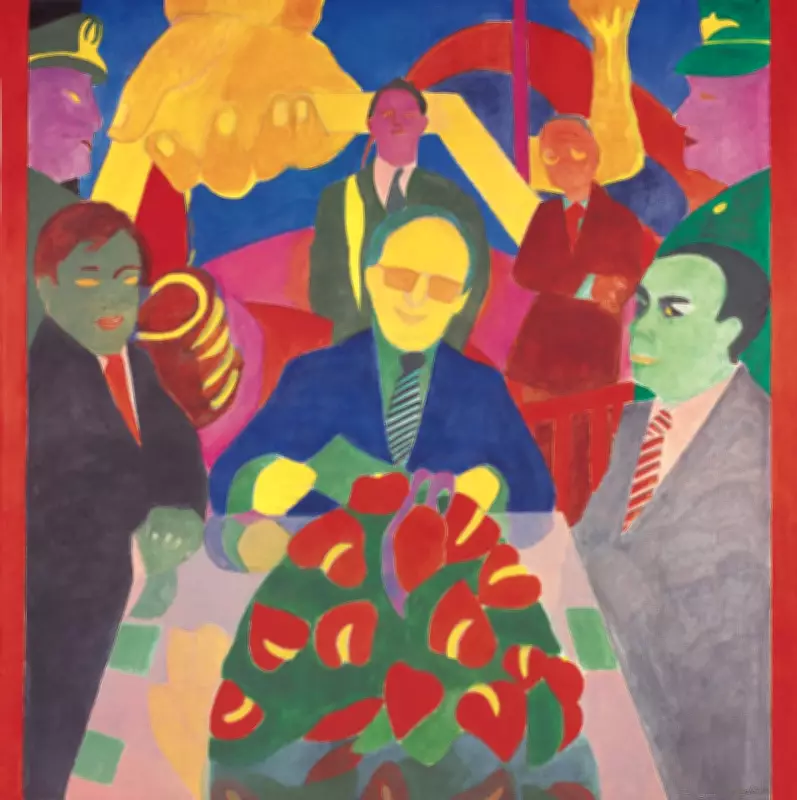
The violence in Colombia escalated, and González's work became more direct and incisive through the 1980s and 1990s. In response to the 1985 siege of the Palace of Justice in Bogotá, where about 100 people died, she created Mr President, What an Honour to Be With You at This Historic Moment, a large drawing depicting the smiling president and ministers with a charred body on the table before them. As events worsened, her art took on a more elegiac tone, with women covering their faces and corpses often possessing more presence than the living.
Legacy and Remembrance: The Final Works
In 2003, when the mayor of Bogotá planned to demolish mausoleums in the Central Cemetery housing victims of conflict, González collaborated with artist Doris Salcedo to save them. Although the project faltered, González conceived Anonymous Auras, sealing 8,956 graves with small tombstones featuring silkscreened silhouettes of men carrying corpses. This work, recently designated as national heritage, represents the culmination of her career—succinct, powerful, and a permanent site for remembrance. The final room at the Barbican is lined with a digital print of these tombstones, underscoring the inexorable journey of her art. Beatriz González lived through tumultuous times, and her forceful, generative legacy continues to resonate, challenging viewers to confront the harsh realities of history and humanity.