Desmond Williams: Visionary Architect of Modernist Catholic Churches Passes Away
The architectural world mourns the loss of Desmond Williams, who has died at the age of 93. Williams was renowned for his groundbreaking modernist Catholic churches, a body of work that earned him a distinguished place in postwar British architecture. His unique ability to blend liturgical function with architectural innovation resulted in four of his churches being listed, a rare honor that underscores his significant contribution to ecclesiastical design.
A Response to Liturgical Reform and Growing Congregations
The mid-20th century presented a dual challenge for Catholic church architecture: accommodating expanding congregations and responding to the liturgical reforms of the Second Vatican Council in the early 1960s. These reforms emphasized communality, intimacy, and active participation by worshippers, leading to a shift away from traditional axial plans. Williams masterfully addressed these needs by creating spatially dynamic, inclusive forms that fostered a deeper sense of connection and engagement within the congregation.
St Mary's in Dunstable: A Masterpiece of Form and Light
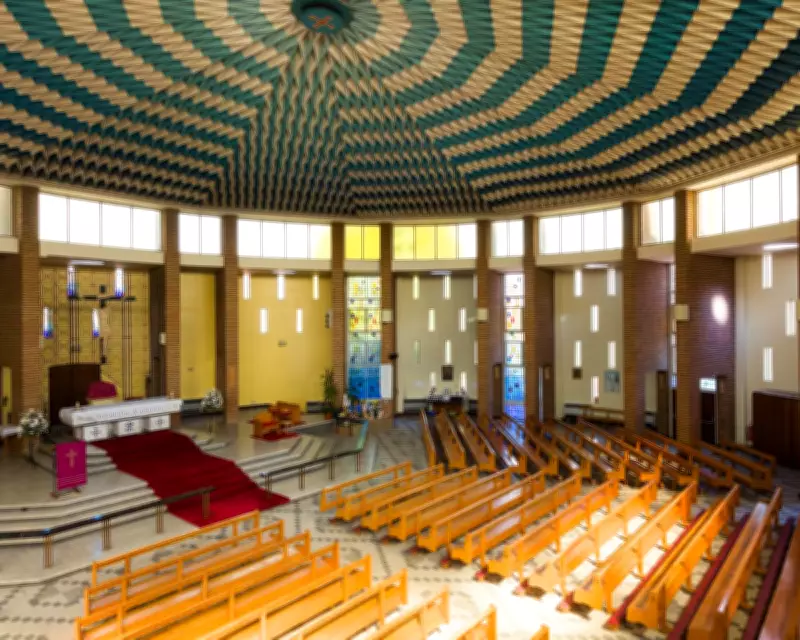
Completed in 1964, St Mary's church in Dunstable, Bedfordshire, stands as a quintessential example of Williams's architectural philosophy. The building's circular plan envelops the congregation, drawing them closer to the altar and enhancing the communal experience. However, the true marvel of St Mary's lies in its extraordinary tetrahedral ceiling. This complex structure, resembling an intricate piece of origami, is composed of 600 aluminium pyramids bolted together in alternating bands of blue and white, creating a modern interpretation of a vaulted heaven.

Williams revealed that the ceiling's inspiration came from his visits to King's College Chapel in Cambridge, drawing a direct line between medieval fan vaulting and his own contemporary, innovative design. Historic England, in its listing citation, recognizes St Mary's as an important early work by Williams, highlighting his role during a pivotal era of change in church architecture.
A Legacy of Listed Churches and Collaborative Spirit
Williams's legacy is cemented by four grade two-listed Catholic churches, all celebrated for their bold yet disciplined approach. Alongside St Mary's in Dunstable (1964), his listed works include St Dunstan in Birmingham, St Michael in Wolverhampton, and St Augustine in Manchester, the latter three all completed in 1968. These structures embody the Vatican's call for "noble simplicity," characterized by confident material use, precise proportions, and exceptional acoustics.
Collaboration was a cornerstone of Williams's practice. At St Augustine's in Manchester, he worked closely with ceramic artist Robert Brumby, whose imposing sculptural reredos, combined with abstract stained glass by Pierre Fourmaintraux, enriched the architectural space. This interdisciplinary approach resulted in unified, powerful liturgical environments that epitomized the progressive spirit of 1960s British modernism.
From Early Inspiration to a Prolific Career
Born in Whalley Range, Manchester, in 1932, Desmond Williams was the son of a submarine draughtsman and a devout Catholic mother. Educated at St Bede's College, his architectural passion was ignited early. A teenage visit to Quarr Abbey on the Isle of Wight proved formative; its simple brick interior, harmonious proportions, and synthesis of architecture, music, and liturgy left an indelible mark, fostering his lifelong exploration of the relationship between space, sound, and spiritual experience.
After studying architecture at the University of Manchester, Williams briefly partnered with Arthur Farebrother before establishing his own practice in Manchester at just 28. His career flourished with commissions for churches and schools, including his first project as lead architect, St Catherine of Siena in Didsbury (1957). He later designed a major extension for Ampleforth College and cultivated a strong relationship with the Department of Education and Science, leading to numerous educational projects noted for their practical efficiency and pedagogical insight.

Expansion, Influence, and Lasting Impact
In 1968, Williams formed a partnership with the firm W & JB Ellis, which evolved into Ellis Williams Architects, now with studios in London, Berlin, and across northern England. Beyond his practice, he significantly influenced the wider profession, serving as chair of RIBA's north-west region, president of the Manchester Society of Architects, and an adviser to the OECD on educational development. Known as a generous mentor, he supported young architects throughout his career. In recognition of his services, he was appointed OBE in 1988.
In retirement, Williams enjoyed interests in aviation and orchestral organ music. He is survived by his second wife, Susan, and four children from his first marriage. Desmond Williams's architectural vision, which redefined sacred spaces for a modern era, ensures his enduring legacy in the annals of British design.