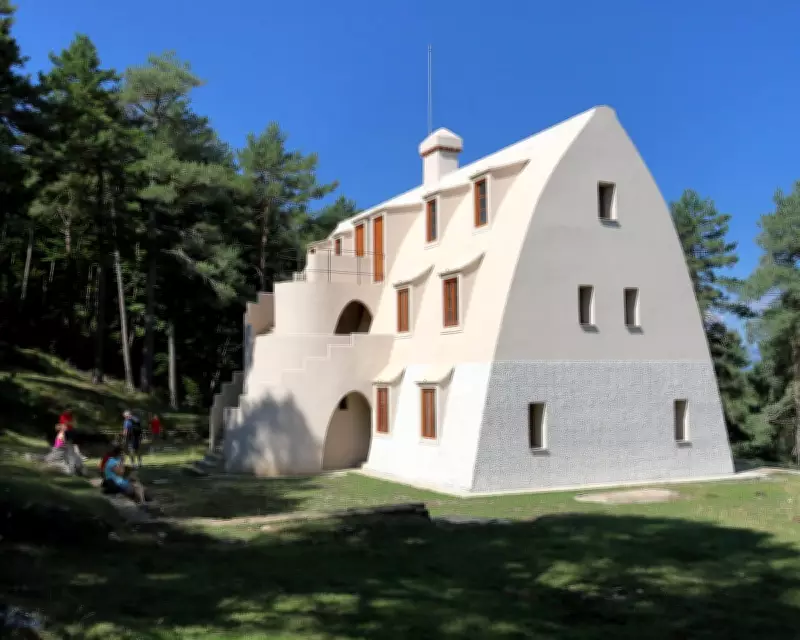
Hundred-Year Reveal: Catalonian Chalet Confirmed as Gaudí Work in Centenary Year
An elegant modernist building nestled in the mountains north of Barcelona, originally constructed to house engineers for a nearby mine, has been definitively confirmed as a creation of Antoni Gaudí, Catalonia's most celebrated and distinctive architect. This announcement comes during the centenary year of Gaudí's death, adding a significant chapter to his architectural legacy.
Historical Context and Commission
The Xalet del Catllaràs, located about 80 miles from Barcelona in the county of Berguedà, was built in 1905 and commissioned by Eusebi Güell, Gaudí's lifelong patron. Güell, who owned a cement company with mines in the region, required accommodation for the engineers, many of whom were British, tasked with extracting coal for his factories. For decades, it has been suspected that the chalet, now not in use, was Gaudí's work, but historians had not firmly established the architect until now.
Architectural Elements and Style
The building contains elements of Gaudí's naturalistic style, evoking the forms of plants and animals that would later be expressed in iconic works such as Park Güell and the Casa Batllò in Barcelona. Notably, the pointed arch structure in the chalet foreshadows Gaudí's best-known project, the Sagrada Família. These features highlight Gaudí's innovative approach to design, blending organic shapes with functional architecture.
Rigorous Research and Attribution
Sònia Hernández Almodóvar, the Catalan culture minister, emphasized that the attribution results from rigorous research of enormous value for heritage, enriching Gaudí's legacy on the centenary of his death. The analysis was conducted by the Catalan heritage department, led by Galdric Santana Roma, chair of Gaudí studies. Santana stated, After much research we have concluded that the Xalet del Catllaràs is the work of Gaudí. However, this attribution is strictly limited to the initial stages of the project as Gaudí didn't supervise the work, which didn't follow faithfully the original design.
Certification Process and Broader Implications
Santana explained that certifying an architectural work differs significantly from authenticating a painting, and the knowledge gained from studying the chalet will aid in investigating other works attributed to Gaudí. This discovery underscores the importance of ongoing scholarly efforts in preserving and understanding architectural history.
Gaudí's Legacy and Centenary Commemorations
Gaudí died on 10 June 1926, at the age of 73, three days after being hit by a tram in Barcelona. Numerous commemorative events and exhibitions are planned throughout the centenary year. His most famous project, the Sagrada Família, continues to evolve, with the installation of the final elements of the illuminated cross atop the central Jesus Christ tower set for June. This will make it, at 172.5 meters, Barcelona's tallest building, and it already holds the title of the world's tallest church since part of its central tower was lifted into place in October.
Future Challenges and Impact
Gaudí devoted the latter part of his life to the Sagrada Família, but little was completed in his lifetime, with work halting during the Spanish Civil War in 1936. The rise of mass tourism after the 1992 Olympic Games accelerated progress, moving the church into its final stages. However, challenges remain, such as constructing the grand entrance stairway from Gaudí's original plan, which would require rehousing 10,000 people and demolishing about 3,000 apartments, a process expected to take another 10 years for the Glory facade alone.
This confirmation of the Xalet del Catllaràs as a Gaudí work not only celebrates his enduring influence but also highlights the intricate connections between his lesser-known projects and his masterpieces, offering new insights into his creative process during a pivotal year of remembrance.