China Reclaims Top Spot as Germany's Leading Trading Partner
Official figures released by Germany's Federal Statistical Office have confirmed a significant shift in global trade dynamics. China has overtaken the United States to become Germany's most important trading partner for 2025, with bilateral trade reaching €251 billion (£219 billion). This represents a 2.2% increase from the previous year when the United States held the top position.
Merz's Diplomatic Mission to Beijing
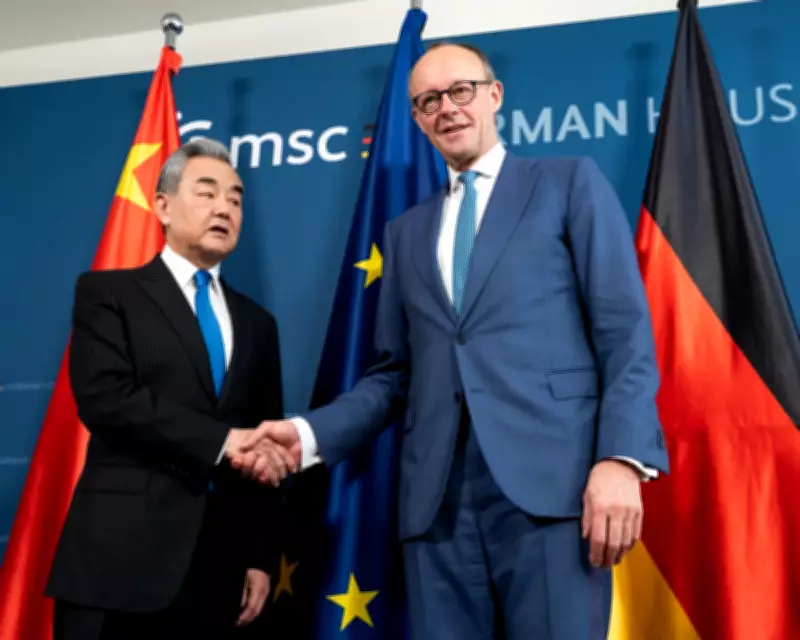
This economic milestone coincides with Chancellor Friedrich Merz's first official visit to China since assuming office. The two-day diplomatic mission begins on Tuesday, with Merz scheduled to receive military honors in Beijing on Wednesday. He will meet with Prime Minister Li Qiang and later hold talks over dinner with President Xi Jinping.
"Complex global challenges can only be solved by working together," said BMW chief executive Oliver Zipse, who will be among 30 business representatives accompanying Merz. "With his trip to China, the chancellor is sending a strong signal for dialogue and cooperation."

Trade Imbalance and Global Tensions
The trade relationship reveals a substantial imbalance. Germany imported approximately €170.6 billion worth of goods from China in 2025, more than double the value of German exports to China, which stood at €81.3 billion. Meanwhile, trade with the United States totaled €240 billion, experiencing a 5% decline that analysts attribute partly to controversial tariffs implemented during the Trump administration.
The European Union continues to struggle with China's manufacturing dominance. Tariffs imposed on electric vehicles imported to the EU in 2024 have had minimal impact on sales, while threatened tariffs on steel through safeguard measures later this year highlight ongoing trade tensions.
Germany's Complex Economic Dependencies
Germany's approach to Chinese trade barriers remains nuanced due to deep economic entanglements. The German automotive industry, a major employer, maintains significant manufacturing presence in China. Volkswagen has famously referred to China as a "second home market," while BMW and Mercedes-Benz rely heavily on Chinese sales for their financial success.
This dependency influenced Germany's vote against the EU's decision to implement tariffs on Chinese electric vehicles in 2024. Recently, Germany avoided EU tariffs on imports of the Chinese-built Volkswagen Cupra Tavascan SUV by agreeing to minimum price undertakings for the vehicle.
Strategic Discussions and Itinerary
During his visit, Chancellor Merz is expected to address multiple critical issues including the war in Ukraine, human rights concerns, and trade relations. His itinerary includes visits to cultural and industrial sites:
- The historic Forbidden City in Beijing
- Chinese robotics firm Unitree Robotics
- German automotive company Mercedes-Benz facilities
- Turbine manufacturer Siemens Energy operations
- The eastern Chinese city of Hangzhou
The EU's broader strategy of "de-risking" from Chinese dominance in critical supply chains—including rare earths, processed minerals, lithium for EV batteries, and permanent magnets for various technologies—creates additional complexity for Germany's balancing act between economic interests and strategic autonomy.