
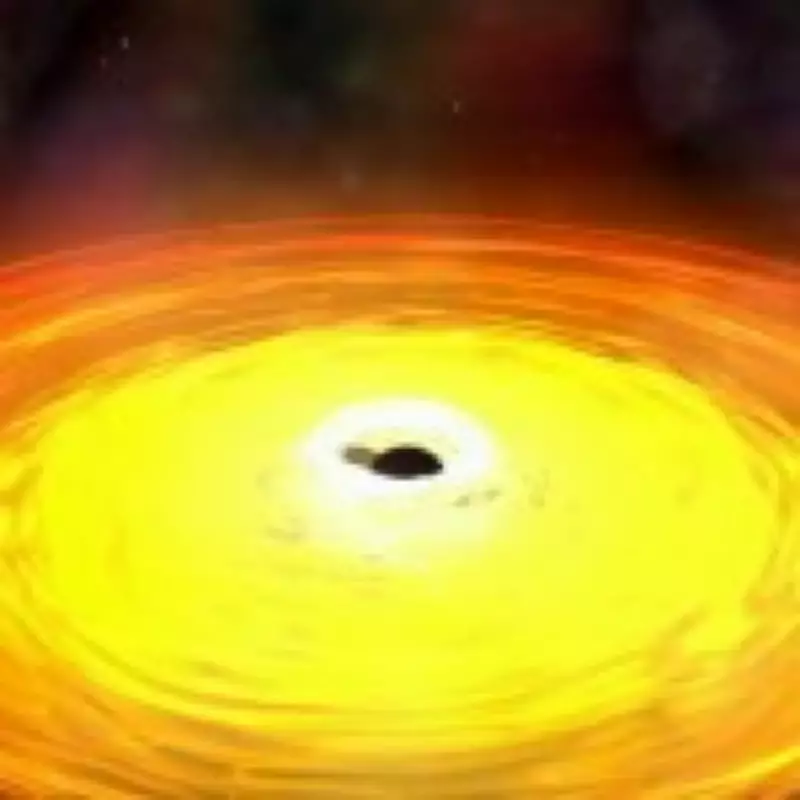
Supermassive Black Holes in 'Death Spiral' Could Collide Within a Century
Astronomers have made a groundbreaking discovery that could reshape our understanding of cosmic phenomena. Researchers have identified what appears to be two supermassive black holes locked in a 'death spiral' that could result in a spectacular collision within the next century. This cosmic event, located in the galaxy Markarian 501 approximately 500 million light-years from Earth, would send massive gravitational waves across the universe that will be detectable from our planet.
From Blazar to Binary Black Hole System
For decades, Markarian 501 had been classified as a blazar—a bright galactic core typically powered by a single supermassive black hole. However, a comprehensive new analysis of radio telescope data spanning several decades has revealed a far more complex reality. Scientists discovered evidence of not one but two powerful jets of particles emerging from the galaxy's core, each believed to be driven by a separate black hole with masses estimated between 100 million and one billion times that of our Sun.
The findings, published in the prestigious journal Monthly Notices of the Royal Astronomical Society, indicate these cosmic giants orbit each other approximately every 121 days. They maintain an astonishingly close separation of just 250 to 540 times the distance between Earth and the Sun—an extremely tight configuration given their immense proportions.
Einstein Ring Provides Crucial Evidence
Further compelling evidence supporting the binary black hole theory emerged from observations in June 2022. During this period, the alignment of the system caused light from one jet to be bent by the gravity of the foreground black hole, creating what astronomers call an Einstein ring. This gravitational lensing effect provided strong confirmation that two supermassive black holes are indeed present in this distant galaxy.
Implications of an Impending Cosmic Collision
When these two supermassive black holes eventually merge—potentially within the next 100 years—the event will generate gravitational waves of unprecedented strength. These waves will be far more powerful than those previously detected from smaller black hole collisions, offering scientists a rare opportunity to study extreme physics on a cosmic scale.
Key aspects of this discovery include:
- The black holes are in a 'death spiral' that will culminate in a spectacular merger
- Gravitational waves from the collision will be detectable from Earth
- The event provides unique research opportunities for astrophysicists
- Earth remains completely safe from any direct effects of the distant collision
While the cosmic drama unfolds 500 million light-years away, astronomers emphasize that Earth faces no danger from this distant event. The gravitational waves, while powerful, will pass through our planet without causing any physical harm. Instead, they represent an extraordinary scientific opportunity to observe and study one of the universe's most violent and energetic phenomena.
This discovery not only challenges previous classifications of blazars but also opens new avenues for understanding how supermassive black holes interact and evolve in distant galaxies. As astronomers continue to monitor Markarian 501, they anticipate gathering unprecedented data about black hole dynamics and gravitational wave physics that could transform our comprehension of the cosmos.




