
Last week's stock market turmoil, triggered by Chinese advances in chip technology, has exposed the fragility and opacity of the AI-driven economy, but analysts suggest the immediate panic may be an overreaction.
Market Turmoil: A Week of Volatility
The week began with a double whammy. On Monday, Chinese memory chipmaker CXMT surged 466% on its Shanghai debut, reaching a valuation of 3.3tn yuan (£365bn). Simultaneously, reports emerged that China had developed its own deep-ultraviolet (DUV) lithography tools, breaking ASML's monopoly in a critical chipmaking process.
These events triggered a global sell-off in AI-linked shares. South Korea's Kospi fell 11.5% on Tuesday and another 6% on Wednesday, dragged down by SK Hynix and Samsung Electronics. Thursday saw the Nasdaq dip into correction territory, dropping over 10% from its peak, while Nvidia lost 5% and was overtaken by Apple as the world's largest listed company.
Friday brought a rebound as strong earnings from Amazon and Microsoft calmed investors. The Kospi jumped nearly 20%, yet the week still marked its worst month since October 2008.
CXMT: A Boon, Not a Threat?
Despite the market's jitters, CXMT's debut may actually benefit the AI economy. The company produces DRAM chips, essential for data storage in AI systems, but not the GPUs that power AI computations. This means CXMT is not a direct competitor to Nvidia, the dominant GPU maker.
Instead, CXMT could challenge SK Hynix and Micron in the memory chip market. However, Alvin Nguyen, an analyst at Forrester, called the sell-off in those shares an "overreaction," noting the global memory chip shortage is expected to persist until 2030. "SK Hynix, Micron, others, they can't produce enough memory chips to begin with… the demand keeps growing even higher," Nguyen said.
DUV Lithography: A Long-Term Concern
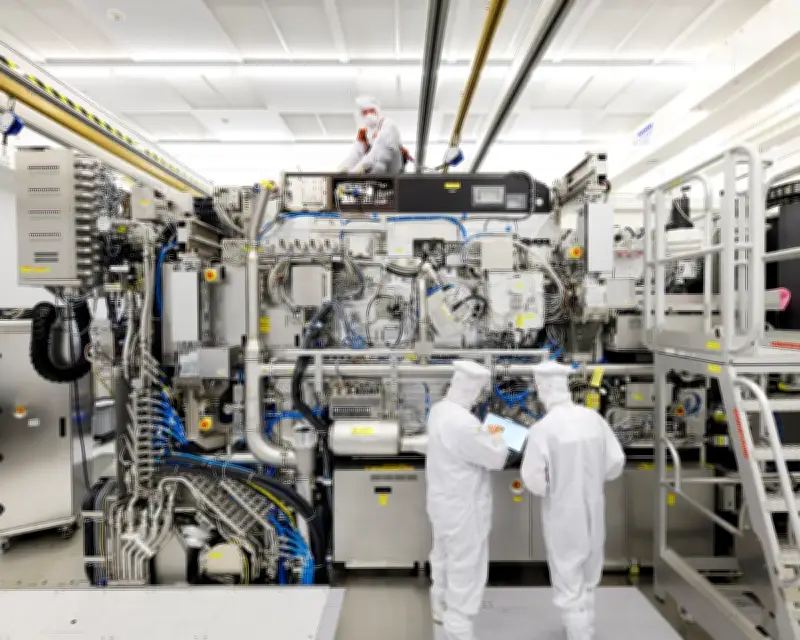
The more serious issue is China's reported ability to manufacture DUV lithography machines. These precision tools are vital for etching circuits onto silicon wafers, a process previously monopolized by ASML. If China can produce them, it could eventually make GPUs rivaling Nvidia's, threatening the world's most valuable company.
Yet, experts emphasize that a real competitor is years away. "Fabs [semiconductor fabrication plants], as I know them, still take years to develop," Nguyen said. Mark Boost, CEO of UK cloud company Civo, echoed this, saying, "Investors are overreacting to the short-term threat. Manufacturing a handful of [DUV] machines is a massive symbolic victory, but not a commercial replacement for ASML overnight."
Long-Term Implications for the AI Economy
These developments could be game-changers in the long run, but they were predictable given US export controls forcing China to build domestic capabilities. Chris Beauchamp, chief market analyst at IG, noted, "These Chinese chip companies appear poised to do to the big chipmakers what they have done to steel, automobiles and a host of other industries, namely undercut them and outcompete them on price."
Last week's correction may be an overreaction, but it also reflects a circular and opaque AI economy heavily dependent on Nvidia. The company's shares are recovering, but investor anxiety persists, fueled by reports that Nvidia might provide a $250bn backstop to OpenAI for a datacentre project, following a $100bn deal collapse earlier.
According to Morningstar, this uncertainty contributed to Nvidia's decline. The company has become the "central bank of AI," propping up vast parts of the economy in ways that are not fully understood. Nguyen warned, "Nvidia knows the gravy train's going to run out. Everybody's waiting for them to fall apart. I don't know that they will because what they do still has value… at some point in the future, they'll no longer be one of the most valuable companies in the world. Maybe… they'll be worth only $2tn. It's still pretty good."




