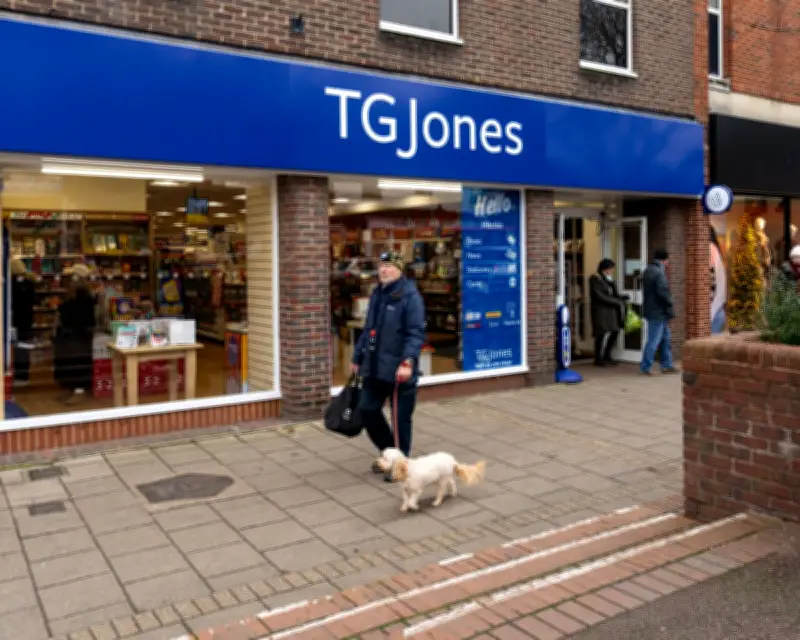
The judge who sanctioned the rescue plan for TG Jones, the former WH Smith high street business, has cast doubt on the retailer's future, describing the turnaround as fraught with 'very considerable' risks. Mr Justice Hildyard, who approved the restructuring in July, published his judgment on Wednesday, revealing his scepticism about the company's prospects.
Judge's stark warning
In his written ruling, Mr Justice Hildyard noted that the plan 'has all the hallmarks of an adventurous equity play'. He added that the group's turnaround strategy 'might strike the sceptic as more in the nature of generic aspirations than concrete grounds for confidence in a successful outcome'. The judge highlighted that the £3m valuation of the company, compared with its acquisition value of about £40m just a year earlier, reflected the potential for high losses as well as high profits.
The restructuring involves the closure of 150 of the retailer's 450 stores, a move that will significantly reduce its high street footprint. The company, which until recently employed about 5,000 staff, was bought last year by Modella Capital, a private equity firm that also owns Hobbycraft and recently acquired Flying Tiger, the Danish retailer known for cut-price homewares and craft kits.

Background and financial troubles
Sales fell sharply after the acquisition, prompting Modella to warn that it might need to call in administrators if the restructuring plan, which includes writing off debts to suppliers and cutting rent for many landlords, was not approved. The original WH Smith retains its stores in airports, hospitals, and railway stations, while the high street outlets were rebranded as TG Jones.
Despite his scepticism, the judge approved the plan because Modella had committed new investment to support the turnaround. Alex Willson, chief executive of TG Jones, welcomed the approval last month, stating: 'The plan protects the substantial core of the store estate and makes TG Jones a stronger, more sustainable business.'
Creditor opposition and cram down
Court approval was necessary for the 'cram down' scheme, as many classes of creditors who would lose money under the plan rejected it. This legal mechanism allows courts to impose a restructuring on dissenting creditor classes under certain circumstances. Fewer than a third of general creditors, including card makers and pen brands, assented to the plan, and no landlords owning unwanted stores—where rent will be cut to zero or closed—backed it.
Small suppliers, such as toy makers, are set to lose at least half of the money owed to them by the former WH Smith high street chain under the restructure. Hossein Dabiri, head of courtroom reporting in Europe for credit analysis firm Debtwire, commented: 'Justice Hildyard's judgment recognises the fine line UK courts must walk with restructuring plans involving cross-class cram downs, scrutinising them carefully to avoid them becoming an 'engine of abuse' or 'private equity power play', while weighing the very real danger of an imminent collapse from one of the few remaining national high street businesses.'
Impact and outlook
The decision underscores the challenges facing the UK high street, as traditional retailers struggle with changing consumer habits and rising costs. TG Jones's future now hinges on the successful execution of its turnaround strategy, which the judge has publicly questioned. The company's ability to stabilise sales and restore profitability will be critical in the coming months.
With 150 store closures already underway, the retailer aims to streamline its operations and focus on its most profitable locations. However, the judge's remarks highlight the inherent risks, leaving uncertainty over whether TG Jones can avoid the fate of other collapsed high street chains.