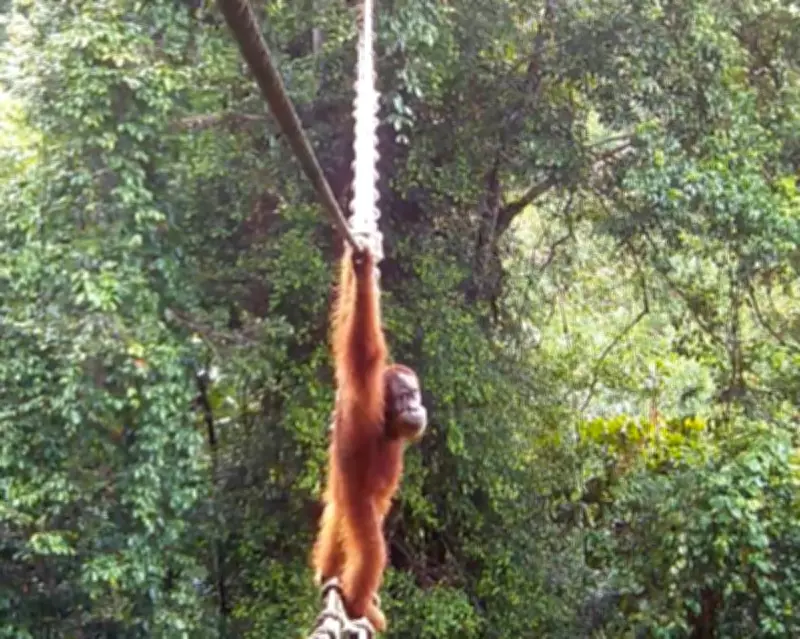
For the first time, a critically endangered Sumatran orangutan has been captured on video using a canopy bridge to cross a road in North Sumatra, Indonesia. The footage, recorded in 2024, shows a young male cautiously edging onto the bridge, pausing midway to glance at the road below, and then continuing into the Sikulaping protection forest.
Bridge Installation and Long Wait
Conservationists from the Sumatran Orangutan Society (SOS) and their local partner, Tangguh Hutan Khatulistiwa (TaHuKah), installed the canopy bridge over the Lagan-Pagindar road in the Pakpak Bharat district. This road is vital for local communities but had become an impassable barrier for wildlife. Erwin Alamsyah Siregar, director of TaHuKah, noted that natural crossing was impossible for animals.
For two years, the teams monitored camera-trap footage, hoping to see an orangutan use the bridge. Helen Buckland, chief executive of SOS, described the moment of success: “You should have heard the cries of delight from the team. After two long years, it’s finally happened.”

Genetic Bottleneck Threat
The area is home to approximately 350 Sumatran orangutans, split into two populations by the road—one in the Siranggas wildlife reserve and the other in the Sikulaping protection forest. This fragmentation poses a severe threat, as orangutans have a slow life history and are prone to genetic bottlenecks. Buckland explained that if kept in small groups, they weaken through inbreeding, leading to functional extinction.
Other Species Using the Bridge
Before the orangutan, other animals had successfully used the bridge, including black giant squirrels, long-tailed macaques, and agile gibbons. The young male orangutan’s crossing marks a milestone for the project.
Significance for Conservation
Sumatran orangutans are among the world’s most threatened apes, with only about 14,000 remaining in the wild. As the largest arboreal mammal, they spend over 90% of their time in the forest canopy and are a keystone species. Franc Bernhard Tumanggor, head of the Pakpak Bharat district, commented: “Witnessing a Sumatran orangutan confidently crossing that bridge is living proof that we need not sever the forest’s lifeline in order to build our communities’ own. Modernisation does not have to mean destruction.”
This event provides hope that conservation efforts can help the species survive habitat fragmentation. The bridge was built with support from the local government, and its success underscores the importance of such infrastructure in preserving biodiversity.