Twelve years ago, George Hunt needed a new roof on his cow barn in Orange, Massachusetts. Solar was 'hot' back then, thanks to federal and state commitments to increase renewable energy supplies. When Hunt crunched the numbers, he found that adding solar panels to that roof would be a financial boon to his struggling dairy. He applied for a Rural Energy for America Program (Reap) grant from the US Department of Agriculture (USDA), which covered about a third of the cost; he borrowed the rest and mostly paid that loan off with a solar energy credit he received from the state of Massachusetts. After that, 'we didn't have an electric bill for a decade,' Hunt said. 'It was wonderful.'
Thanks to the farm bill, it could get harder for farmers like Hunt to access government help for some solar projects. That's because the current bill, which passed the House and now awaits the Senate's response, includes a provision that would disallow federal funding to convert prime farmland to ground-mounted solar projects. Farm properties under five acres would be exempt (as would Hunt's roof-mounted solar); so would farm properties under 50 acres, although these would require approval from the county or municipality where they would be located. That has become an increasingly uphill battle, according to trade group Solar Energy Industries Association (SEIA), as 'a growing number of local governments are considering - or enacting - restrictions on solar development on farmland'.
Richa Patel, a policy specialist at the National Sustainable Farm Coalition (NSAC), said: 'Solar is one of those farm-saving opportunities that have allowed producers to keep farming on their operations during times of bad financial strain.' And it's why Hunt, experiencing spikes in the costs of fertilizer, seed and fuel, along with stagnant milk prices, more recently applied for another Reap grant. With that money, he would have added agrivoltaics arrays – a collection of solar panels allowing farmland to generate energy while remaining in agricultural production – to a 19-acre hayfield he harvests to feed his cows; he expected to earn steady income by selling solar energy into the regional grid while also growing a crop. The prospect made him feel less like he is operating in a 'third world' economy as a dairy farmer, Hunt said.

But this time, as a harbinger of the farm bill to come, his application was denied (and Reap stopped accepting grant applications). The year was 2025, and the second Trump administration had arrived with its fervently anti-renewables stance. It began abolishing tax credits and delaying permits for solar energy projects while touting oil and coal. Its cancellation of $7bn in Biden-era funding for affordable solar projects prompted a lawsuit by over a dozen state attorneys general. 'Congress passed a solar energy program to help make electricity costs more affordable, but the administration is ignoring the law and focused on the conspiracy theory that climate change is a hoax,' the Washington attorney general, Nick Brown, said in a statement about the suit.
The farm bill provision has a final wallop to solar: even exempted properties would be ineligible for federal funding if they used any components made or assembled in a 'foreign entity of concern', like China. Since that country is responsible for about 80% of solar panel production, 'this can act as a de facto ban', said Samantha Levy, a senior policy manager for conservation and energy at farm advocacy non-profit American Farmland Trust (AFT). Added the NSAC's Patel: 'If we shore up domestic production, even then [components] are going to be more expensive. And that's going to price out more small farmers, when we should be focused on helping them.'

Levy believes that the farm bill's solar provision is a misdirected attempt to correct an actual mounting crisis in rural communities: the loss of farmland to development. Solar companies can offer so much more money to landowners to develop their arable acres than, say, other farmers who lease that land to grow crops or run livestock, large, utility-scale solar projects (that is, facilities large enough to sell power to utility companies). That's taken 'an appreciable percentage of a community's farmland out of production and put it into solar energy generation. This has trickle-down effects on the rest of the farms in the community and their own land availability, land affordability, land access.' Levy said. As a result, 'there was this backlash in farm communities and Republicans were hearing about it, and smaller-scale solar projects have gotten mixed up in this broader political conversation'. However, she said the farm bill's anti-solar language is 'the wrong tool to solve this problem'.
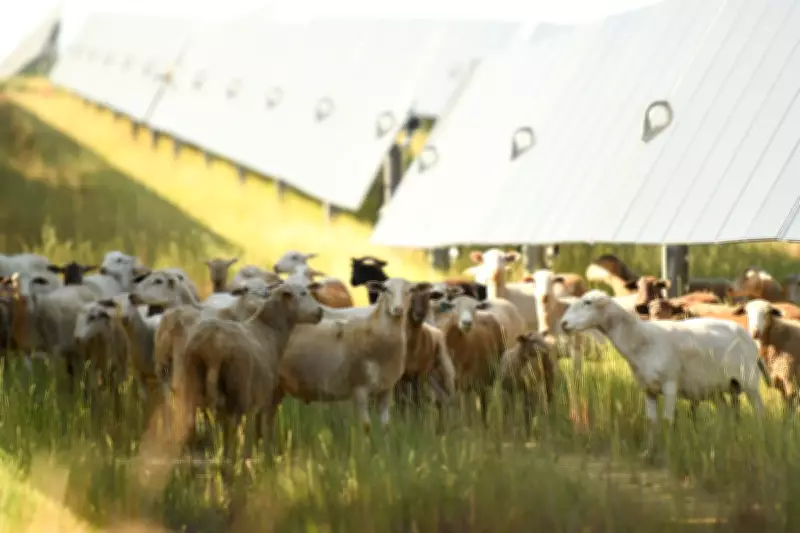
Ann Mesnikoff, federal legislative director for the Environmental Law Policy Center (ELPC), said: 'I don't see anything in this bill that says a farmer can't sell their farm for a datacenter. I don't see anything in this bill that says you can't sell prime farmland for sprawl.' She called farmers' use of solar 'a proven technology for lower energy costs'. It doesn't help that the solar provision is confusingly written, so that farmers seeking to add agrivoltaics to their operations may have no idea if those projects count as farmland conversions or not. Unlike traditional solar arrays that are placed over gravel and that permanently take land out of production, agrivoltaics, such as the hayfield-friendly arrays Hunt was denied Reap funding to install, can coexist with native grasses and flowers that feed honeybee colonies; some can share land with flocks of sheep or herds of cattle; others can support a variety of fruit and vegetable crops. AFT, NSAC and many farm-centric organizations are pro-agrivoltaics, seeing them as a way to both boost rural economies while also addressing climate goals.
A separate but unrelated provision in the House-passed farm bill calls for a study into the effects of adding solar to farmland. That includes the impact of agrivoltaics – referred to as 'shared solar energy and agricultural production' – on rural economic opportunity, biodiversity, and agricultural resilience and production. Utility-scale solar developers like Silicon Ranch, which has built 1,380 megawatts worth of agrivoltaics projects across five states, believes such a study would be an 'incredible opportunity', said co-founder, president and CEO Reagan Farr. If conducted by reputable researchers with no specific agenda, it could 'elevate the industry' by setting a federal definition of agrivoltaics on which concrete standards could be based – 'as opposed to the situation where we sit today, where there's a perceived tension between ag and energy production that I don't think is helpful' for farmers or communities. But whatever such a study learns about the pros and cons of agrivoltaics, it won't influence whether USDA decides to fund them or not. Not to mention, said ELPC's Mesnikoff: 'There is plenty of research already on the benefits of agrivoltaics; it's out there. It's working.'
How the farm bill will change in the Senate's hands is an open question. John Boozman of Arkansas, chairman of the agriculture, nutrition and forestry Senate committee, has said the Senate will probably begin marking up its own bill sometime in June. Mesnikoff would like to see language included that ensures the Reap program (if and when it starts issuing grants again) 'is implemented in timely and regular cycles'. The USDA's cancellation of Reap commitments in 2025 was 'harmful to the farmers, ranchers, and rural small businesses who invested time and resources into getting ready to apply to the program', only to be denied, Levy said. AFT approves of some of the solar-related wording in the House bill, like requiring a farmland conservation plan to ensure a solar project doesn't damage the soil, and language that would streamline the Reap application process. The organization would like the Senate to 'revisit' the rest of that solar-restrictive provision, though, to further consider how it would undermine farmer access to assistance. NSAC's Patel said: 'Let's take this back and try to address some of the issues that folks have, while also not completely getting rid of the [solar] option for farmers who are frankly just looking for ways to stay on their land.'
New York farmer Rebekah Pierce keeps her sheep operation solvent by grazing her animals on several different community agrivoltaics sites across four different counties. It's an increasingly popular way for livestock operators to diversify their income streams. In this instance, farmers lease their unused land to solar developers, who then hire Pierce's sheep to munch down the grasses beneath the array. Still, she'd like to further shore up her business by offsetting some of her energy bill which lately, she said, has been 'out of control'; farm-scale solar panels are the obvious way to do this. But with the cost somewhere around $60,000 even after state incentives, 'without any federal assistance, we can't afford it', Pierce said. 'A farmer should have the option to be able to choose which energy sources they want to use without having to shoulder that crippling financial burden.'