Poland's Coal Heartland Grapples with an Uncertain Future
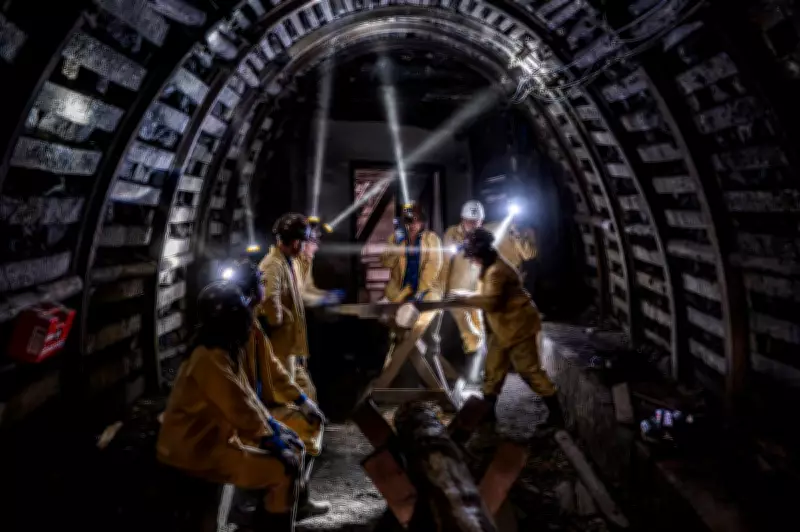
In the Guido coal mine, founded in 1855 and closed in 1960, visitors now dress as miners to simulate logging work 350 meters underground, transforming this historic site into a popular museum. This shift symbolizes a broader transformation sweeping through Poland's coal industry, where 80,000 people still work in mines—the last in the European Union fully committed to the energy transition. Despite active mines being repurposed, global coal extraction has hit record highs, and with the Iran war driving up oil and gas prices, some in Poland are questioning the wisdom of completely abandoning this fossil fuel.
The Daily Grind of a Polish Miner
Coal dust is notoriously fine, seeping into the pores of the skin and leaving a permanent black outline around the eyes, akin to makeup. Rafal Dzuman, a 49-year-old team leader of the G-2 mining crew, bears this mark as a testament to his two decades of daily descents to 700 meters below ground at the Murcki-Staszic coalmine in southern Poland. Opened in the mid-17th century and now owned by the Polish giant PGG, this mine on Katowice's outskirts extracts about 23,000 tonnes of coal daily, with reserves estimated to last another 50 years. After each shift, miners step out of lifts and head to showers, but the dust often leaves indelible stains, a gritty reminder of their labor.
Katowice, once called Stalinogród, is the epicenter of Upper Silesia, Europe's historic coal-mining heartland and the last EU district where hard coal is still extracted. Here, schools continue to train young miners, and the industry supports half of Poland's electricity production. However, Upper Silesia has become a complex laboratory for the European energy transition, with Brussels mandating a shift to a "climate-neutral" model by 2049, potentially accelerating to 2035.

The Economic and Identity Crisis of Decarbonization
Today, no new coal exploration or mines are permitted in Poland. Existing operations survive on substantial state subsidies, as extraction requires digging deeper than 1,000 meters, while cheaper coal from countries like Indonesia, Kazakhstan, and Colombia—formerly Russia—floods the market. This economic calculus was upended by the Middle East conflict and rising oil and gas prices, sparking debates in Poland. Questions abound: Will billions from the European just transition fund suffice to diversify this mono-industrial region? Can over 200,000 workers in mines and supply chains be redeployed? Might geopolitical uncertainty slow the inevitable transition?
In 2025, global coal extraction exceeded 9 billion tonnes, led by China, India, and Indonesia, accounting for one-third of the world's electricity. Poland's contribution is a mere 85 million tonnes, less than 1% of the total, yet phasing out coal represents both an economic and identity trauma for Upper Silesia. "On one hand, we will lose a centuries-old tradition and a stable energy source," says Jacek Nowak, a geologist at the Silesian University of Technology, "and on the other, we will buy coal from countries with predatory extraction practices, ignoring environmental and worker rights."
Transforming Mines into Museums and More
Under the European Green Deal, two-thirds of Polish mines have closed or been repurposed. In Zabrze, the Guido and Queen Luiza mines are now museums where tourists explore tunnels in miner attire. In Mikołów, the Barbara Experimental mine has become a research center studying extraction risks like methane explosions. Other sites have been converted into art galleries, such as the Wilson Shaft gallery in Katowice, or golf courses like the Armada club in Bytom. The former Wieczorek mine is slated to become a hub for hi-tech, creativity, and gaming.
However, concerns persist about the pace of change. "If the transition imposed by Brussels is too fast," warns Arkadiusz Sienczak of the miners' union ZZG, "we will not offset mining job losses with new opportunities." Coal has deeply shaped Silesia's history, influencing generations and landscapes. Schools like the technical complex in Rybnik still train future miners, though employment has plummeted from 140,000 to 6,000 locally. Miners retire at 50 after 25 years of service, with 15 underground, making it a physically demanding career with an uncertain future.

Despite this, about 20 young people, including 17-year-old Wiktor Dudek, choose mining, driven by family tradition. Dressed in a hard hat and checked shirt, Dudek learns in a tunnel-laboratory beneath his school, speaking Silesian—a miner's tradition. "My grandfather and father were miners, so I will be one too," he says, highlighting the enduring cultural ties even as the industry faces existential threats. As Poland navigates this transition, the balance between economic necessity, environmental goals, and cultural heritage remains precarious.