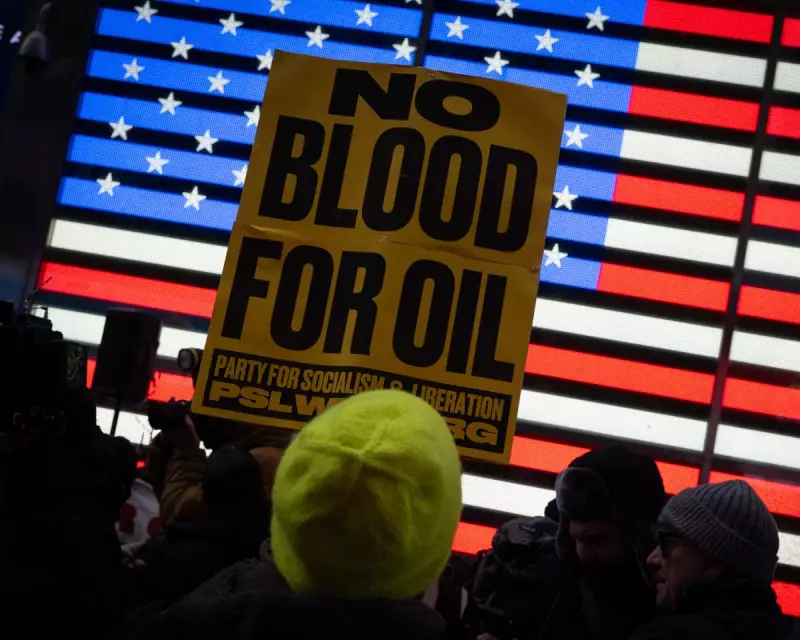
Protests erupted in New York's Times Square over the weekend, with one demonstrator's sign reading 'No blood for oil' capturing the tension surrounding US military operations in Venezuela. The scene unfolded as former President Donald Trump outlined a vision for American energy dominance in the troubled South American nation, but major industry players are far from convinced.
The Grand Plan Meets Harsh Reality
Donald Trump recently declared his intention to mobilise the world's largest US oil companies to pour billions of dollars into Venezuela's dilapidated oil infrastructure. The goal, as he stated, is to unlock the country's vast reserves, fix its broken systems, and "start making money for the country." On paper, the logic appears sound: Venezuela possesses enormous oil reserves and its production has plummeted to less than a third of its former capacity.
However, the reality for corporate boardrooms is fraught with complexity. While Chevron's share price rose 4% on the news—a nod to its existing joint ventures in the country—the initial optimism for other US oil majors is puzzling to analysts. For companies like Exxon Mobil and ConocoPhillips, the risk-reward calculation is murky at best.

Staggering Costs and Political Uncertainty
The financial hurdle alone is monumental. Energy consultancy Rystad Energy estimates that repairing a decade of underinvestment and doubling Venezuela's oil output to 2 million barrels per day by the early 2030s would require a staggering £115 billion. This is serious capital, even for industry giants, especially if Trump simultaneously aims to cap oil prices at around $50 per barrel.
Beyond the cost, a cloud of political questions looms large. David Oxley, chief climate and commodities economist at Capital Economics, noted, "Even if the political environment backdrop was more predictable, in a world already awash with oil, the business case for significantly ramping up drilling in Venezuela is far from strong." Key concerns for investors include:
- The precise meaning of the US aiming to "run" Venezuela.
- The ability to make credible, decades-long commitments.
- The unclear future fiscal regime for oil extraction.
These unresolved issues make other regions like the Gulf of Mexico, Guyana, and Brazil appear as significantly easier and less risky investment destinations.
Geopolitical Shifts Versus Corporate Caution
The geopolitical implications of US influence over Venezuelan oil are undeniable. In the short term, redirecting Venezuela's exports to US refineries could reshape global markets, displacing China, which is currently the largest buyer of Venezuelan crude.
Yet, the instinct of major US oil producers will likely be one of extreme caution. Analysts from Societe Generale highlighted a critical historical deterrent: Venezuela has nationalised oil assets not once, but twice. This history, combined with shareholder pressure to prioritise share buy-backs over high-risk projects and a potential low oil price environment, creates a powerful disincentive.
While Trump may attempt to pressure companies into spending, the multitude of uncertainties means a rapid influx of investment is improbable. The title of Oxley's research note, "Venezuela's vast energy potential to remain untapped," reflects what many now see as the most plausible outcome. For now, the industry's stance is clear: wait and see.