UN Chief Demands Economic Revolution: Ditch GDP to Save Planet
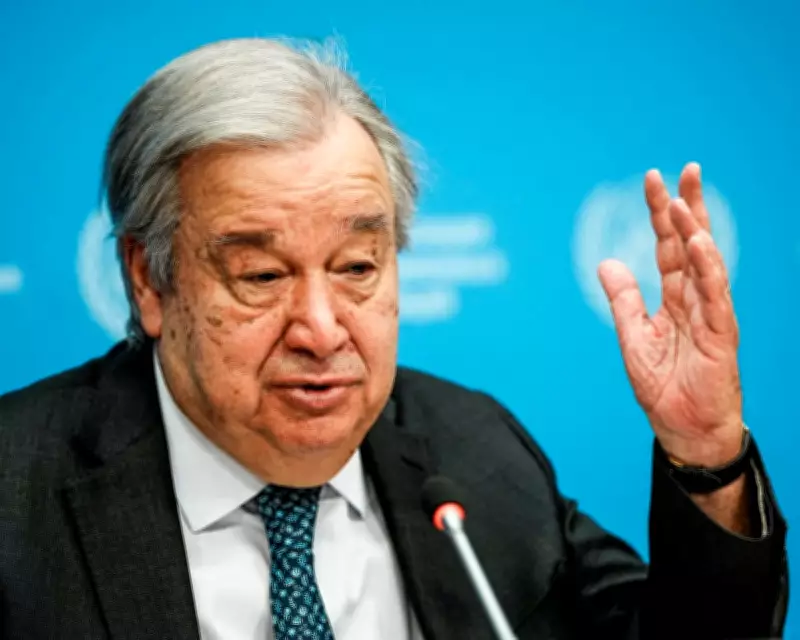
In an exclusive interview with the Guardian, United Nations Secretary-General António Guterres has issued a stark warning: the global economy requires radical transformation to prevent planetary disaster. He argues that current accounting systems, which prioritise growth measured by Gross Domestic Product (GDP), are fundamentally flawed and driving environmental destruction.
The Flawed Measure of Progress
Guterres stated unequivocally that humanity must urgently overhaul existing economic frameworks. "We must place true value on the environment and go beyond gross domestic product as a measure of human progress and wellbeing," he declared. The UN chief highlighted the perverse incentives created by GDP-focused models, noting: "Let us not forget that when we destroy a forest, we are creating GDP. When we overfish, we are creating GDP."
For decades, politicians and policymakers across the globe have treated GDP growth as the paramount economic objective. However, critics increasingly argue that this pursuit of endless, indiscriminate expansion on a planet with finite resources is exacerbating multiple crises:
- The accelerating climate emergency
- The biodiversity collapse
- Deepening social and economic inequality
Measuring What Truly Matters
Guterres emphasised that moving beyond GDP involves measuring what genuinely matters to people and communities. "GDP tells us the cost of everything, and the value of nothing," he observed. "Our world is not a gigantic corporation. Financial decisions should be based on more than a snapshot of profit and loss."
This call to action follows a significant UN conference titled 'Beyond GDP' held in Geneva this January. The gathering brought together senior economists from around the world, including Nobel laureate Joseph Stiglitz, leading Indian economist Kaushik Basu, and equity expert Nora Lustig.
A New Dashboard for Economic Success
These three experts form part of a UN-appointed group tasked with developing a new dashboard of economic success measures. This framework aims to incorporate three crucial dimensions:
- Human wellbeing and quality of life
- Environmental sustainability and regeneration
- Social equity and fair distribution
A report published by the group late last year argued that repeated global shocks over the past two decades - from the 2008 financial crash to the COVID-19 pandemic - have made economic transformation increasingly urgent. These crises have been exacerbated by what the UN describes as the "triple planetary crisis" of climate change, biodiversity loss, and pollution.
Expert Perspectives on GDP's Limitations
Professor Kaushik Basu, who co-chairs the UN group alongside Nora Lustig, explained the problematic dynamics of GDP-focused competition: "Nations are so locked into the game of beating other nations in terms of the GDP metric, that the wellbeing of ordinary citizens and sustainability are getting ignored." He warned that this approach "is feeding hyper-nationalism, inequality and polarisation."
Professor Lustig added crucial context about GDP's original purpose: "GDP had never been designed to measure human progress, yet it remains the dominant benchmark of success." She noted that "economic growth can coexist with poverty, exclusion, violence, and serious violations of human rights - outcomes that remain largely invisible in conventional economic accounts."
The group's objective is not to eliminate GDP entirely but to complement it with better indicators. "Helping governments and the public assess whether development is truly improving human wellbeing, advancing equity, and safeguarding sustainability now and for future generations," Lustig explained.
Growing Momentum for Economic Alternatives
This UN initiative arrives amid expanding debate within academic, civil society, and policy circles about creating economic structures compatible with greater equality and sustainability. Various alternative frameworks are gaining attention:
- Green growth and green Keynesian approaches
- Post-growth initiatives including doughnut economics
- Wellbeing economics and steady-state models
- Degrowth perspectives emphasising planned reduction of harmful production
Political economist Jason Hickel, a prominent degrowth advocate, acknowledged supporting Guterres's call but argued for more fundamental change: "A deeper system change is required. Specifically, we need to democratise control over production, which can enable us to change what we produce and for whom." He suggested that "the dominance of GDP is not an accident, it occurs because GDP measures what is valuable to capital."
Recent research indicates these ideas are gaining substantial traction. A survey of nearly 800 climate policy researchers worldwide found that 73% support post-growth positions, suggesting significant academic momentum behind rethinking economic fundamentals.
The UN's intervention represents perhaps the most high-level endorsement yet for moving beyond traditional growth metrics. As environmental crises intensify and inequality persists, the pressure to develop economic systems that genuinely serve both people and planet continues to build across international institutions, governments, and civil society.