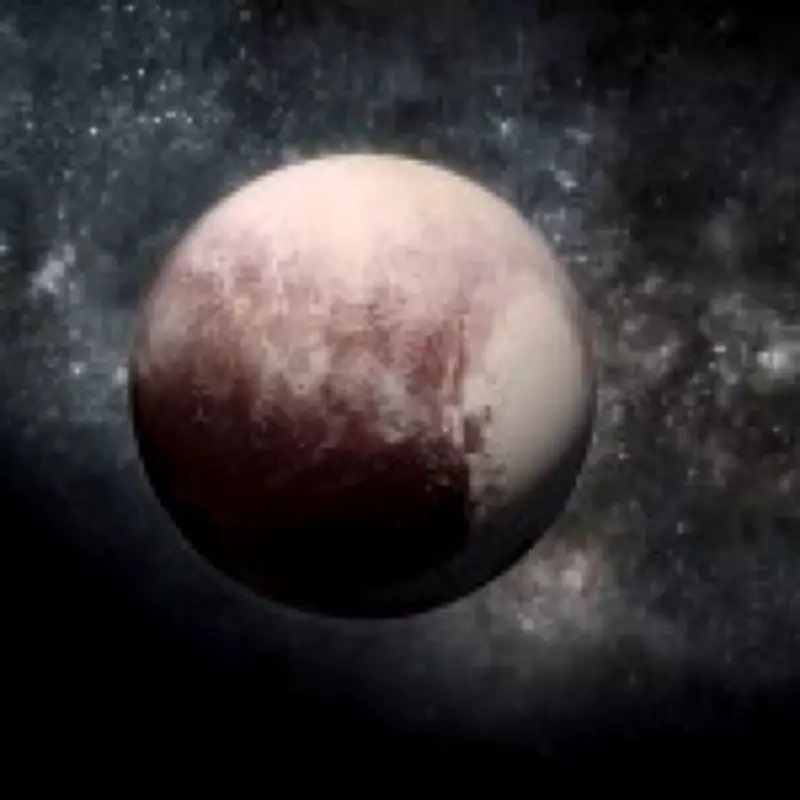
About 20 years ago, leading astronomers decided that Pluto was too small to be a planet, undoubtedly giving it a Napoleonic complex. But NASA's top official came out with a new rallying cry on Tuesday: Make Pluto Great Again. Well, kind of.
The US space agency's administrator, Jared Isaacman, told a Senate committee that he wants little Pluto to be reclassified as a planet. He added: 'We are doing some papers right now on, I think, a position that we would love to escalate through the scientific community to revisit this discussion.' Isaacman made the comments after telling a 10-year-old that NASA is 'looking into' giving Pluto a planetary promotion.
Despite being the chief of NASA, this isn't something Isaacman can casually do. Instead, it is up to the International Astronomical Union (IAU). The union is the world's largest professional body for astronomers, meaning that all NASA can do is push for experts to reconsider Pluto. Isaacman's predecessor, Jim Bridenstine, even joked at Tuesday's NYSE Space Summit: 'You've all been lied to. Pluto is a planet.'

But don't expect this to happen anytime soon, said IAU's press coordinator Ramasamy Venugopal. 'We understand that many people feel Pluto was 'demoted'; but in fact, Pluto became the leading object of a new family of solar system bodies,' he told Metro. 'Scientific classifications are determined through international consensus and evidence-based processes. While they are not subject to unilateral change, they can be amended if the supporting evidence changes.'
Why is Pluto not a planet?
Pluto was originally classified as the ninth planet in our solar system after its discovery in 1930 by astronomer Clyde Tombaugh. It was named after the Greek god of the underworld by an 11-year-old English girl named Venetia Burney. But union astronomers thought this icy, barren orb about 3,000,000,000 miles away doesn't fit their definition of planethood.
In 2006, the union voted that there are three conditions that a celestial object must meet to be counted as a planet: the object orbits the sun; it is large enough for its gravity to pull it into a round shape; and it 'has cleared the neighbourhood around its orbit.' By 'cleared the neighbourhood', astronomers mean it has ploughed through all the cosmic dirt and snow orbiting the sun to make a clear path. This is the condition Pluto falls short on – it is located in a ring of ice known as the Kuiper Belt – so they gave it the new term, 'dwarf planet'. It is, after all, only about 1,400 miles wide – or half the width of the US.
Demoting Pluto caused immediate uproar in the scientific world – 300 scientists signed a petition against the solar system's B-list a week later. University of Arizona planetary scientist Dave Tholen told the media at the time that the IAU's definition was too vague. Out of the 3,000 space experts that met in Prague to cast a vote, only 500 were eligible to do so, he said. 'This is about as big a brouhaha in the astronomical world as I can recall,' he said. 'It's one of the most passionate discussions I've witnessed.'
Four other dwarf planets have since been discovered, including Ceres, a larger-than-average rock among hundreds of thousands of rocks in the asteroid belt between Mars and Jupiter.