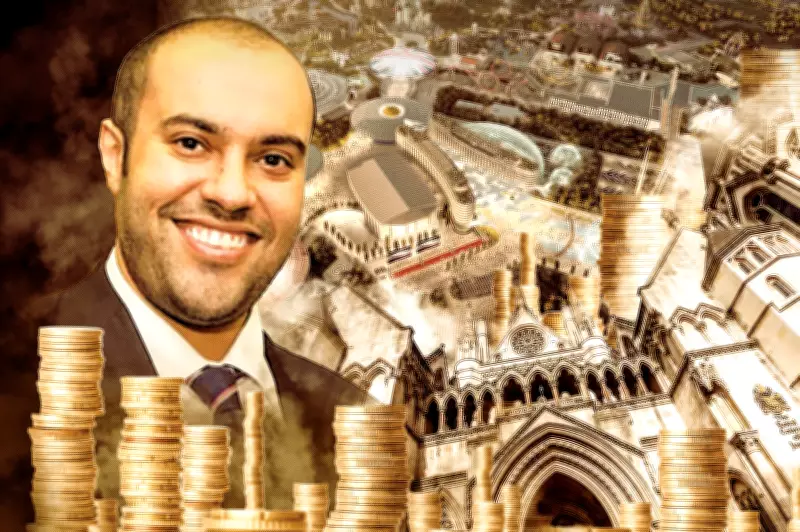
The Collapse of Britain's 'Disneyland Paris' Answer
What was once heralded as Britain's ambitious answer to Disneyland Paris has descended into a protracted legal nightmare for creditors. The grand vision for a 900-acre theme park in Kent, unveiled in 2012 with promises of Europe's largest indoor water park, Mission Impossible-themed rollercoasters, and 27,000 new jobs, now lies in ruins. The mastermind behind this £3.5bn project, Kuwaiti investor Abdulla Al-Humaidi, has been declared bankrupt, leaving a trail of frustrated creditors and court battles in his wake.
A Dream Turned Bankruptcy Nightmare
Al-Humaidi, who comes from a wealthy Kuwaiti real estate family and holds a medical degree from Dublin, sought to expand his family's business through Kuwaiti European Holdings (KEH). His ambitious theme park project south-east of London initially generated significant excitement, particularly when Hollywood giant Paramount announced a key partnership through a licensing agreement. However, more than a decade later, the project has completely unraveled.
The theme park company has been put into liquidation, and Al-Humaidi finds himself battling former American partners owed £13.5m in a High Court case that exposed what creditors called "sham" debts presented to reach a more favorable insolvency agreement. The investor has blamed UK planning rules for "destroying" his life, citing complications ranging from environmental interventions to literal spider webs that entangled the project.
Creditors Face Obstruction in Asset Recovery
Restructuring trustees from advisory firm Interpath, representing Al-Humaidi's creditors, are struggling to determine what assets belong to the bankrupt investor for potential recovery. This process has become exceptionally challenging due to what a High Court judge described as Al-Humaidi's "foot-dragging" and resistance to sharing crucial information.
Judge Mullen blasted the investor's "obstructively legalistic approach" and highlighted several instances of non-cooperation. In one particularly telling example, Al-Humaidi could not explain the terms of a £9.5m payment made from KEH to his mother in 2017—a transaction creditors argue is crucial to understanding his true shareholding in the family company.
Inconsistent Claims and Legal Consequences
The court proceedings have revealed troubling inconsistencies in Al-Humaidi's claims about his business interests. In a 2020 witness statement, he stated his shareholding in KEH was 50%, but a 2019 share register showed it to be only 29%. Al-Humaidi claimed he "did not have access to the company records" when providing his statement, an argument Judge Mullen found technically "right" but ultimately deemed "incredible" given the investor's apparent inability to produce evidence about his own shareholding.
Further complicating matters, creditors discovered that on the same day, one licensing form indicated Al-Humaidi owned 0% of Ebbsfleet United FC (where he held a stake and was forced to resign following his bankruptcy), while another form claimed he owned the entire club. The judge ruled creditors were reasonable to doubt Al-Humaidi's claims at face value, noting he had done "little to assist them."
International Complications and Delaying Tactics
Al-Humaidi's legal troubles extend beyond the UK. He has been convicted of fraud in Kuwait and given a prison sentence, though lawyers are contesting these cases. Meanwhile, his cooperation with UK bankruptcy trustees has been minimal at best. When asked about two Egyptian resorts reportedly owned by KEH—which Al-Humaidi previously claimed represented up to 90% of the company's total assets—he erupted in frustration.
"Frankly, this is getting absurd," Al-Humaidi declared. "My duty to cooperate relates to my bankruptcy. These requests of information pertain to the dealings of third-party entities that are independent and separate to my bankruptcy." He accused trustees of attempting to "pierce the corporate veil" and assume corporate assets as part of his bankruptcy estate.
His cooperation amounted to sending a Google Maps pin for just one of the two Egyptian resorts investigators had requested. Judge Mullen characterized this as "sitting on his hands" and highlighted it as one of several "delaying tactics" employed by Al-Humaidi during bankruptcy investigations.
The Long Road to Resolution
Al-Humaidi now faces less than 12 months to comply with asset investigations or risk "the teeth of criminal consequences." He has been forced to personally pay for legal costs outside his bankruptcy estate, and while he won't have to disclose his legal funding sources, a judge hinted trustees could make a separate application for this information.
The year 2026 will see trustees continuing their investigation and eventually filing a report on whether Al-Humaidi has complied with his cooperation obligations. Fourteen years after media outlets trumpeted the arrival of 'Dartford Disneyland,' the rollercoaster ride may finally be drawing to a close—though Al-Humaidi's connection to Kent may persist through family property interests reportedly backing new developments near the failed theme park site.
Al-Humaidi's legal representatives have declined to comment on the ongoing proceedings. With battles continuing against both Kuwaiti authorities and bankruptcy trustees, it may be months before this bumpy ride reaches its conclusion—if it ever truly does. The case serves as a stark warning about the risks associated with ambitious development projects and the challenges creditors face when pursuing assets from bankrupt investors.