
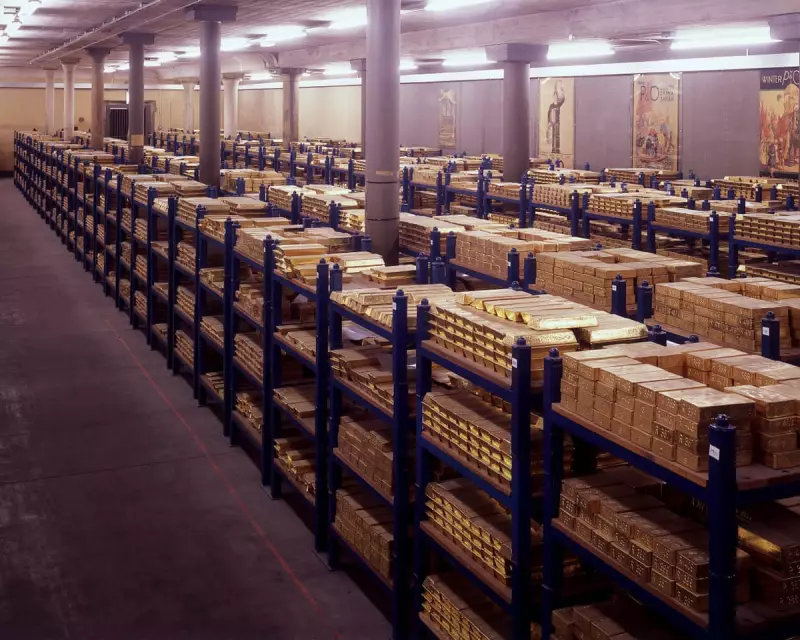
Deep beneath the streets of London, a geopolitical and legal stalemate involving billions of pounds in gold bullion has been reignited by dramatic events thousands of miles away in Caracas. The recent seizure of Venezuelan leader Nicolás Maduro by the United States has thrown a fresh spotlight on the question of who rightfully controls Venezuela's vast gold reserves, a significant portion of which are stored in the vaults of the Bank of England.
The Frozen Fortune in Threadneedle Street
Venezuela holds approximately 31 tonnes of gold within the Bank of England's secure facilities. UK court documents from 2020 valued this hoard at around $1.95bn (£1.4bn), representing about 15% of the nation's total foreign currency reserves. Given that the price of gold has more than doubled since that valuation, the current worth of these bars is likely to be substantially higher.
The practice of storing gold in London is common for many nations. The Bank of England acts as the world's second-largest storage hub, safeguarding roughly 400,000 gold bars on behalf of governments and financial institutions globally, second only to the New York Federal Reserve. Venezuela's bullion has been held in London since the 1980s, but access was blocked in 2018 following the disputed re-election of President Maduro and the imposition of severe US sanctions.
A Tangled Legal and Political Battle
The UK, along with dozens of other countries, refused to recognise Maduro's government as legitimate after the 2018 election. Opposition figures, and later the US-sanctioned interim leader Juan Guaidó, argued that releasing the gold would allow the Maduro administration to either steal it or use it to prop up what they termed a dictatorial regime.
This political stance was formalised when the UK government recognised Guaidó as Venezuela's interim head of state. A memoir by Donald Trump's former national security adviser, John Bolton, later confirmed that the UK Foreign Office agreed to block the gold's transfer at the direct request of the United States.
In 2020, the Maduro government sued in the London courts to recover the gold, stating it was needed to fund its response to the COVID-19 pandemic. This initiated a complex legal battle between the Maduro-appointed board of the Venezuelan central bank and the Guaidó-appointed board, a case that remains unresolved despite Guaidó no longer being officially recognised by the UK.
Broader Implications for Global Finance
The immobilisation of Venezuela's sovereign reserves is not an isolated incident but part of a contentious trend in global geopolitics. Following Russia's 2022 invasion of Ukraine, Western nations froze approximately $300bn in Russian central bank assets, primarily held in Belgium. This pattern of using financial systems as a tool of foreign policy is driving a growing desire among nations to repatriate their overseas gold holdings, a factor analysts believe is contributing to the metal's strong market performance.
In response to Maduro's capture, Venezuela's interim president, Delcy Rodríguez—who once labelled the Bank of England's refusal as "blatant piracy"—has adopted a more conciliatory tone towards the US. However, UK Foreign Secretary Yvette Cooper stated this week that Britain continues to withhold official recognition from the Venezuelan administration, emphasising the importance of maintaining pressure for a "transition to democracy."
The Bank of England has declined to comment on the ongoing situation. As the legal proceedings continue and the geopolitical landscape shifts, the fate of Venezuela's £1.4bn gold in London remains a potent symbol of the intersection between high finance, international law, and global power struggles.




