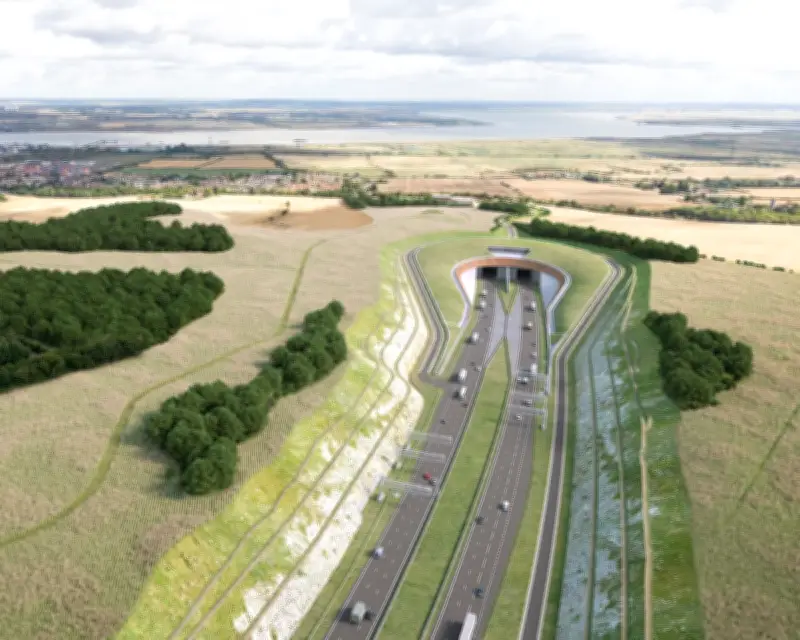
The UK's public spending watchdog has announced plans to investigate the Lower Thames Crossing, a proposed £11bn road tunnel between Kent and Essex, as campaigners raise concerns over escalating costs.
NAO Confirms Investigation
Gareth Davies, head of the National Audit Office (NAO), stated in a letter to campaigners that he anticipates the agency will “examine and report” on the project, with monitoring already underway. “My teams are tracking activity on the programme. This will inform my decision on the right timing for audit work,” Davies wrote.
The project, one of the UK's largest infrastructure schemes, was spared from billions of pounds in cuts announced by Prime Minister Keir Starmer to accommodate a £15bn increase in defence spending. Ministers committed to proceeding with the controversial and long-delayed tunnel this month.

Costs and Financing
It emerged last month that an additional £174m of public money was allocated to the scheme, which is estimated to cost more per mile than the HS2 high-speed rail link from London to Birmingham. The government has committed £3.1bn to construct the twin 2.6-mile tunnel, designed to ease congestion on the Dartford Crossing. The remainder is expected to be financed by the private sector.
Over £1bn has been spent before any construction has begun. Labour ministers, frustrated with Britain's slow handling of large infrastructure projects, argue the scheme exemplifies the need for urgent planning reform. The Department for Transport (DfT) took direct control of the project last year, removing National Highways as the main planning and oversight agency.
Timeline and Private Operation
A licence to operate the new tunnel and the existing Dartford tunnel, about seven miles to the west, is expected to be awarded to a private consortium in 2029, offered in perpetuity and overseen by a regulator. The project's completion date is now scheduled for 2034.
Campaign group Transport Action Network (TAN) hopes that the arrival of Andy Burnham as prime minister could lead to a rethink on using public funds to build a privately run asset. TAN wrote to the NAO earlier this year calling for an investigation amid mounting costs and carbon emission concerns.
Campaigner Reactions
In April, Davies replied that no work was underway but he would “keep this topic in mind.” His latest letter, dated 6 July, indicates the watchdog is moving closer to action. “When we start new work we publish work-in-progress notices on our website... At the point at which we begin any work on Lower Thames Crossing I will ask my team to contact you,” Davies wrote.
Abby Coften, TAN chief executive, said: “We’re pleased the NAO agrees with us that the privatised Lower Thames Crossing (LTC) needs investigating. However, this must be fast-tracked before more public funds are wasted. The same mistakes are being made as on HS2, but worse as LTC costs more per mile and has no completed business case. Billions of pounds of taxpayers’ money are being spent for just five years’ relief at Dartford. Meanwhile the toll revenues at LTC and Dartford will be gifted to private investors, and lost to the exchequer. It’s time to give the LTC the red card.”
Official Responses
An NAO spokesperson said: “The Lower Thames Crossing is a significant programme and is of high parliamentary and public interest. The NAO is tracking activity on the programme, which will inform its decision on the right timing for audit work. A work in progress notice will be published on the NAO website once work has begun.”
A Department for Transport spokesperson countered: “The NAO routinely reports on major government investments, and we would expect the same to apply to the Lower Thames Crossing. The cost-per-mile comparison to HS2 is misleading - these are entirely different projects with different objectives. Doing nothing at Dartford is simply not an option. Creating a new connection will reduce congestion, boost economic growth and establish a new strategic trade route between the ports of the South East, the Midlands and the North.”