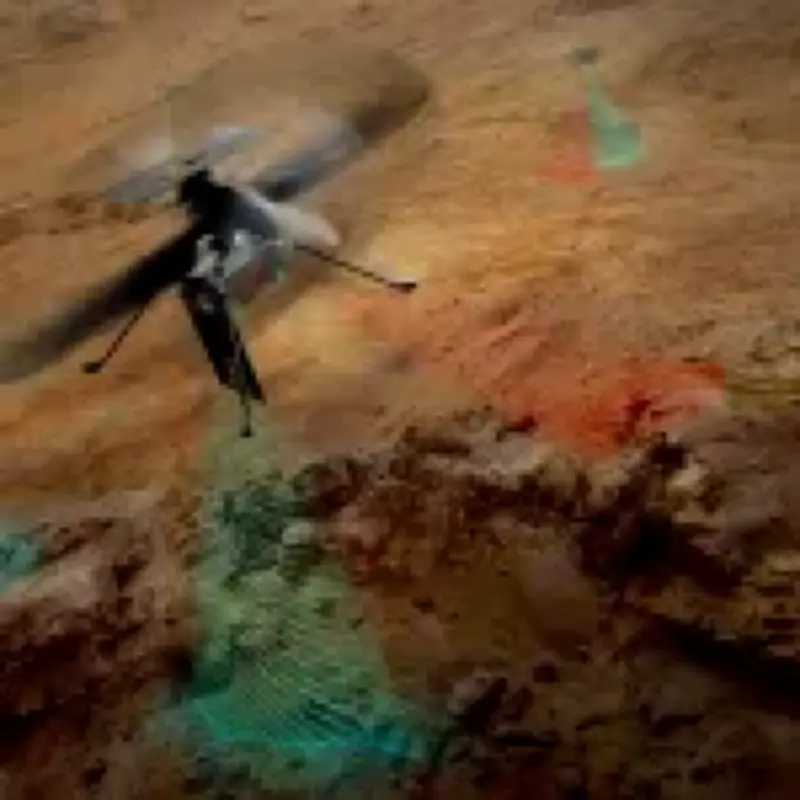
Nasa has released a new artist's impression showing three SkyFall helicopters sweeping across the Martian surface to search for hidden ice beneath the ground. The aircraft are scheduled to launch in late 2028 and will be delivered to Mars using what the US space agency describes as a 'daring mid-air deployment'.
Green waves and red beams: how SkyFall detects ice
Nasa's image shows green waves emanating from the helicopters' antennas, representing the collection of subsurface radar data. Red beams indicate near-infrared measurements being taken from crushed rock, soil and other material on the Martian surface. Once airborne, the trio will use sophisticated instruments for subsurface radar mapping, near-infrared imaging, visible-light photography and temperature monitoring.
To make the mission possible, engineers developed a unique flexible antenna covered in polyester and Vectran – a high-performance fibre previously used in landing airbags for Mars rovers. The design recently completed testing at Nasa's Jet Propulsion Laboratory and allows the helicopters to fly extremely close to the ground without damaging the antenna when landing.

Flying low and slow to map shallow ice
Adrian Tang, SkyFall's ground-penetrating radar lead instrument scientist, said: 'The only way to detect shallow subsurface ice remotely is to fly close to the ground.' He added: 'By flying low and slow, a SkyFall helicopter could capture radar images that resolve the fine layering where dry soil gives way to ice, detecting its presence and mapping its extent.'
SkyFall will build on the success of Ingenuity, Nasa's first aircraft to achieve powered and controlled flight on another planet. However, while Ingenuity relied on the Perseverance rover as a communications relay, the SkyFall helicopters will be able to independently transmit information to spacecraft orbiting Mars.