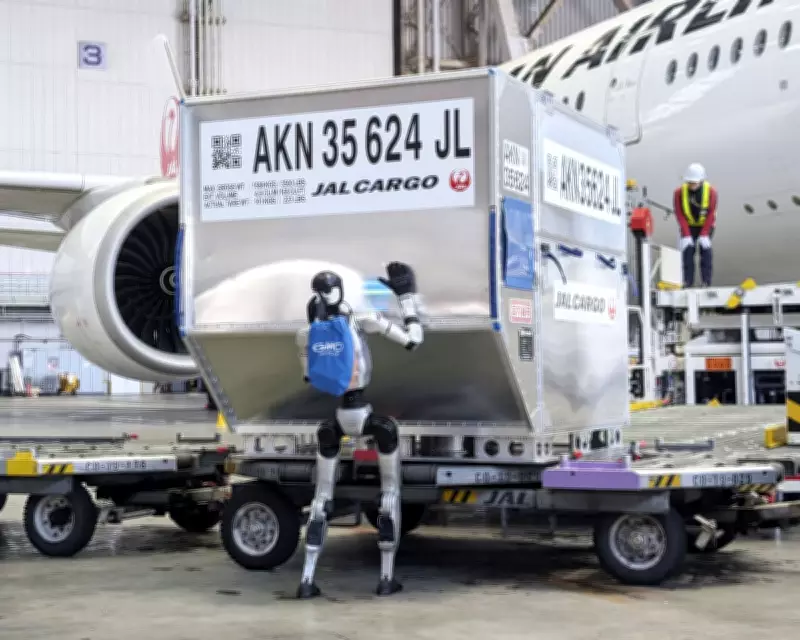
Japan's famously conscientious but overburdened baggage handlers will soon be joined by extra staff at Tokyo's Haneda airport – although their new colleagues will need to take regular recharging breaks.
Japan Airlines Introduces Humanoid Robots on Trial Basis
Japan Airlines will introduce humanoid robots on a trial basis from the beginning of May, with a view to deploying them permanently as a solution to the country's chronic labour shortage. The Chinese-made humanoids will move travellers' luggage and cargo on the tarmac at Haneda, which handles more than 60 million passengers a year.
JAL and its partner in the initiative, GMO Internet Group, hope the experiment – which ends in 2028 – will lessen the burden on human employees amid a surge in inbound tourism and forecasts of more severe labour shortages.

Media Demonstration Shows Robot Handling Cargo
In a demonstration for the media this week, a 130cm-tall robot manufactured by Hangzhou-based Unitree was seen tentatively pushing cargo onto a conveyor belt next to a JAL passenger plane and waving to an unseen colleague. The robot, which operates for two to three hours on a single charge, is designed to perform physically demanding tasks on the tarmac.
The president of JAL Ground Service, Yoshiteru Suzuki, said using robots to perform physically demanding work would inevitably reduce the burden on workers and provide significant benefits to employees, according to the Kyodo news agency. Suzuki added, however, that certain key tasks – such as safety management – would continue to be performed by humans.
Japan Faces Labour Shortage Amid Tourism Boom
Japan is struggling to cope with a simultaneous surge in tourists from overseas and an ageing, declining population. More than 7 million people visited the country in the first two months of 2026, according to the Japan National Tourism Organisation, after a record 42.7 million last year, despite a drop in the number of visitors from China triggered by a diplomatic row between Tokyo and Beijing.
According to one estimate, Japan will need more than 6.5 million foreign workers in 2040 to reach its growth targets as the indigenous workforce continues to shrink. The country's foreign population has risen dramatically in recent years, but the government is now under political pressure to rein in immigration.
Future Plans for Robot Use at Airports
The president of GMO AI and Robotics, Tomohiro Uchida, said: "While airports appear highly automated and standardised, their back-end operations still rely heavily on human labour and face serious labor shortages." The firms are planning to use the robots to perform other tasks, such as cleaning aircraft cabins, in addition to baggage handling.
The trial is part of a broader trend in Japan to deploy robots in various industries to offset demographic challenges. If successful, the humanoid robots could become a permanent fixture at Haneda and potentially other airports across the country.