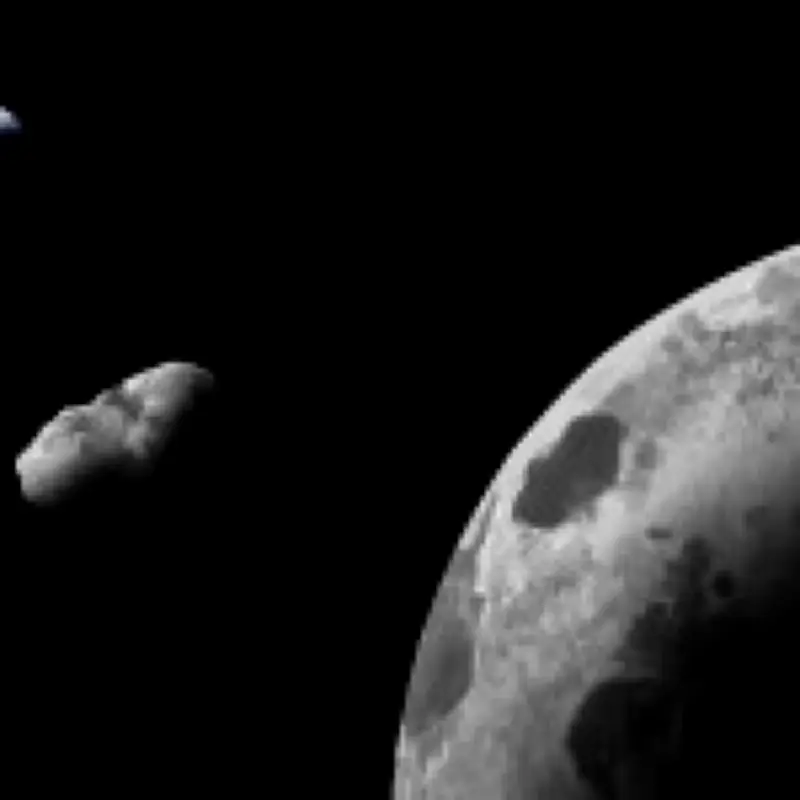
China has released the first-ever photograph of 469219 Kamo'oalewa, an asteroid that orbits Earth as a quasi-moon. The image was captured by the Tianwen-2 spacecraft from a distance of just 20 kilometers, the Chinese National Space Administration (CNSA) announced on July 6, 2026.
Historic close-up of a tiny asteroid
Kamo'oalewa, meaning 'wobbling celestial object' in Hawaiian, is about 100 meters in diameter. If confirmed, it would be the smallest asteroid ever visited by a spacecraft. The rock is one of seven known quasi-moons of Earth, gravitationally bound to the sun but looping around our planet. Its orbital dance with Earth began about a century ago and will continue for a few more centuries.
The Tianwen-2 spacecraft launched in May 2025 aboard a Long March 3B rocket from the Xichang Satellite Launch Center in southwest China. After traveling approximately 600 billion miles over 400 days, it sent back the historic photo.

Scientific significance of Kamo'oalewa
Scientists suspect Kamo'oalewa is a piece of the lunar surface torn off by a meteor impact, based on 2021 research showing its composition matches frozen minerals found on the moon. Three other quasi-moons share similar compositions, suggesting they may all originate from the same cataclysmic lunar strike. Alternatively, it could be an asteroid caught in Earth's gravitational pull or a fragment of a rock torn apart by the Earth-Moon system.
According to a report on China's Lunar and Planetary Data Release System, the asteroid's trajectory (ephemeris) shows it trails just behind Earth's clockwise orbit. Because the rock is so tiny and often hides in Earth's shadow, officials used optical navigation data to verify its position before taking the image.
Mission objectives and next steps
The Tianwen-2 mission aims to collect samples from Kamo'oalewa to answer questions about its origin. The CNSA stated: 'Going forward, the probe will gradually conduct more detailed scientific explorations to obtain information on the asteroid's shape, material composition and internal structure, providing support for preparations for sampling.'
The spacecraft will scoop up celestial material into a capsule and crash-land on Earth late next year. If successful, China will become the third country, after Japan and the United States, to retrieve material from a flying asteroid.
Asteroids are remnants from the early solar system, ranging in size from a frying pan to 329 miles wide. Collectively, they have less mass than the moon. Kamo'oalewa's close approach to Earth occurs only every 45 years, making it a rare and valuable target for study.