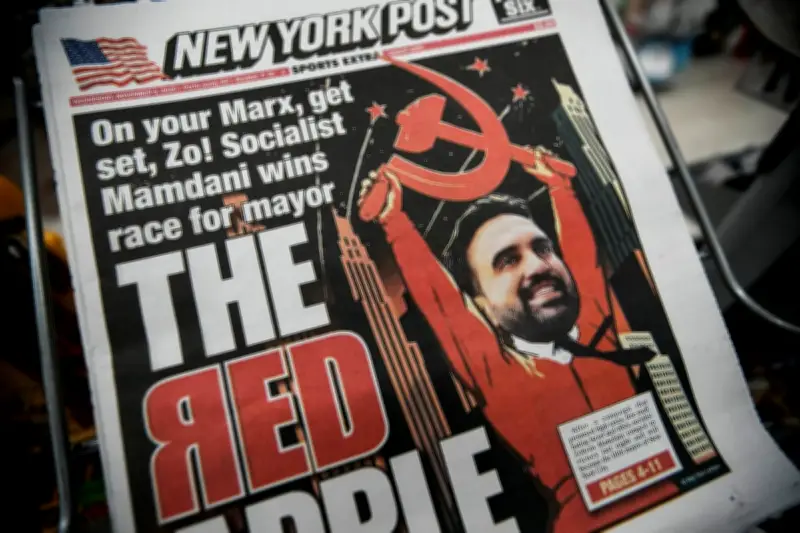
Six months into his tenure as mayor of New York City, Zohran Mamdani has achieved what many of his predecessors could not: he has bested the city's most powerful tabloid, the New York Post. Despite enduring near-daily criticism from the Rupert Murdoch-owned newspaper since launching his campaign in late 2024, Mamdani's popularity has grown in line with his influence.
Poll shows rising favorability
A Siena University poll in late June found that Mamdani's favorability had increased over the previous two months, with 58% of New Yorkers approving of the mayor and only 26% disapproving. These ratings surpass those of the Democratic party as a whole. The surge comes despite the Post publishing multiple pieces on the mayor every day—29 stories tagged “Zohran Mamdani” from Monday to Wednesday this week alone. Topics ranged from his stance on Israel to plans for public supermarkets, investment in public schools, the spelling of a police officer's name, and even his wife going on holiday.
Historical context of Post attacks
Historically, the Post has managed to weaken liberal mayors. Bill de Blasio, a progressive who served two terms from 2014 to 2021, saw parts of his agenda stall under relentless criticism, as did his subsequent presidential bid. “He did have relative popularity, but he was never beloved, and he did not have the same ability, unlike Mamdani, to exert his political will in various races,” said Ross Barkan, author of The Revolutionary: Zohran Mamdani and the Remaking of American Politics, set for release in October. According to Barkan, the Post has failed to find a line of attack that sticks with readers. “With De Blasio they had one, and it was very straightforward: the feckless liberal who can't govern the city. They got that quickly. Mamdani isn't like that. He can't run for president because he's a naturalized citizen, so he's not distracted by the national spotlight.”
Media-savvy strategy
Angelo Carusone, president of Media Matters for America, described the Post's approach as a “spaghetti against the wall strategy.” He noted that Mamdani understands media well. “He's out-Murdoch-ing Murdoch. Part of what gave the Post the edge is that they were able to be the mainline right into the zeitgeist. What Mamdani does is totally bypass that process. He has his own distribution system, his own ability to engage with the public. He doesn't rely on a third-party system; he's his own storyteller, and that is a really effective way of neutralizing the attacks.”
Apocalyptic predictions fail to materialize
In the lead-up to the election, the Post issued hyperbolic warnings that companies and millionaires would flee the city, crime would soar, and the city would declare bankruptcy. However, none of this has occurred. There is no evidence of businesses relocating, and data shows more offices were leased in the city in the first quarter of 2026 than the previous quarter. “Everything was apocalyptic, but the amount that they've overexaggerated all these things becomes sort of self-defeating,” Carusone said. “The Post is basically saying it's going to be a war zone, and yet people are not feeling that day to day. The vibes are actually pretty good.”
Post still searching for effective attack
Barkan, who ran for New York state senate in 2018 with Mamdani as his campaign manager, said the Post was still figuring out how to deal with the mayor but currently resembled a “ship at sea.” “While the New York Post is benefiting in terms of page views and interest, because they never run out of ways to attack him, the reality is they have not moved the needle politically against him. They attack Mamdani every day, but the average New Yorker looks at some of their criticisms and rolls their eyes, because they've not yet found the talking point that sticks.”