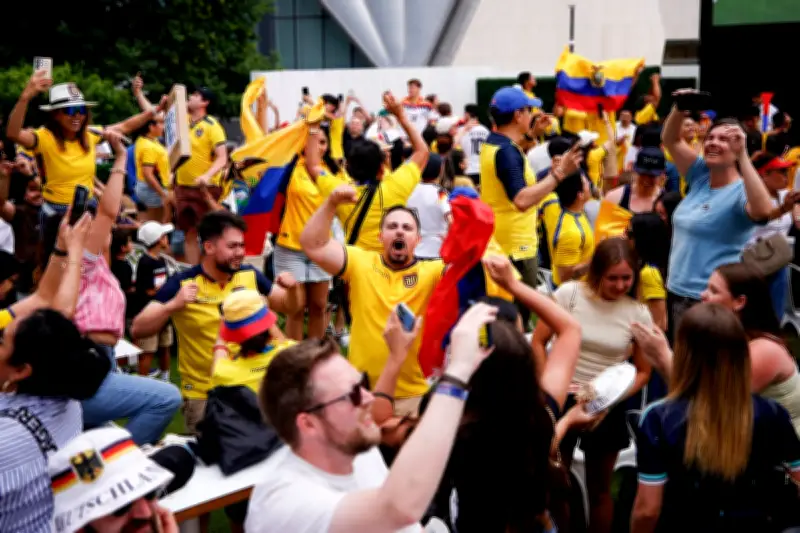
Almost 200,000 Ecuadorians and Ecuadorian Americans live in New York City. Last week, many gathered at El Encebollado de Victor, a Brooklyn restaurant, to watch their team face Germany. The venue was filled with yellow shirts under a blue roof adorned with red, blue, and yellow balloons. Among the most patriotically dressed was Luis Aguilar, 45, a US-born son of Ecuadorian immigrants, wearing an Ecuador jersey, scarf, straw hat, and flag, accompanied by his dog Jax also wearing a flag.
Ecuadorian community rallies behind the team
As the match began in New Jersey, the stadium was awash with yellow shirts, and the national anthem, ¡Salve, Oh Patria!, resonated both in the stadium and at the restaurant. Aguilar remarked, “It’s very fascinating. I have not seen this many Ecuadorians in one place [the stadium] probably ever. To see all the yellow jerseys – it’s incredibly heart-warming and mesmerizing.”
New York City is home to over 3 million foreign-born residents from more than 150 countries. During the World Cup, this diversity creates patriotic hubs around bars and restaurants as New Yorkers seek a taste of home.
At El Encebollado de Victor, 12-year-old Karen Lasluisa, a football fan who plays defense and sometimes goal, watched with her sisters and mother, Elvia Tubon. She predicted, “I think she will cry if Ecuador loses,” pointing at her mum. Germany scored after two minutes, but Ecuador equalized to make it 1-1 at half-time. Daniel Gutierrez, 30, born in Quito and a US resident for four years, expressed confidence in a win. He said, “It’s kind of like being close to home,” while eating encebollado, a fish stew with yuca, onions, and cilantro.
Ecuador's challenges and the World Cup as an escape
Gutierrez noted the tough times in Ecuador, which has become a transit hub for cocaine and faces human rights issues, with at least 51 people allegedly forcibly disappeared by law enforcement. He said, “There’s lots of things going on in the country, and with all those bad things, this feels like an escape for people to enjoy themselves a little bit. To enjoy being together, to maybe hope for better things. The political situation, it’s always been difficult for us. That’s why there’s lots of Ecuadorians in the US right now, because of immigration: we all have to come here and search for a better future.”
When Ecuador scored to take the lead and won 2-1, the restaurant erupted. Chairs flew, and cheers filled the street. Karen didn’t see her mother cry, at least not from sadness.
Senegal fans face visa barriers
Unlike Ecuador, Senegal faced challenges with fan attendance. In March, the Trump administration introduced a policy requiring people from countries including Senegal to pay a one-time bond of up to $15,000 to enter the US. This meant few members of the Douzième Gaindé, the national supporters group, could attend. Without them, Senegal struggled in early games.
In New York's “Petit Sénégal” neighborhood in Harlem, fans rallied at Pâtisserie Les Ambassades. Charlotte Gueye, 31, originally from Dakar, said, “I think the visas thing did have an effect for the Norway game [Senegal lost 3-2], for example. The Norwegians’ cheers were really loud, and I feel like there’s a psychological aspect for players from that: if you can’t see or hear your fans, I feel like that can affect you on the pitch. I think it’s really sad that it came to that, not just for Senegal, but also for other countries where they were not able to get visas to come. That’s not what the World Cup is about.”
Gueye ordered thiebou dieune (fish and rice) and lamb mafé. Rokhaya Ndiaye, 25, and her husband Momodou Sey wore Senegal jerseys bought nearby. Ndiaye said, “Just to sit down and eat Senegalese food while watching our game, just showing full-on patriotic support, having our jersey on and everything, it’s the only way to watch the game. Senegalese people are about warmth, kindness. They’re definitely super welcoming. Hilarious. Yeah, Senegal is just a place where, if you just want to put your mind at ease, it’s the place to go.”
Brazilian energy in Queens
Brazil, a five-time World Cup winner, has a diaspora spread across Queens. At Beija Flor in Astoria, owner Lucia Cruz decorated with yellow and green streamers and A Seleção cloths. Fans arrived early for a 1pm game. Ana Paula Fortkamp, 33, who moved from Paraná three years ago, said, “It’s a different energy. It’s Brazilian energy. The whole world knows that we’re excited, and that we dance: you cannot find that in an American sports bar, you know, it’s very, very different.”
Brazil fell behind 1-0 to Japan but equalized and scored a last-minute winner. Fans jumped and embraced. Monique Prado, 29, who drove 90 minutes from Connecticut, said, “I think our culture as Brazilians, we’re a very embracing culture. Even if you don’t know who you’re standing next to, they become like family at the time of a game. Brazilians – we embrace soccer so much, so when you’re watching the game with other people, we’re just your people so it’s a lot of fun, and it’s a great energy.”
For these fans, watching with compatriots offers a taste of home, community, and the joy of victory.