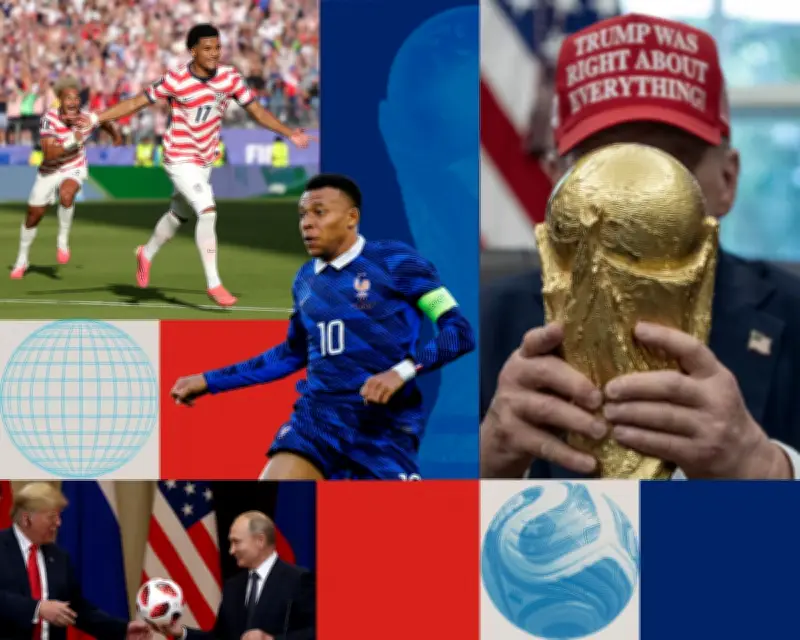
Donald Trump has been conspicuously absent from the 2026 World Cup, a tournament that has shattered attendance records with 4.6 million spectators in host cities across the US, Mexico, and Canada. The president, known for his relentless social media presence, has made only one brief mention of the event, praising the numbers as a "Great Tribute to the United States of America" in a Truth Social post on June 28. This silence marks a stark contrast to his usual bombastic style, raising questions about his strategic avoidance of the world's largest cultural event.
Trump's Silence as a Strategy
Barney Ronay, writing for The Guardian, suggests that Trump's absence is a deliberate tactical move. Unlike his typical approach of flooding the zone with noise, the president has chosen to step back, likely to avoid the booing he faced at the NBA Finals in New York last month. Ronay draws parallels to Vladimir Putin's muted presence during the 2018 World Cup in Russia, where the strongman leader avoided public displays of authoritarianism to present a positive image to the world.
"This is a president whose entire methodology has been to transform himself into an industrial-scale brain-shout noise delivery system," Ronay writes. "His silence during the world’s largest single cultural event can only be deliberate."
Football's Resistance to Trump's Narrative
The article highlights that football, despite its corporate gloss, remains resistant to political manipulation. The US men's national team is notably multicultural and diverse, reflecting the immigrant populations that Trump has often targeted. The World Cup has become a diaspora event, showcasing the porous nature of nationality and the success of immigrant communities. This contrasts sharply with Trump's rhetoric of exclusion and demonization.
"This sport will not bend to your will," Ronay notes. "It remains somehow non-compliant, in its emotional framing and in the makeup of its teams."
Practical Reasons for Absence
There are also practical reasons for Trump's avoidance. All US games to date have been played on the West Coast, a region where the president is unpopular. On Wednesday, Trump's Special Presidential Envoy for American Tourism, Exceptionalism and Values posted that the president would attend the USA vs. Belgium match in Seattle on Tuesday, but this remains unconfirmed. Trump was booed at the NBA Finals in New York, and similar reactions are expected at football matches.
Immigration and Customs Enforcement (ICE) agents have been active elsewhere but not visibly in host cities, a stark contrast to their presence at the Club World Cup last year. This suggests a tactical restraint to avoid provoking backlash during the tournament.
The Deeper Implications
Ronay argues that Trump's absence is an admission of wariness. Football, with its multicultural teams and inclusive spirit, challenges his divisive agenda. The dominant image of the tournament's later stages is a team of mixed and hyper-talented players performing under one flag—a symbol of unity that Trump cannot embrace.
"Nobody out there seriously believes that a spectacle of competing nations might somehow arrest the current descent into divisiveness and authoritarianism," Ronay concludes. "But Trump’s absence from this World Cup should still be recognised for what it is, a strategy, a tactical vacating of the zone, an act of sportswashing in itself."