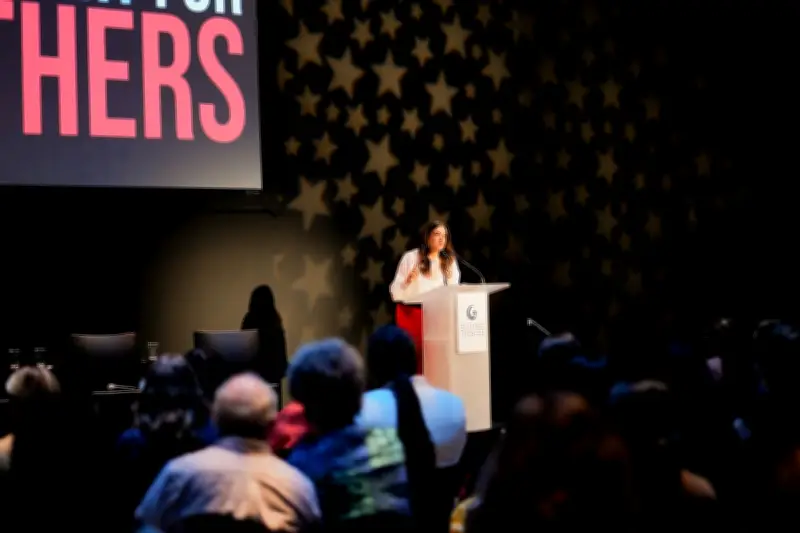
Reshma Saujani, executive producer of the documentary No Country for Mothers and founder of Moms First and Girls Who Code, is screening the film not on streaming platforms or at festivals, but in person across the US, hosted by hundreds of mothers themselves. The documentary details how American mothers lack support, paid leave, and childcare help, and aims to inspire collective action.
Film Screening Strategy: Community Over Isolation
Saujani explained that mothers often consume content alone at night, leading to frustration in isolation. By screening together, she hopes to foster unity and action. “We’ve been intentionally divided and distracted through culture wars, and mostly I think a lot by politicians, and now I would say influencers and tech companies,” Saujani told the Guardian at a June screening in Minneapolis. “And so I think that the only way to beat back the culture wars is to get moms to come together.”
Decades of Policy Failures
The documentary traces decades of failed family policies, featuring voices across the political spectrum. Hillary Clinton notes in the film that Congress passed a childcare bill in the 1970s, only for President Richard Nixon to veto it. Saujani emphasizes that childcare and paid leave are key priorities. While some states have created paid programs, former President Donald Trump said in April that federal funding is “not possible,” stating, “We can’t take care of daycare. You got to let a state take care of daycare, and they should pay for it, too.” In another scene, Saujani questions Trump on childcare funding, which he bungled; she says, “They had no fucking clue how to answer that question.”
Mothers as Producers and Hosts
The film credits a record-breaking number of producers—thousands of mothers who shared stories or hosted screenings. Saujani told a crowd in Minneapolis that America makes it “impossible to be a mom” by pitting women against each other through culture wars. “They know that the moment that we choose our power over their blame, it’s over for them,” she said. “This film is gasoline, and we are the match. So, let’s burn it down and build back America to what should have always been: a country for mothers.”
Cross-Political Engagement
Saujani intentionally engages with politically diverse audiences, including a Turning Point USA summit. “I want to be in a room full of people who subscribe to Evie magazine,” she said, referring to the rightwing women’s magazine. “I want them to watch this. I want to hear what they have to say.” Alice Mann, a Democratic Minnesota state senator who authored the state’s new paid leave law, noted at a post-screening panel that the US is experiencing backlash to women’s advancement, citing the overturning of Roe v Wade. Mann said passing the paid leave law required “absolutely astounding” effort, with no Republican support. One male senator told her he believed women of child-bearing age should be at home.
Personal Stories and Community Building
Brittney Walker, a mother of six hosting a screening in Arizona, said the film offers a chance to discuss taboo issues. “It’s hard to imagine anything being unifying right now, but I’m hopeful,” she said. Joanna Carolina Berry, a mom in Atlanta, hosted a screening after her employer told her she couldn’t do her job pregnant. “It really does take a village, and they keep telling us about the village, but they won’t give us the address,” she said. Stephanie Valdez, a news creator in Las Vegas, rented a library room, questioning why families paying taxes are not part of the conversation. “How come families who are paying taxes, who are raising the future – how come we’re not part of the conversation?” she asked.