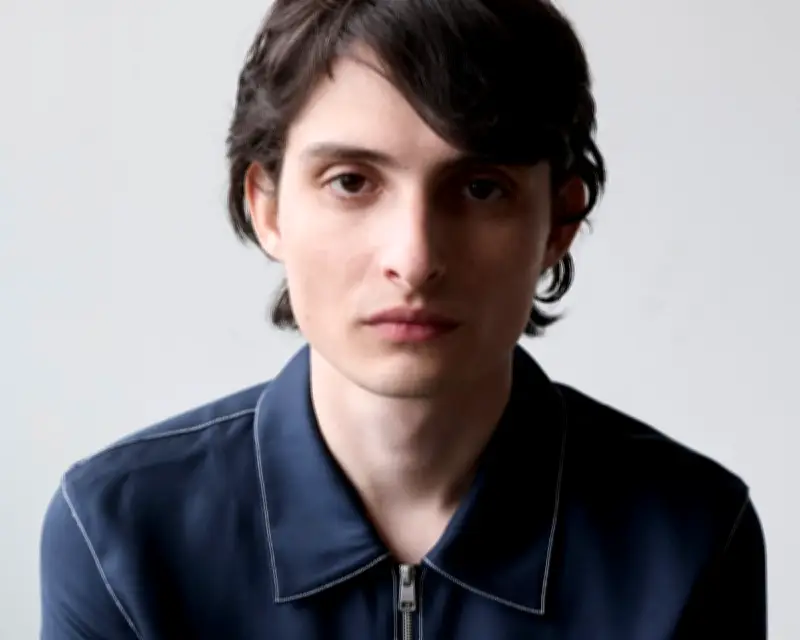
Finn Wolfhard is remembering his first experience of celebrity. It was 2016 and he was 13. The first season of Stranger Things had aired that summer, and he returned to his high school in Vancouver as if nothing had changed. But things had changed. “People didn’t know how to treat me, especially the teachers. Kids that didn’t even look at me before were paying attention to me or wanting to hang out.” He remembers a girl in the year above who really wanted a photo with him. “And I was like: ‘Oh, I can’t really take photos at school.’ And she wasn’t listening to me and pulled me into, like, a side hug. I remember thinking: ‘Shit, man. I have no control over this. This seems crazy.’ So, it was definitely weird at first, and something I still haven’t totally grasped.”
Growing up on screen
How strange it must be to have spent such a large part of your life playing a character that half the world knows, and has watched grow up on screen, turning from a wide-eyed, gawky, nerdy kid to a sharp-cheekboned (but still quite gawky) action hero. Nobody could have predicted how huge Stranger Things would become or how long it would last, fuelled by popular demand, then stalled by the pandemic. It concluded a decade later, at the end of last year, having reached the point where it was no longer sustainable for twentysomethings like Wolfhard to pass as high schoolers.
As a result, the kids from Stranger Things have become the benchmark teens of the era, navigating the trials of adolescence on screen and off, along with many of their viewers. Wolfhard’s co-star Millie Bobby Brown has said that their on-screen kiss in season one was the first time she had ever kissed a boy. It was pretty much the same for Wolfhard, he says. “I’d kissed a girl when I was maybe in second grade, but it wasn’t real at all.” For Stranger Things, he was just focused on doing a good job: “So, weirdly, I was not nervous for the actual kiss. I just was like: ‘Oh, it’s part of the thing, part of character.’”
Navigating fame and online scrutiny
Now 23, Wolfhard is very much a young man, even if it is still disconcerting to see him in stylish, non-80s streetwear. It is a hot summer day and we meet in the empty upstairs of a London pub (he is drinking water). He has been taking some time off, he explains, holidaying in Europe with his family – and being recognised wherever he goes. It happens a lot in central London, he says, but generally people are “pretty chill” – as is Wolfhard, it seems. “I was in Hackney yesterday and, like, no one came up to me and it was really nice. I could tell people were recognising me, but they weren’t coming up for photos.”
As child stars, the Stranger Things kids grew up in a particular online environment, where people write fan fiction about them (as the object of affection for Brown’s Eleven and Noah Schnapp’s Will, Wolfhard’s Mike Wheeler has been fertile and often inappropriate territory for this). Etsy creators market bizarre merchandise plastered with their faces (kudos to the “Wolfin’ hard or hardly Wolfin’?” T-shirt); and there is a running online commentary about every development, from their voice breaking to their face looking different because they are no longer 12.
Now that they are adults, they are even more in the crosshairs. Brown especially has been a target for celebrity stalking – and she named and shamed journalists commenting on her appearance in an Instagram post last year: “This isn’t journalism, it’s bullying.” Schnapp, meanwhile, was condemned for making pro-Israel comments a few years ago and had to clarify his position. Wolfhard avoids weighing in on political matters but still gets his share of celeb speculation. His trip last year to a London theatre to see Stranger Things co-star Sadie Sink in Romeo and Juliet sparked speculation that they must be dating (they weren’t). “People have a really hard time seeing things in a way that isn’t romanticised,” he says casually. “People like having stories for stuff that isn’t there. But usually it’s more boring than you think. A lot more boring.”
Childhood and the pre-internet era
Does all that stuff get to him? “For us, there was no choice because we had such public-facing jobs at such young ages,” he says. “I never totally … got too wrapped up in what the internet was saying or doing. But yeah, developmentally, it’s probably not a good thing to read things about yourself.” But he considers himself relatively lucky. “I still had a large chunk of my childhood that had nothing to do with technology or being judged by someone else or anything like that. But now I look at gen Alpha: even though most of them have normal school lives, all of them have Instagram, so they all kind of do have public personas in a weird way – being ‘famous’ isn’t that far out of reach because it’s normal for the younger generation to like get that kind of dopamine hit at such a young age.” Few of them will have as many Instagram followers as Wolfhard, mind you: nearly 25 million.
Perhaps that’s part of the broad appeal of Stranger Things: it was a nostalgia trip for adults who remember the 80s, but for younger viewers it evoked a kind of “phantom nostalgia” for a pre-internet childhood they never knew, where you could innocently cycle around, play board games together and do goofy things without the threat of being virally shamed online. Your home town being ravaged by monsters from a parallel dimension might have felt like a small price to pay.
Wolfhard’s early childhood really was riding bikes around the neighbourhood with his friends, he says. He grew up in an artsy household in a not particularly artsy neighbourhood of Vancouver. “So we were kind of the outliers a little bit when it came to just being into nerdier things.” His mother was a visual artist; his father wrote screenplays and worked in human rights. “There was no shortage of film and music from a very young age in my house. It’s the thing that we all talk about to each other.”
From Stranger Things to music
He was inspired to give acting a go after seeing his brother, Nick, who is five years older (and also an actor), on stage in a school play. He got a few bit parts in music videos and local TV productions, then, at 12, auditioned for Stranger Things. Like many of his co-stars, he wasn’t an “actor kid”, he stresses. “That’s maybe why we were cast in the first place, because we were closer to our characters at that time.” It also helped that, thanks to his upbringing, he was up to speed with the series’ 80s reference points: “I grew up with ET, Stand By Me, The Goonies, even a lot of the John Hughes films, so it was familiar territory for me.”
Emotions were mixed about Stranger Things coming to an end, Wolfhard says. It had been such a regular part of his life for so long. “That’s what was so great about it. Every year it was like, OK, I know I’m going to be in Atlanta filming this thing with the same people for the next however long. It was like my school in a really odd way.” They were shooting the final season for about a year. He shared a house with Gaten “Dustin” Matarazzo. “Everyone was having a great time, hanging out … All the cast lived in the same neighbourhood. We would go to each other’s houses all the time.”
There was a sense of denial, it seems. “The vibe was almost like, ‘Oh, we’ll back next year,’” he says, “but once we got about halfway through, everyone started to realise like, ‘Oh. This is it.’ And then everyone just really valued the time we all had together for that last half. It was pretty depressing for everyone when it ended … but it feels absolutely right that we’ve ended at the time that we did.”
So does he feel liberated? “For sure, yeah. At first I felt really lost, because that’s your life for so long and so many of the crew and cast were so integral to the person that you are and to your identity. You almost have a kind of withdrawal for a little while. Then you realise all those relationships, those friendships, they’re around for ever.”
Life beyond Hawkins
Wolfhard has been preparing for life beyond Hawkins for some time, in fact. He has done several movies between seasons. Admittedly, he mined similar 80s nostalgia territory in the recent Ghostbusters reboots (Afterlife and Frozen Empire), and the two-part adaptation of Stephen King’s smalltown horror story It, although in the latter Wolfhard played the clownish loudmouth of the ensemble, rather than the sensible “Mike” figure. “It’s fun sometimes to be the dick,” he says.
He has also done more “grown-up” drama, like 2019’s The Goldfinch, adapted from Donna Tartt’s bestseller and co-starring Nicole Kidman and Sarah Paulson. Even if the movie fell short, he was convincing as a sun-hating Ukrainian outsider in Las Vegas, thick accent and all. And in Jesse Eisenberg’s mother-son drama When You Finish Saving the World, he held his own alongside Julianne Moore as a self-absorbed wannabe musician. Some of the songs were Wolfhard’s own compositions.
This is the other part of Wolfhard’s strategy for life beyond Stranger Things: he has been making music longer than he’s been acting. “My mom bought me my first guitar when I was four.” He’s about to release his second solo album, Fire From the Hip, having already been guitarist and singer with two Canadian bands, Calpurnia and the Aubreys. Wolfhard’s solo music is generally tuneful rock in a Beatlesy, 90s indie vein, with playfully surreal lyrics and often deliberately lo-fi production. There is a retro analogue vibe to it all: strummed guitars, handmade album art, recording on physical tape rather than digitally. Again, it’s that sense of phantom nostalgia, he says. “Maybe that’s why I’m drawn to it, because I’m longing for that time still.”
If Wolfhard needed to find liberation after Stranger Things, it looks like he’s finding it here, recording and performing: “I spent my whole childhood having to be on a certain mark, and listen to directors and having the pressure to be perfect all the time, and with music it’s great because I can control my own thing, control my own life and destiny.”
Music career and future plans
It helps to have a built-in fanbase, he admits, as he prepares for a US tour this month. The music route has become a fruitful post-Stranger Things sideline. Maya Hawke is on her fourth album, Caleb “Lucas” McLaughlin has released a few tracks, Jamie “Vecna” Campbell Bower has moved on from his punk band and appears to be headed for a more commercial solo career. Then there’s Joe “Steve Harrington” Keery, AKA Djo, whose 2022 track End of Beginning rode a wave of TikTok virality to become a global hit. Keery is currently supporting Tame Impala on their US tour. “Joe was like a cool older brother on set,” says Wolfhard. Keery introduced him to a lot of music and musicians, and they still have a close bond, he says. “I’ll get advice from him, and send him demos and stuff.”
But he has no huge ambitions for rock domination. “The goal for me in my music career is to have people find my music just from hearing the songs on a playlist, or seeing a show or at a festival and going: ‘Oh, who’s that?’”
Nor is he giving up the day job. He is taking a break from his tour to shoot a new film in Toronto next month, he says – “a movie that I’ve been trying to make with a friend since before Covid”. But he’s not particularly looking for the next big thing in acting terms, either. “I want to prove myself by being in things that people would maybe not expect me to be in. And however long it takes to find that perfect thing or that right thing, I’m fine to wait.”
One way of handling the pressures of childhood celebrity has been to keep moving, he says. “That’s a reason, maybe, why I try to work, because it’s a way of dealing with the anxiety, just by throwing yourself into something else.” But Wolfhard seems to have reached a stage where he can take his foot off the gas slightly. He has loved being back in Canada – “it just seems more calm for me, for my personality” – and having a bit more downtime: “I really like being able to be at home, not having any plans, like not having any expectation on yourself to do anything. My favourite hobby is being bored.” No one could say he hasn’t earned it. Finn Wolfhard’s album Fire From the Hip is released on 10 July.