Lindsey Vonn's Olympic Comeback Ends in Dramatic Cortina Crash
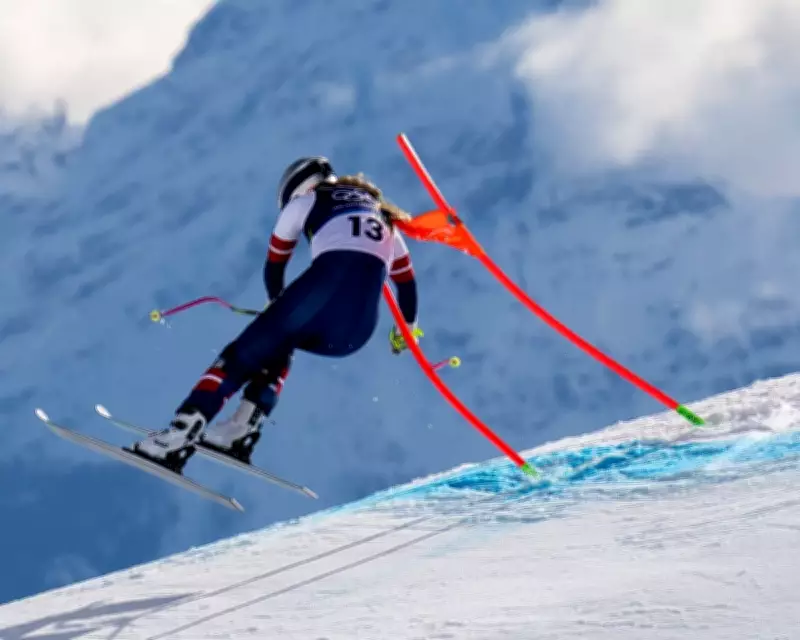
The Olympic downhill race that Lindsey Vonn had spent two years preparing for ended in a single, violent instant on Sunday morning in Cortina d'Ampezzo. The 41-year-old American skiing legend, competing with a fully ruptured ACL in her left knee, clipped a pole just 13 seconds into her descent, triggering a catastrophic crash that required immediate helicopter evacuation from the Olympia delle Tofane course.
A Brutal End to an Unprecedented Bid
Vonn had pushed out of the start gate knowing exactly what she was racing against: not just the world's best downhill skiers, but her own body's limitations. With a heavy brace supporting her injured knee and the accumulated wear of a career spent testing the boundaries of speed and safety, she represented one of the most remarkable comeback stories in Olympic history.
The contact with the gate was subtle, almost imperceptible at racing speed, but its consequences were immediate and severe. Vonn lost her balance, lurched violently to the right, twisted awkwardly in the air, and landed hard on her side before being pitched backward down the piste. On television coverage, her screams could be heard clearly over the course microphones as she slid to a stop along the side of the run.
Stunned Reactions and Immediate Response
In the finish area, the stomach-turning noise of the crash drained the color from thousands of spectators gathered at the Tofane Alpine Centre. Teammates watching the big screen in clusters froze in disbelief. Breezy Johnson, the reigning world champion who had just set the fastest time, covered her eyes and turned away. Nearby, Vonn's sister stood motionless, her face pale with shock.
Within seconds, the race was officially stopped. Medical staff reached Vonn as she lay on the course, and within minutes a helicopter was summoned. The delay stretched toward half an hour as she was stabilized, strapped into a stretcher, and winched into the air. This marked the second time in nine days that Vonn had left a racecourse by helicopter, following a previous crash in Crans-Montana, Switzerland.
As the aircraft lifted away from the mountainside, the crowd broke from their stunned silence into sustained, respectful applause for the fallen champion.
The Deeper Meaning of the Comeback
Just like that, the Olympic downhill Vonn had spent years trying to reach was over. But the deeper truth is that the meaning of this comeback was never going to be found in the finishing order or medal count. Vonn did not arrive in Cortina chasing a storybook ending. Instead, she spent the past year dismantling the idea that this return needed to be measured in conventional success metrics.
Again and again, she framed her participation in simpler, harder terms: showing up in the start gate and trying, even when the odds suggested she probably shouldn't. "The odds are stacked against me with my age, no ACL, and a titanium knee," she said before the race. "But I still believe."
That self-belief was never really about winning. It was about proving that the version of herself built over two decades on the World Cup circuit still existed somewhere inside a body that had, by any reasonable sporting metric, already given more than enough.
A Career Defined by Resilience
For nearly six years, Vonn's competitive career appeared to be over. Her right knee, rebuilt multiple times, required a partial titanium replacement in 2024. The surgery was initially meant to restore quality of life rather than competitive viability. Instead, it reopened a door she had assumed was closed forever.
When she returned to competition, she did not come back for a participation trophy. She came back fast. This season alone, she reached the podium in all five World Cup downhills she entered, winning twice and seizing the red bib as the discipline's season-long leader. Then came the crash in Crans-Montana, followed by the MRI that revealed her ACL rupture, and finally the decision that would define the final act of her career.
The Unforgiving Nature of Downhill Skiing
There is something uniquely unforgiving about downhill skiing. There is no easing into it, no way to negotiate with gravity once you push out of the gate. It is not a sport that rewards nostalgia or sentiment or narrative symmetry. It does not care about legacy arcs or redemption stories or emotional neatness.
Cortina – the place that defined Vonn's greatness more than any other, where she won a record 12 World Cup races, the rare track where her technical gifts, appetite for risk, and competitive psychology were in perfect alignment – offered no special treatment on Sunday. That is not cruelty, but simply the fundamental honesty of the sport she chose.
"I can't guarantee a good result," Vonn said before the race. "But I can guarantee I will give it everything I have."
An Ending That Defies Simple Interpretation
On Sunday, she did exactly that. And in time, that commitment may be what outlasts the crash itself in the collective memory of the sport. Because elite sport rarely allows athletes to author their own endings. Most are written gradually: through decline, injury, or the slow realization that the gap between who you were and who you are has become too large to reconcile.
"She always goes 110%, there's never anything less," Vonn's sister told NBC Sports. "Sometimes things just happen."
Vonn resisted that erosion longer than almost anyone in her discipline ever has. She did it not by pretending she was still invincible, but by insisting that trying still mattered, even when the physical evidence suggested otherwise.
The inevitable debate about whether she should have raced began while Vonn was still lying on the side of the course. Questions circulated about whether the risk was proportionate to the reward, whether this represented courage or stubbornness or something more complex and fundamentally human. But none of those arguments really change what this comeback ultimately represented.
In the end, the mountain does not remember who you were. It only measures who you are in that single moment between the start gate and the finish line. On Sunday, Lindsey Vonn accepted that bargain one more time. In a sport built on confronting risk rather than avoiding it, that may be as honest an ending as any champion is allowed to have.