Thermal Imaging Transforms Winter Olympic Photography into Artistic Expression
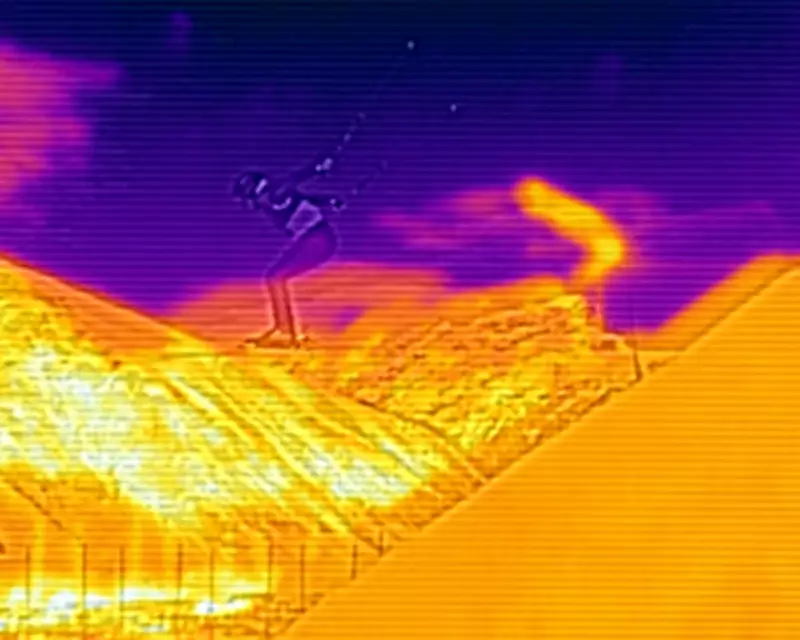
While traditional sports photography at the Winter Olympics typically focuses on freezing fast-paced action, a creative team from Getty Images is pursuing a radically different approach at the Milano Cortina 2026 Games. Photographers Pauline Ballet, Ryan Pierse, and Héctor Vivas are employing compact thermal-imaging cameras to capture the invisible heat signatures of athletes, producing hauntingly beautiful and innovative visual art.
Revealing the Invisible: Heat as a Poetic Medium
Equipped with technology more commonly associated with scientific or industrial applications, the trio has been documenting competitors across various venues, from the slopes of Cortina to the ice rinks of Milan. Their thermal images transform athletes' bodies into spectral forms rendered in vivid yellows and reds, while the surrounding snow and ice appear in striking shades of cyan and indigo.
"As visual artists, we're drawn to photography as a form of art that allows us to be expressive, creative and experimental," explains Pauline Ballet. "Thermal cameras capture the infrared radiation emitted by bodies, thereby revealing heat, muscular effort and the thermal exchanges between the athlete and the environment in which they perform. It's both a documentary tool and a poetic medium."
Technical Innovation and Creative Challenges
Each specialized camera features dual lenses – one for thermal imaging and another for conventional photography. This unique setup enables photographers to create intriguing composite images that merge visible action with delayed thermal imprints, producing what Ballet describes as "a visual dialogue between the visible and the invisible."
The photographers acknowledge significant technical challenges compared to traditional sports photography. "It's a bit like learning photography all over again, which is fun," says Ballet. "The main difference lies in the visual language. In classical photography we work with light, composition and fast or slow shutter speeds; in thermal imaging we work with temperature, energy dissipation, colour and the thermal traces of movement."
Notable limitations include the inability to adjust standard settings like exposure speed, aperture, and focal length, along with a noticeable delay between shutter activation and image capture. These constraints have forced the team to completely reinvent their compositional approach and visual reference points.
Additional Experimental Projects at the Games
Beyond thermal imaging, the Getty Images special projects team is exploring several other creative photographic techniques during the 2026 Winter Olympics:
- Infra-red photography that captures different light spectrums
- Vintage Graflex cameras adapted for modern smartphone integration
- Digital composite techniques combining multiple image layers
Héctor Vivas notes that the Graflex cameras serve as "paying tribute to the type of camera that would have been used 70 years ago when Cortina previously hosted the Games in 1956." However, in a contemporary adaptation, these vintage cameras have been modified to record images directly onto smartphones, enabling live transmission of captured content.
"It's exciting to be part of Getty's special projects team," adds Ballet. "We can't wait to share the finished set at the end of the Games." This innovative approach represents a significant departure from conventional sports photography, transforming athletic documentation into a form of thermal art that reveals the unseen physical efforts and energy exchanges of Olympic competition.