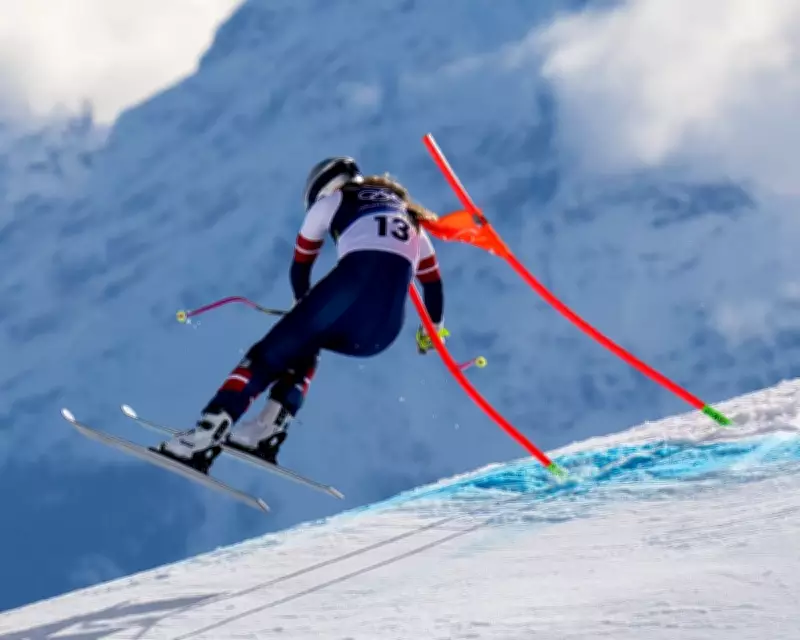
The world of winter sports has been rocked by Lindsey Vonn's dramatic crash during the women's downhill event at the Winter Olympics, sparking intense debate about athlete safety and personal choice. The American skiing legend suffered a fractured leg after clipping a gate at high speed, an incident that led to her being airlifted from the course. This occurred just one week after she had ruptured her ACL in a previous crash, raising questions about whether she should have been competing at all.
Fellow Athletes Rally in Support
While some social media critics questioned Vonn's decision to race with such a significant injury, her fellow competitors have been quick to defend her choice. Keely Cashman, Vonn's US teammate, emphasized that the crash was unrelated to her knee injury. "People that don't know ski racing don't really understand what happened," Cashman explained. "She hooked her arm on the gate, which twisted her around. She was going probably 70mph, and so that twists your body around."
Cashman, who experienced her own serious crash five years ago, stated definitively that Vonn's accident had "nothing to do with her ACL, nothing to do with her knee," calling those who suggested otherwise "totally incorrect."
The Comeback Story Interrupted
Vonn's crash represents a heartbreaking interruption to what had been a remarkable comeback story. After six years of retirement and knee replacement surgery, the 41-year-old had returned to competitive skiing in 2025, defying expectations by reaching the podium in all five World Cup downhill races leading up to the Olympics, including two victories. Her quest for a second Olympic gold medal was cut short by the late January crash that ruptured her ACL, followed by Sunday's dramatic incident.
International Support for Personal Choice
The debate has drawn responses from across the skiing world. Italy's Federica Brignone, a two-time world champion, offered a straightforward perspective: "It's her choice. If it's your body, then you decide what to do, whether to race or not. It's not up to others. Only you."
Kyle Negomir, another US teammate and downhill specialist, echoed this sentiment while acknowledging Vonn's unparalleled status in the sport. "Lindsey's a grown woman and the best speed skier to ever do this sport. If she made her decision, I think she should absolutely be allowed to take that risk," Negomir stated. "She's obviously good enough that she's capable of pulling it off."
Official Perspective on Injury Management
Johan Eliasch, president of the International Ski and Snowboard Federation, provided context about athletes competing with injuries. "I firmly believe that this has to be decided by the individual athlete," Eliasch said. "And in her case, she certainly knows her injuries on her body better than anybody else." He noted that injuries are common among elite athletes and described Vonn's crash as "incredibly unlucky" and "a one in a 1,000" occurrence.
Eliasch emphasized the inherent dangers of the sport, explaining the mechanics of Vonn's accident: "She got too close to the gate, and she got stuck when she was in the air in the gate and started rotating. No one can recover from that... This is something which is part of ski racing. It's a dangerous sport."
The Emotional Toll of Competition
Breezy Johnson, Vonn's US teammate who claimed gold on Sunday, offered insight into the emotional dimension of such incidents. "I know how difficult it is to ski this course and how sometimes, because you love this course so much, when you crash on it, and it hurts you like that, it hurts you that much worse," she reflected. Johnson highlighted that while athletes can manage physical pain, "the emotional pain is something else."
The discussion surrounding Vonn's crash continues to evolve, touching on fundamental questions about athlete autonomy, risk assessment in elite sports, and the fine line between determination and recklessness in pursuit of Olympic glory.