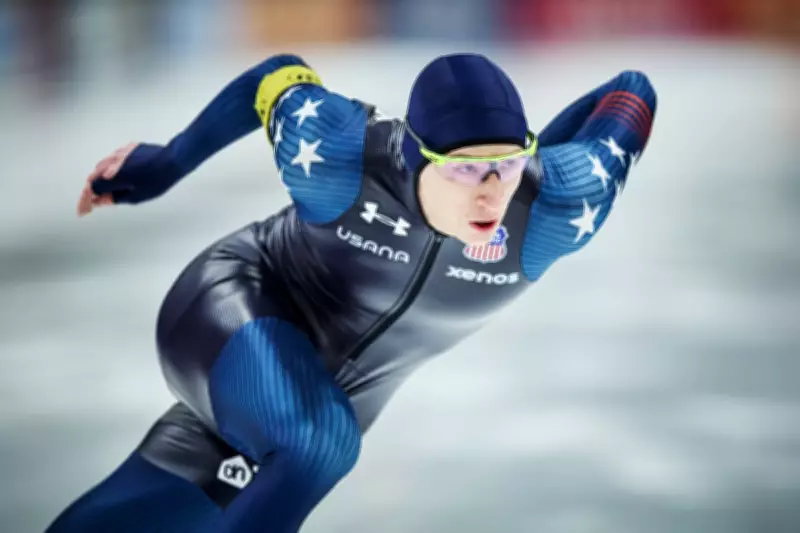
Jordan Stolz is anticipated to become only the second American athlete to secure more than two gold medals in any single sport at a Winter Olympics, a remarkable achievement that places him in elite company. The 21-year-old speed skater from Wisconsin has dominated his discipline for three consecutive years, setting the stage for a potentially historic performance over the next 11 days at the Milano Cortina Games.
A Star in the Making
Each Winter Olympics often produces one or two iconic figures whose performances transcend mere results and become synonymous with the event itself. For decades, the United States has awaited its next such star, someone capable of capturing the national imagination amid a crowded sports landscape. Jordan Stolz may very well be that individual, arriving in Italy not just as the current dominant force in speed skating but as an athlete who could emerge as the defining face of the entire Winter Games.
Dominance and Expectations
Stolz is already a seven-time world champion and enters the Olympics as the favourite across three individual distances: the 500m, 1000m, and 1500m, with additional medal potential in the mass start event. Over the past three seasons, his grip on the sport has tightened to such an extent that defeats are now considered statistical anomalies rather than expected outcomes. If this dominance continues in Milan, it could propel him into household name status, far beyond the confines of speed skating.
His Olympic campaign commences on Wednesday with the men's 1000m, followed by the 500m on Saturday, the 1500m next Thursday, and the mass start semi-finals and final on the subsequent Saturday. Should Stolz achieve the 500-1000-1500 treble, as he has at two of the last three world championships, he would join fellow speed skater Eric Heiden as the only Americans to win more than two golds in any sport at a single Winter Games. Heiden's legendary five-gold sweep in 1980 remains one of the most towering individual achievements in all of sports history.
Historical Comparisons and Growing Attention
The lofty comparisons to Heiden and even swimming great Michael Phelps have trailed Stolz for years, highlighting the scale of his potential impact. NBC has prominently featured him in its Olympic coverage and marketing campaigns, including a teaser advertisement with Hollywood actor Glen Powell, which Stolz admits cost him a valuable training day to film. While speed skating often remains a niche sport in the U.S., treated as a quadrennial event, the Olympics dramatically amplifies its visibility, transforming athletes like Stolz into global figures.
Stolz has expressed a measured approach to the mounting pressure, stating, "I try not to think about the pressure too much. Once you get to the line, it's the same thing you've been doing for years. Everything around you is just noise." This mindset stems from his upbringing and training philosophy, which emphasises routine and control over external distractions.
From Frozen Pond to Olympic Stage
Stolz's journey began on a frozen pond behind his family home in Kewaskum, Wisconsin, where he first skated at age five while wearing a blue lifejacket for safety. His parents, initially fearful, only allowed unrestricted skating after verifying the ice thickness. The 2010 Olympics served as a pivotal inspiration, with the family glued to the television watching short-track star Apolo Anton Ohno, which introduced them to the thrilling speed of competitive skating.
Access to the Pettit National Ice Center, located 40 minutes away, proved crucial in shaping his path. There, Stolz honed his technique in relative anonymity, often training in near-empty rinks while American sports culture largely overlooked speed skating outside Olympic cycles. In contrast, in the Netherlands, where the sport enjoys immense popularity akin to the NFL in the U.S., Stolz is already a recognised figure on the streets, though he remains largely unnoticed in his home state of Wisconsin.
A Technical and Isolated Approach
What sets Stolz apart from many elite skaters is his engineering-like approach to speed. He views long-track speed skating as an honest discipline where outcomes are determined by preparation and performance, free from the chaos of contact sports. This perspective extends to equipment, as he once spent six hours at a blade factory inspecting 77 pairs by hand to find minute differences that could yield "free speed." Each stride is analysed as data, and each corner treated as a physics problem, with Stolz preferring to lead his own laps in training to simulate race conditions.
Over the past two seasons, his results have been nothing short of surreal, with World Cup win streaks extending into the twenties and victories achieved through clinical precision rather than dramatic surges. Despite facing challenges such as crashes, illness, and training interruptions, Stolz has maintained a focus on constant refinement, influenced by former Olympic champion Shani Davis's philosophy of never rating performance as perfect, but always seeking improvement.
The Olympic Challenge Ahead
As the Milano Cortina Olympics unfold, Stolz faces the unique pressures of the global stage, with the temporary Milano Speed Skating Stadium adding an element of unpredictability due to variable ice conditions. He remains pragmatic, cataloguing these uncertainties rather than obsessing over them. When asked about his biggest rival, Stolz often points to himself, emphasising the internal battle for perfection.
He describes his current readiness as "95 percent" – good, but not perfect – highlighting that the final 5% is where history is made. In events decided by hundredths of a second, factors like blade edges, ice temperature, and mental focus become critical. Dutch star Kjeld Nuis, unbeaten in his Olympic career, has acknowledged the changed landscape, suggesting that a podium spot might be the best he can achieve against Stolz's dominance.
Ultimately, Stolz's performance in Milan could place him alongside legends like Eric Heiden, or it may serve as another step in his ongoing journey of adjustment and refinement. Regardless, he approaches each race with the same deliberate focus, aiming to execute at full speed while tuning out the surrounding noise. As he succinctly puts it, "Many things are possible, but I have to actually do it."