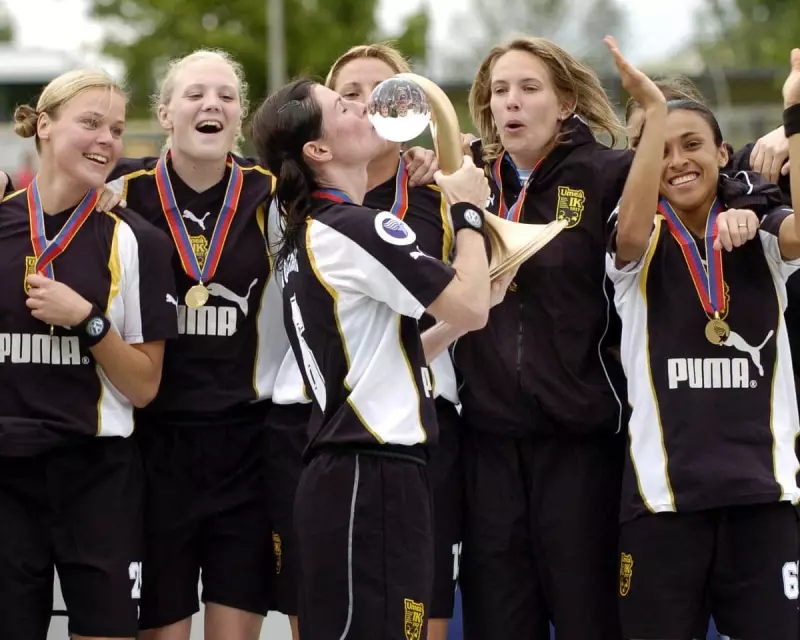
Two decades ago, the sight of a Scandinavian club lifting European football's top prize was a familiar one. In 2004, Umeå captain Malin Moström famously kissed the UEFA Women's Cup trophy after her side's triumph, cementing a period of Nordic dominance. The Swedish powerhouse, boasting global stars like Marta, seemed an unstoppable force.
The Widening Gulf: From Dominance to Distant Challengers
Today, that era feels like a distant memory. The prospect of a Norwegian, Swedish, or Danish club winning the UEFA Women's Champions League in 2025 is almost unthinkable. This season, only Norwegian side Vålerenga reached the Champions League league stage, and they failed to progress to the knockout phase.
The decline has been a steady process over the past 20 years, not a sudden collapse. As women's football professionalised across Europe, investment, infrastructure, and commercial power concentrated in leagues like England's Women's Super League (WSL), leaving the Nordic nations behind.
Harriet Rudd, Vålerenga's chief executive, is blunt about the economic realities. "The football economy in Norway is much smaller," she states. "Norway is not a country where you have a lot of very, very big investors or big men's clubs who can afford to fund women's clubs, which are operating at a deficit over many years."
Financial Realities and the Development Model
Faced with this landscape, many formerly independent Scandinavian women's clubs have merged with their male counterparts for financial survival. Vålerenga made this move in the early 2010s. While integration brought stability, it has not unlocked the level of sustained investment seen at top WSL or European clubs.
This financial disparity has turned Scandinavian leagues into crucial talent incubators. Steinar Pedersen, Vålerenga's women's sporting director, sees the exodus of top players as inevitable. "It's very natural that we have the best Norwegian players playing abroad," he says, acknowledging it as part of the modern game.
The sentiment is echoed in Sweden. Markus Nilsson, deputy CEO of Hammarby, highlights the stark differences in finances and infrastructure compared to WSL clubs. While appreciating the Swedish FA's work on grassroots gender equality, he calls for more direct investment in the elite game. "I would love to see that the Swedish FA also actually did some investments for the top talent or top leagues," Nilsson explains.
Building for the Future: Academies and a Changed Philosophy
With profitability elusive, player development remains the core focus. Clubs like Häcken have embraced their role as developers. Stars like Stina Blackstenius and Johanna Rytting Kaneryd have moved from the Gothenburg club to the WSL, with several more following in recent weeks.
Christian Lundström, Häcken's director of women's football, stresses the long-term view. "It's taking time to develop players... we need to develop new players." He emphasises the critical need for investment in youth academies and high-quality coaching from a young age.
Nils Nielsen, former Denmark national coach and ex-director of women's football at Manchester City, identifies a fundamental philosophical difference. "In England, the investment came first and the results followed," he observes. "In Denmark, people were often asked to deliver results with no funding." He argues replicating the English model is not difficult, but requires a mindset shift: stop expecting results without first providing the necessary resources.
Despite the challenges, Nielsen is optimistic about the future for nations that commit fully. The key question for Scandinavia is whether the ambition exists to bridge the gap. While a return to European domination seems unlikely, the region's leagues are poised to remain a vital production line of world-class talent for the foreseeable future.