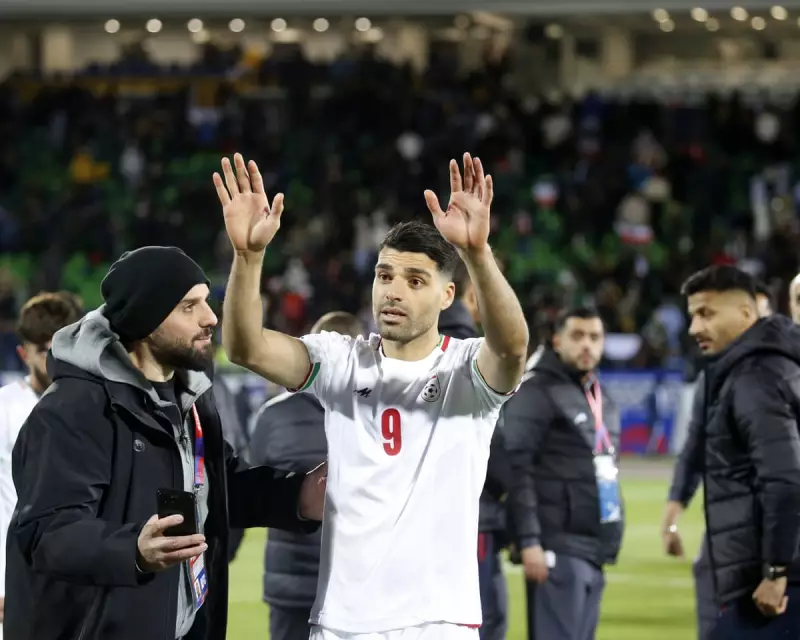
Iranian international footballer Mehdi Taremi has become the latest high-profile athlete to face threats from the regime in Tehran after publicly expressing solidarity with protesters in his home country.
A Silent Celebration Speaks Volumes
The 33-year-old striker, who currently plays for Greek side Olympiakos, scored his eighth goal of the season in a 2-0 win against Atromitos last Saturday. However, his usual celebration was conspicuously absent. In a powerful political statement, Taremi deliberately refrained from celebrating the goal.
"It actually has to do with the conditions in my country," Taremi explained. "There are problems between the people and the government. The people are always with us, and that's why we are with them. I couldn't celebrate in solidarity with the Iranian people."
His act of defiance occurred against a backdrop of severe internet and communications blackouts imposed by the Iranian government, meaning many of his supporters back home were unable to witness the match or his poignant gesture.
A Brutal Crackdown and Football's Political Role
Iran is currently experiencing its most significant unrest since the 1979 Islamic Revolution, with widespread protests triggered by soaring inflation and a collapsing currency. The regime's response has been characterised by a brutal clampdown, increased repression, and prolonged digital blackouts.
Football occupies a uniquely powerful position in Iranian society. The government has historically been wary of the sport's potential to mobilise mass gatherings for political purposes, yet has also been quick to co-opt national team successes for its own propaganda.
This tension is not new. In 1998, players were instructed to delay their return after World Cup qualification to let celebrations subside. During a crucial 2010 qualifier, several players wore green armbands in support of opposition leader Mir Hossein Mousavi.
A Dangerous Pattern of Intimidation
Taremi is not the first Iranian footballer to face repercussions for speaking out. The regime has a established pattern of intimidating sporting icons who dare to criticise it.
Legendary former striker Ali Daei, a cultural icon like Taremi, saw his family prevented from leaving Iran after he backed protests in 2022. During the 2022 World Cup in Qatar, which coincided with nationwide protests following the death of Mahsa Amini, former national team defender Voria Ghafouri was detained. State-linked Fars News Agency accused him of "spreading propaganda against Iran".
Last week, Ghafouri reportedly announced he was closing his cafes in Tehran in solidarity with protesters. IranWire reported that Fars News subsequently issued a warning, stating: "These unrests will soon come to an end, but the real test for officials of the football federation will begin afterwards, when they must show that calls for chaos will receive a firm response."
Similar threats have now been directed at Taremi. Despite once being viewed as supportive of the regime, the Porto and AC Milan veteran has grown increasingly vocal. He has criticised the state of domestic facilities, including Tehran's iconic Azadi Stadium, and questioned restrictions on crowd sizes.
He led the symbolic protest at the 2022 World Cup where the Iranian team refused to sing the national anthem before their opening match against England. This act was repeated on 7 January 2024 by the Iranian Under-23 team before their Asian Cup fixture against South Korea.
International Concern and Calls for Freedom
The situation has drawn concern from international figures connected to Iranian football. Former national team head coach Carlos Queiroz, who faced relentless questioning about Iran's political situation during the Qatar World Cup, recently took to social media.
He posted a line from influential Tehran-born poet Ahmad Shamlou: "Freedom is breathing in an air where there is no lie." Queiroz added a message of support, saying, "My heart and thoughts are with the people of Iran during these difficult but challenging days of hope. I am deeply concerned for their safety and wellbeing."
For Taremi and other Iranian athletes playing abroad, showing solidarity with their compatriots carries immense personal risk, including threats and the potential for detention should they return home. Their battle to be heard continues as the regime attempts to silence all forms of dissent, both on and off the pitch.