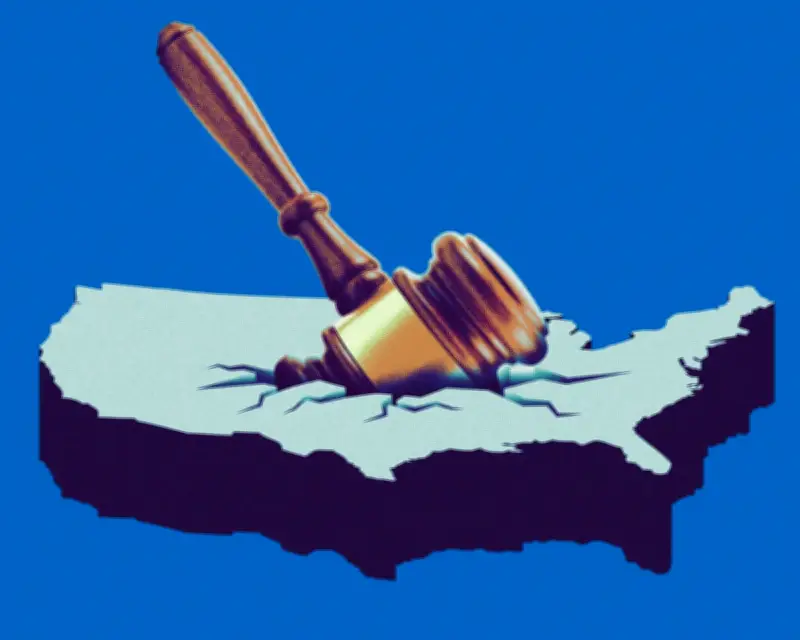
The US Supreme Court has made Donald Trump stronger than ever, showing little inclination to stop his expansive view of presidential powers. Despite a symbolic defeat on birthright citizenship, the court has acquiesced in multiple power grabs, leaving a dramatically transformed political landscape.
Birthright Citizenship Ruling: A Surface-Level Setback
The court's rejection of Trump's attempt to scrap birthright citizenship appeared as a major setback. However, closer inspection reveals a court that has shifted its perception of what is legally possible. Four conservative justices challenged the long-held principle enshrined in the 14th Amendment, with three filing dissenting opinions and one concurring in part. Laurence Tribe, an emeritus law professor at Harvard University, called this shift revolutionary, stating, "The fact that the Overton window has moved ... is revolutionary. It suggests that the republic is hanging by a thread."
Court Adopts Vast Segments of Trump's Program
In multiple rulings, the court has adopted large parts of Trump's agenda. Most significant was Monday's ruling in the Slaughter case, where the court overturned a 90-year-old precedent, allowing the president to fire heads of federal agencies at will. This decision, justified through the unitary executive theory, opens the door to an "imperial presidency," according to critics. Daniel Epps, a law professor at Washington University in St Louis, noted, "What the court has done with executive power has been really significant ... giving the president much greater power over that state."

Weakening Voting Rights and Other Rulings
The court also weakened the 1965 Voting Rights Act, allowing southern legislatures to redraw congressional districts, likely benefiting Republicans. On the same day as the birthright ruling, the court dismissed rights for transgender girls in sports and lifted campaign finance restrictions, benefiting the Republican party, which has $125 million in the black. The court also allowed Trump to strip temporary protected status from refugees from Haiti and Syria.
Shadow Docket and Future Targets
Un explained rulings on the court's "shadow docket" further demonstrate conservative indulgence of Trump. Kim Lane Scheppele, a Princeton professor, predicted that weakening the Voting Rights Act would reduce Black representation in Congress. She compared the court to "packed" courts in Russia and Hungary, noting that such courts occasionally rule against autocrats to maintain legitimacy but ultimately enable their agendas.
Trump's next targets may include Congress and civil servants. Scheppele warned that arguments once considered "off the wall" are now plausible, such as questioning the constitutionality of the civil service. Future rulings could assert presidential power to ignore congressional mandates, propelling the US into uncharted waters. Tribe concluded, "Even King George III had a parliament to worry about, but King Trump, as the supreme court would have it, really needn't worry about much at all."