Trump's Iran Conflict Transforms US Role in Global Order
US allies worldwide are increasingly recognizing that former President Donald Trump will deploy numerous questionable justifications to rationalize his aggressive foreign policy actions. This realization comes as the economic fallout from the conflict in Iran exposes America's dramatic transformation from a guardian of international stability to an unpredictable arbiter of global chaos.
Asian Economies Bear the Brunt of Energy Disruption
The closure of the Strait of Hormuz has created severe energy crises across Asia, where economies import approximately one-third of their consumed energy on average. South Korea imports four-fifths of its energy needs, Japan imports nine-tenths, and Thailand imports 55%, with most originating from Gulf nations. According to International Energy Agency data, about 80% of oil and petroleum products transiting through the strait in 2025 were destined for Asian markets, but maritime traffic through these critical waters has collapsed by 90%.
Governments across Asia have implemented emergency measures to protect their populations. India redirected liquefied gas supplies from industrial uses to households, where it serves as the primary cooking fuel. Nepal instituted gas rationing programs, while the Philippines reduced the government workweek to four days. Bangladesh took the drastic step of closing universities and implementing comprehensive fuel rationing systems.

European Markets Experience Significant Downturn
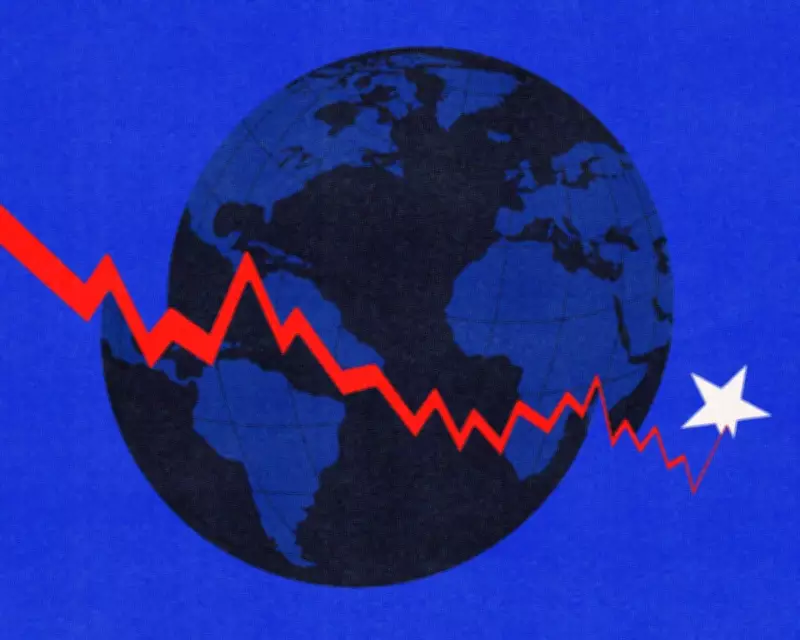
While Europe maintains lower dependence on Middle Eastern fuel sources compared to Asia, the continent faces substantial challenges due to its heavy reliance on imported oil and natural gas. Natural gas prices have surged dramatically since American and Israeli military operations commenced in Iran, creating ripple effects throughout European economies. Equity markets reflect this strain, with the MSCI European stock index falling approximately 11% since the conflict's inception, exceeding the 9% decline observed in Asian markets.
American Economy Demonstrates Remarkable Resilience
In stark contrast to global partners, the United States has exhibited notable economic resilience throughout the Middle Eastern conflict. The S&P 500 index has declined a relatively modest 5% since military operations began, revealing significant insights about America's changing global position. This stability stems partly from America's abundant domestic natural gas resources, which satisfy about 36% of national energy requirements and provide substantial insulation from international price volatility.
International Monetary Fund data underscores this disparity. Before hostilities commenced, the IMF projected 2.4% GDP growth for the United States in the current year, representing nearly 0.4 percentage points above October 2024 forecasts. Meanwhile, economic prospects have weakened for Britain, Japan, Canada, India, the eurozone, and Latin American nations since Trump assumed office.
Global Trade Faces Mounting Disruption
The World Trade Organization has joined other multinational institutions in assessing conflict-related economic damage. If elevated energy prices persist, the WTO forecasts merchandise trade growth will slow from 1.9% to 1.5% this year. North American export expansion would moderate slightly from 1.4% to 1.1%, while Europe would experience export contraction of 0.6% rather than the previously projected 0.5% growth.
Economic growth projections reveal similarly uneven impacts. According to WTO analysis, costly energy would boost North American GDP growth to 2.5% from a baseline of 2.3%, while slowing Asian expansion to 3.1% from 3.9%. Europe would face near-stagnation, with growth slowing to 0.4% from earlier estimates of 1.6%.
Agricultural and Food Security Implications
The conflict's consequences extend beyond energy markets to critical agricultural inputs and food security. Approximately 70% of Brazil's urea imports and 40% of India's essential agricultural fertilizer supplies originate from Gulf nations via the Strait of Hormuz. Gulf countries themselves import the majority of their food supplies, with 75% of rice and over 90% of corn, soybeans, and vegetable oil transiting through the strategic waterway.

Remittance flows represent another vulnerable economic channel. Nations including Bangladesh, India, and Pakistan face inevitable reductions in financial transfers from millions of citizens employed in Gulf countries as regional economic conditions deteriorate.
Environmental Consequences and Energy Alternatives
Paradoxically, the disruption of conventional oil and gas markets hasn't produced positive environmental outcomes. While some climate advocates anticipated accelerated renewable energy adoption, the immediate effect across Asia has been renewed interest in coal as a more accessible and affordable alternative to disrupted hydrocarbon supplies.
Transformed Geopolitical Perceptions
Traditional American allies within the liberal Western order now confront the reality that Trump's United States no longer functions as a reliable partner promoting international stability, but rather represents a primary source of global uncertainty. Allies recognize that the administration will present various questionable rationalizations for belligerent actions, having justified Iranian bombardment by citing imminent nuclear threats shortly after claiming complete destruction of Iran's nuclear program.
This pattern extends to trade policy, where the administration seeks to erect new tariff barriers following judicial rejection of previous efforts, employing dubious arguments about forced labor practices. The international community remains uncertain what justifications might emerge for potential future actions regarding territories like Greenland or strategic assets like the Panama Canal.
Enduring Political Realities
It would be misguided to consider this episode of international aggression an isolated incident or anticipate that American belligerence will conclude following the 2028 presidential election or potential Democratic congressional gains. Tens of millions of Americans within the MAGA political base maintain profound skepticism toward international institutions and foreign nations, perceiving external actors as untrustworthy and exploitative.
This substantial political movement shows no signs of imminent dissolution. Alongside other global risks including Chinese ambitions toward Taiwan and Russian designs on Baltic states, unpredictable American foreign policy actions must now factor into international risk calculations, representing a fundamental transformation in how nations perceive and engage with the United States on the global stage.