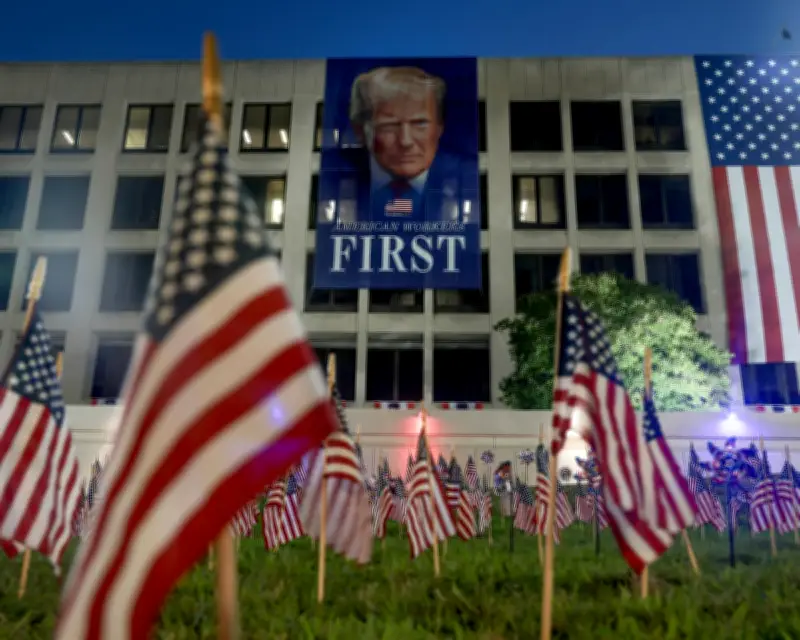
As the United States marks 250 years since its declaration of independence, the nation is deeply divided and anxious about the fragility of its republic, according to Guardian columnist Jonathan Freedland. Writing on the eve of the July 4 celebrations, Freedland argues that President Donald Trump has exposed a fatal flaw in the US constitution: its reliance on human beings to enforce its checks and balances, a duty that many have shirked.
The founders' fears realized
Freedland recalls that from the beginning, confidence in America's future was mixed with foreboding. At the 1787 constitutional convention, Benjamin Franklin famously replied to a woman's question about whether the delegates had established a monarchy or a republic: "A republic, if you can keep it." The founders feared the emergence of a Caesar, a fear that has now materialized with Trump, who Freedland describes as a "would-be emperor" gathering ever greater powers.
The constitution's framers erected multiple barriers against such a figure, including emoluments clauses and a system of checks and balances. Yet Trump has revealed that the constitution "cannot enforce itself." It relies on people—members of Congress, judges, and officials—to uphold it, and many have refused to do their duty.

Concrete evidence of constitutional failure
Freedland points to the aftermath of the January 6, 2021, insurrection as vivid proof. Trump was impeached, but Republican senators "ducked their obligation to convict him and remove him from office." In his second term, Congress has watched as the president gathers more power without stirring. The Supreme Court, intended as the constitution's protector, has enabled the power grab by granting near blanket legal immunity and allowing Trump to fire heads of independent federal agencies, removing another restraint on presidential power.
Freedland notes that Trump personally pocketed $2.2 billion in his first year back in office, launched a disastrous war that strengthened Iran, and dismantled the post-1945 rules-based international order. He and his vice-president seek to replace America's "creedal" national identity with a blood-and-soil ethnic definition.
A shift in perspective
Freedland admits that he once revered the US constitution and the American ideal. His 1990s book, Bring Home the Revolution, argued that Britain could learn from the US system. But the past decade has changed his view. "In Trump, the constitution has come face-to-face with exactly the kind of figure the founders feared—a president who seeks to rule as a monarch, enriching himself and his family," he writes.
Despite America's phenomenal military and economic might, and its head-start on AI, Freedland is not convinced the republic will easily survive. He quotes historian Tom Holland, who notes that the US was "founded as a simulacrum of the early Roman republic. And the lesson of Roman history is that at some point, a republic will become an autocracy."
Hope and uncertainty
Freedland acknowledges that America has overcome civil war, Jim Crow, and McCarthyism. But the current crisis is different because the very people entrusted with upholding the constitution have failed. "Now we have glimpsed it, we cannot unsee it," he concludes, expressing doubt that the republic can easily bounce back once Trump is gone.