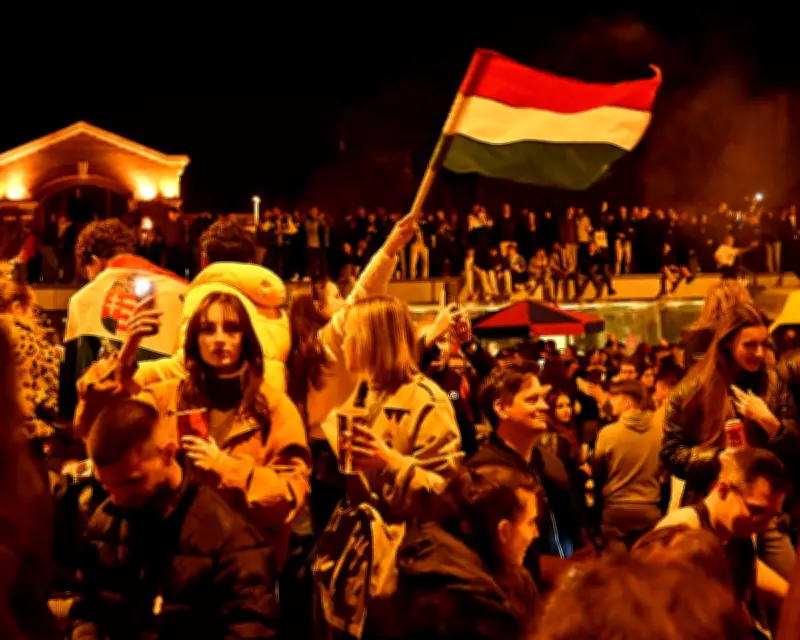
Budapest Erupts in Joy as Tisza Party Secures Landslide Victory in Hungary's Elections
In a historic turn of events, Budapest witnessed jubilant celebrations on Sunday evening as Péter Magyar's Tisza party clinched a decisive victory in Hungary's parliamentary elections. Crowds gathered along the Danube River, chanting patriotic slogans and expressing hope for a restored democracy, marking a significant shift away from Viktor Orbán's long-standing populist regime.
A New Era Dawns with Far-Reaching Implications
The election results are seen as a positive development for Ukraine and the European Union, while posing challenges for Russian President Vladimir Putin and former US President Donald Trump, both of whom have supported Orbán's policies. This victory raises critical questions about whether Hungary can become the first nation to emerge from a deep populist erosion of democracy, often termed "Orbánisation," and whether Europe will provide the necessary support for this transition.
Throughout the weekend, the atmosphere in Budapest was charged with anticipation. On Friday, a massive crowd of young people at a "system-changer" concert on Heroes' Square echoed calls for change, reminiscent of the 1989 protests where a young Viktor Orbán himself demanded an end to communist rule. Now, a new generation is urging the departure of Orbán and his Fidesz party, with chants of "Filthy Fidesz!" and "Russians go home!" highlighting widespread discontent.

Orbán's Weary Regime Shows Signs of Exhaustion
By Saturday, Orbán's final campaign speech in Buda revealed the fatigue of his administration. Despite organized efforts with flags and megaphones, the rally lacked energy, with Orbán appearing hoarse and irritable. Observers noted a stark contrast to his fiery youth, as he now embodies the old guard he once opposed. Reports of paid supporters further underscored the regime's struggles to maintain legitimacy.
Election day brought uncertainty, but record turnout figures fueled optimism. As results poured in, it became clear that popular will had overcome gerrymandering, media control, and alleged vote-buying. In a surprising move, Orbán conceded defeat to Magyar via a Facebook message, prompting immediate celebrations. One young researcher exclaimed, "Voldemort is gone!" capturing the relief felt by many.
Magyar's Vision for a Renewed Hungary
In his acceptance speech by the Danube, Magyar pledged to restore constitutional checks and balances, improve relations with neighboring countries, and strengthen Hungary's role in NATO and the EU. The crowd responded with chants of "Europa!" signaling a desire for reintegration into European structures. With a two-thirds supermajority in parliament, Tisza has the power to enact constitutional changes, potentially overcoming obstacles seen in other post-populist transitions like Poland's.
However, challenges loom, particularly in economics. Hungary's economy is strained, with Fidesz having spent heavily to attract voters. Opaque contracts with Russia and China add to the uncertainty, and Magyar's promises to maintain welfare payments may complicate fiscal recovery. Access to frozen EU funds, totaling around €17 billion, will be crucial for stabilization.
Europe's Role in Supporting Democratic Renewal
The European Union and its member states have a moral obligation to support Hungary's transition, given past failures to curb Orbán's democratic backsliding. Instead of bureaucratic conditions, substantive political measures focused on media freedom and executive accountability are needed. Leaders like German Chancellor Friedrich Merz and Polish Prime Minister Donald Tusk should engage directly with Hungary's new government to foster this change.
Young Hungarians' spontaneous pro-European chants in Budapest suggest a "second return to Europe," echoing the sentiments of 1989. This moment offers a priceless opportunity to demonstrate that recovery from deep populism is possible. As Hungary moves forward, its journey could serve as a vital precedent for other nations, including the United States, grappling with similar challenges.