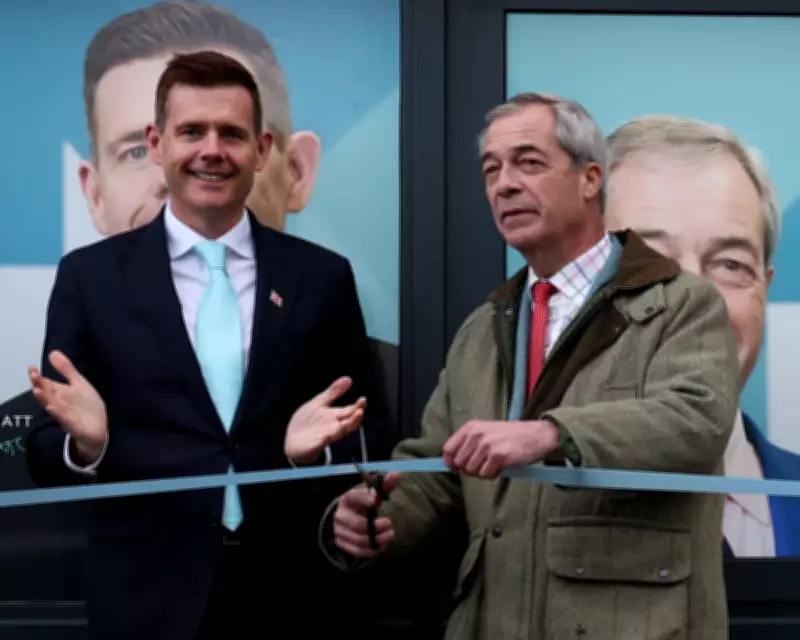
Reform UK's Charmless Candidate Remains a Surprising Contender in Gorton and Denton Byelection
In a stunning political twist, the Gorton and Denton byelection has become a battleground where Reform UK's candidate, Matt Goodwin, defies expectations by remaining a serious contender. Despite his widely criticized persona and controversial policies, recent polling indicates a tight race that leaves Labour struggling to maintain its traditional stronghold.
The Polling Numbers Tell a Surprising Story
New polling data reveals a remarkable shift in voter intentions ahead of this crucial byelection. The Green Party currently leads with 22% support, followed closely by Reform UK at 20%, while Labour trails at just 18%. Perhaps most significantly, 31% of voters remain undecided, creating substantial uncertainty about the final outcome.
These numbers represent a dramatic reversal from traditional voting patterns in what was once considered one of Labour's safest constituencies. The polling trends show Labour's national support has steadily declined from 26% to 18% since January 2025, while the Green Party has experienced a corresponding rise from 8% to 17% during the same period.

The Controversial Reform UK Candidate
Matt Goodwin, Reform UK's candidate, presents what should be an easy target for opposition parties. Described by observers as "utterly charmless" and visibly uncomfortable in public settings, Goodwin has made minimal appearances in the constituency he seeks to represent. His policy proposals include controversial measures targeting women's reproductive choices through the tax system.
Goodwin has suggested punishing women who don't have children through taxation while proposing to remove income tax "for women who have two or more children." This approach continues a pattern of using women's reproductive choices as political footballs in culture wars waged by ambitious politicians.
Further controversy surrounds Goodwin following allegations from a young woman working at GB News, where he presents a show. She accused him of making inappropriate comments she interpreted as sexual harassment, causing significant distress. Goodwin apologized after she filed a formal complaint, but the incident has raised questions about his suitability for public office.
Labour's Strategic Failures
Despite facing what should be an easily defeated opponent, Labour finds itself struggling in this byelection. Keir Starmer continues to claim that "only Labour can beat Reform," even as polling shows his party trailing both the Greens and Reform UK. This byelection should have been a straightforward victory for Labour in what was traditionally one of its safest seats.
Labour's national decline appears connected to a series of strategic missteps that have alienated traditional supporters. The party has faced criticism for its positions on Gaza, benefits policies, and what many see as its imitation of Reform UK's rhetoric on immigration. Additionally, Labour's internal factional warfare against leftwing members and its environmental policy reversals have further eroded support.
The Green Party's Rising Profile
In contrast to Labour's struggles, the Green Party has emerged as a serious political force in this constituency. Their candidate, Hannah Spencer, represents what many voters find appealing: a working plumber and plasterer with firsthand experience of social challenges and practical ideas for addressing them. The Greens have effectively stepped into what political observers describe as "the howling void Labour has vacated."
Throughout the byelection campaign, gambling companies have consistently judged the Greens as the best bet to win, reflecting their growing credibility as a political alternative. Their steady rise in national polling suggests this isn't merely a local phenomenon but part of a broader political realignment.
The Electoral System Debate
George Monbiot emphasizes that the first-past-the-post electoral system remains a crucial factor enabling Reform UK's potential success. He argues that Labour's refusal to consider electoral reform demonstrates that stopping Reform UK isn't actually the party's primary objective. If preventing Reform from gaining power were truly Labour's overriding aim, introducing proportional representation would be the logical response.

Research by Persuasion UK identifies what could be the most effective attack line against Reform UK: highlighting the party's connections to corporate interests, fossil fuel investors, and climate science deniers. The research found that emphasizing how Reform UK represents "the rich, the powerful, his mates in big business" proved far more effective than other messaging approaches.
A Broader Political Crisis
The Gorton and Denton byelection reflects a deeper crisis within British politics. Labour's decline has created space for both the Green Party's progressive alternative and Reform UK's right-wing populism. With 44% of the constituency's population coming from minority ethnic backgrounds, Goodwin's previous comments about what constitutes Britishness add another layer of complexity to the race.
What should have been a straightforward Labour victory has become a three-way contest that could signal significant political realignment. The outcome may indicate whether traditional party loyalties are breaking down and whether single-issue politics or personality-driven campaigns can overcome established political machinery.
As voters prepare to cast their ballots, the fundamental question remains: can Labour recover from its self-inflicted wounds, or has it permanently damaged its relationship with traditional supporters? The answer in Gorton and Denton may foreshadow broader political trends across the United Kingdom.