On a wall inside Andy Burnham’s bustling campaign centre, the signatures of hundreds of MPs, peers, and councillors underscore the massive effort to return him to parliament. “MPs are like buses round here these days,” one Labour volunteer remarks. “You don’t see one for ages, then hundreds turn up at once.”
Voters in this long-neglected corner of Greater Manchester will decide on Thursday whether Labour’s intensive campaigning has paid off in what is considered the most consequential UK byelection in decades.
Barely 24 hours before voting begins in Makerfield, polls suggest Burnham will triumph, and Labour figures are increasingly confident. “It’s really positive,” says Labour MP Rachael Maskell as she climbs into a car stacked with Burnham-branded leaflets on Tuesday afternoon. “I’ve had people take down Reform posters and come back to Andy because they can see it’s so divisive. In the last minutes of reaching a decision, voters are turning to Andy because he’s bringing people together.”
Maskell, who led a rebellion against disability cuts last July, says Labour has “found its values and purpose again” in Makerfield and urges Burnham to launch an immediate leadership challenge if elected. When asked if he could be prime minister by the Labour party conference in September, Maskell says: “I’m optimistic that can happen very quickly … This country is crying out for his leadership.”
Constituency polls give the Greater Manchester mayor a lead of between three and 12 percentage points over Reform. While the “Burnham bounce” is real, the outcome may be decided by another party entirely: the right-wing Restore Britain. Rupert Lowe’s hardline party, which advocates for the death penalty and mass deportations, is predicted to win about 7% of the vote—an astonishing result for a party launched only four months ago. This could be enough to block Reform’s path.
“If Restore weren’t around, Reform would walk it,” says Darren, the Reform-supporting owner of the Triangle snooker club, where Farage hosted a party event last week. Darren, who declines to give his surname for fear of losing customers, says Labour has “hammered” the ground war, but the split among right-wing voters is likely decisive: “Restore will take those votes that will push it Andy Burnham’s way.”
On the streets and social media, energy appears split between Burnham and Restore. A Guardian analysis shows Restore has bought more Facebook and Instagram advertising on Makerfield than any other party—more than double that of Reform.
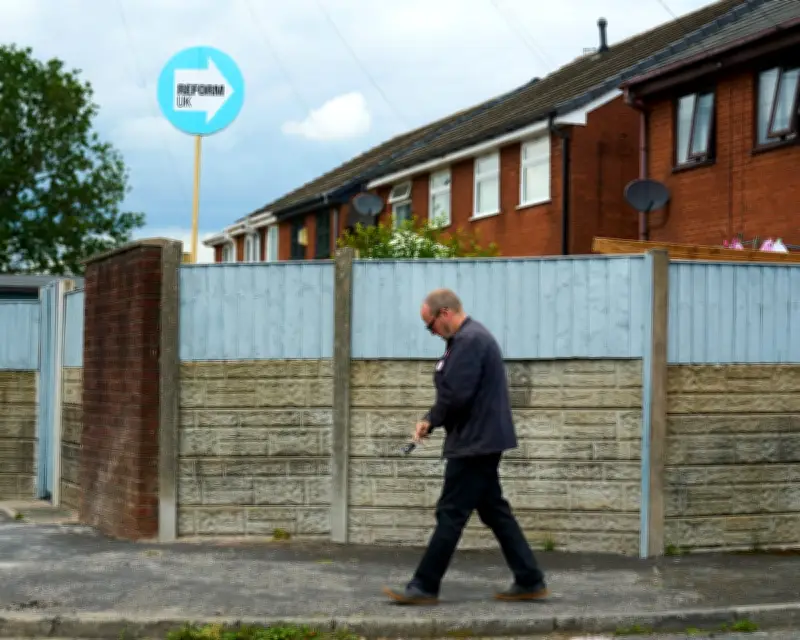
Outside the Triangle club in Stubshaw Cross, Reform’s open-top battlebus, plastered with posters of candidate Rob Kenyon, a plumber, sits empty. Its driver, Trevor Jones, elected as Reform leader of Bolton council in May, drives the bright teal bus across England for party events. He is used to insults, but this campaign, he says, has been “more aggressive than I’ve ever seen.”
Restore Britain activists were filmed last week blocking Reform’s bus with a union flag-branded Land Rover, and Jones says some tried to plaster it with Restore posters. “We should be fighting the same cause, not one another. I bet Burnham is laughing his head off.”
Voters across this semi-rural stretch of former mining villages south of Wigan, where 95% of the population is white British, say the byelection has become increasingly toxic. Reports include Labour placards torn down, neighbours falling out, and divisive rhetoric on local Facebook groups, which a study found this week have been swamped with pro-Reform misinformation.
Speaking beside a Reform placard outside her neat semi in Stubshaw Cross, Pam Flaherty, 70, says people are “turning against each other.” “I had one man spit at my poster,” she says. “He stood there effing and blinding, and I’ve known this man for years.” Flaherty, a retired nursery cook, and her husband Ian, 69, were lifelong Labour voters but joined Reform over concerns about immigration. Pam is now a Restore Britain member but will vote for Farage’s party on Thursday. “People say I’m racist, but I’m not. My knee surgeon was Pakistani, he’s a lovely man; my dentist is Egyptian, and my doctor is Indian—I love them,” she says, adding that she worries about “letting every Tom, Dick and Harry in on the boats and taking over.”
Burnham may be peeling off a small slice of Reform voters, says Prof Rob Ford of the University of Manchester, but the swing is “mainly coming from a squeeze on Lib Dem and Green voters” and “substantial numbers of Tories,” according to polling data. This anti-Farage coalition is based largely in the suburb of Orrell, the most affluent part of the constituency, where Burnham placards are far more numerous than any other.
“This community has been neglected since Thatcher, and people are really angry, but we’ve got two groups, Reform and Restore, coming in stirring that anger towards the wrong people,” says Mal Jones, 64, normally a Green voter, who will vote Labour on Thursday. Jones, a former social worker, says he has seen groups of burly Restore activists “abusing people” and that both right-wing parties are “dividing the community,” adding: “It’s like something from 1930s Germany.”
His friend Peta Prescott, 48, another Green voter backing Burnham, worries about whether the area can come back together after such an intense and polarised campaign. “I don’t know if people realise how far right they’ve fallen,” she says. “They’re just swept up in ‘Stop the boats’.”
Four miles away in the town of Hindley, Lynne Tindall, 70, and the staff at Izzy’s tea room were in raptures about Restore, whose leader visited them on Saturday. None would say who they will vote for, but they were full of praise for Lowe, whom they had not heard of before this byelection. “We need to send the immigrants back,” says Tindall. “We will be a minority in our own country soon.” Her friend Carole Dowd, 64, agrees: “They’re everywhere. It’s like they drop them in the middle of the night. We’ve got no money because we’re giving it to them.”
Helen McDonough, 55, praised Lowe and insisted none of them were racist, pointing to the “lovely lad” who owns the barber shop next door, Hajar Abbasi. Abbasi, 32, who is Kurdish and arrived in Britain nine years ago, says his neighbours at Izzy’s tea room were “really nice to me” and brought him free cakes. But the hostility towards immigrants has left him afraid, he says, one of the reasons he will vote for Burnham: “I’m very worried about this. They are thinking that all immigrants or black people do bad, bad things.”