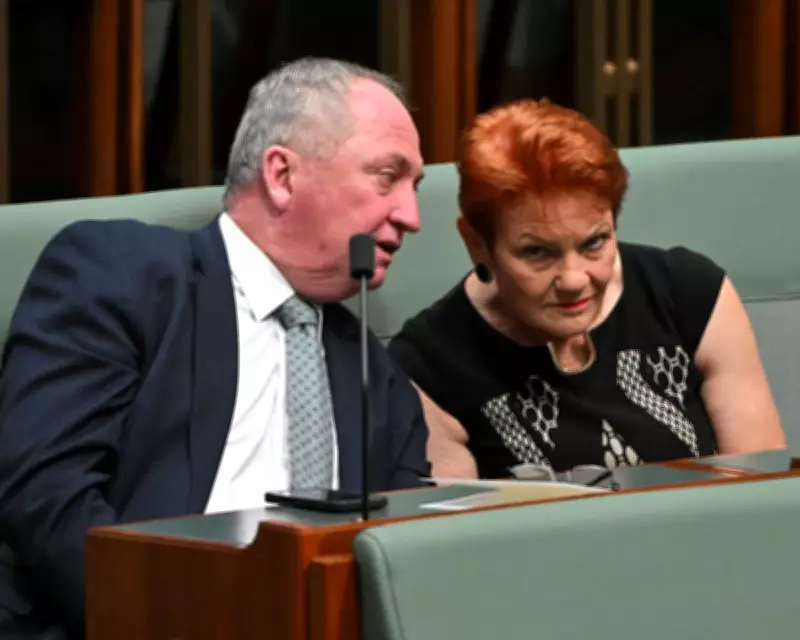
Pauline Hanson Rejects Formal Coalition but Offers Support to Liberals and Nationals
One Nation leader Pauline Hanson has firmly ruled out forming an official coalition with the Liberal and National parties, declaring she will never agree to an arrangement where she is told what to say or do. However, in a significant political development, Hanson has offered to work with the conservative parties to defeat Labor, including through preference deals and supporting a future minority Coalition government.
Political Realignment on the Right
The political landscape in Australia is undergoing a notable shift as One Nation's surging support threatens to erode the traditional voter base of the Liberals and Nationals. This realignment became evident during last weekend's South Australian state election, where One Nation could secure up to four once-safe Liberal seats. The ABC has already called the seat of Ngadjuri for One Nation, with the party also favored to win MacKillop, Narungga, and Hammond.
This electoral success has forced the federal Coalition to apply greater scrutiny to Hanson's policy agenda as they attempt to prevent similar collapses nationwide. Opposition leader Angus Taylor emphasized during closed-door party meetings the need to fight One Nation without alienating their supporters, acknowledging the delicate balance required in this new political environment.

Hanson's Conditional Support
Speaking at a Minerals Council event, Hanson accused the federal Liberals of "bloody-mindedness" for treating One Nation as an enemy. She signaled her party's willingness to engage in future deals, noting that One Nation had previously agreed to preference swaps with the LNP at the 2024 Queensland state election and with the Coalition at the 2025 federal election.
"People want change. They want to get rid of the Labor party, by all means. So as I said, work with me," Hanson declared in a direct message to Taylor and Nationals leader Matt Canavan.
While guaranteeing that One Nation would offer confidence and supply to a future Coalition minority government, Hanson drew a clear line at formal power-sharing. "I will not form a coalition with them, where I will be told what I can say, what I can do, what policies I can put up like they've controlled the National party and shut them down," she stated emphatically.
Internal Coalition Tensions
Within Coalition ranks, opinions about One Nation remain divided. South Australian Liberal senator Andrew McLachlan described One Nation as "not our friends," calling their refusal to direct preferences in SA an "act of war" that only helped widen Labor's margin of victory.
"In my view we should always preference One Nation last. If you hold to Liberal values then you cannot abide by One Nation's negative perspective on our amazing and beautiful multicultural nation," McLachlan argued, highlighting the ideological differences between the parties.
Labor's Perspective
Environment Minister Murray Watt observed that the shifting political dynamics mean the Coalition and One Nation would struggle to govern independently. "The truth is, that in this new era we are living through, the Liberals and One Nation can only form government together," Watt stated during his own address to the Minerals Council.
He warned that "a vote for the Liberals is a vote for the chaos and division of One Nation and a vote for One Nation is a vote for more Liberal cuts," suggesting that this combination would fail to provide the stable, mature government Australia needs.
Upcoming Electoral Test
The first federal test of this new political dynamic will come at the Farrer byelection on May 9th. One Nation and independent candidate Michelle Milthorpe are considered early favorites in the four-cornered contest, meaning Liberal and National preferences could prove decisive in determining the final outcome.
This evolving relationship between One Nation and the traditional conservative parties represents a significant development in Australian politics, with potential implications for future elections and government formation. As Hanson positions her party as a potential kingmaker while maintaining her independence, the political calculus for all major parties continues to shift in this new era of Australian politics.