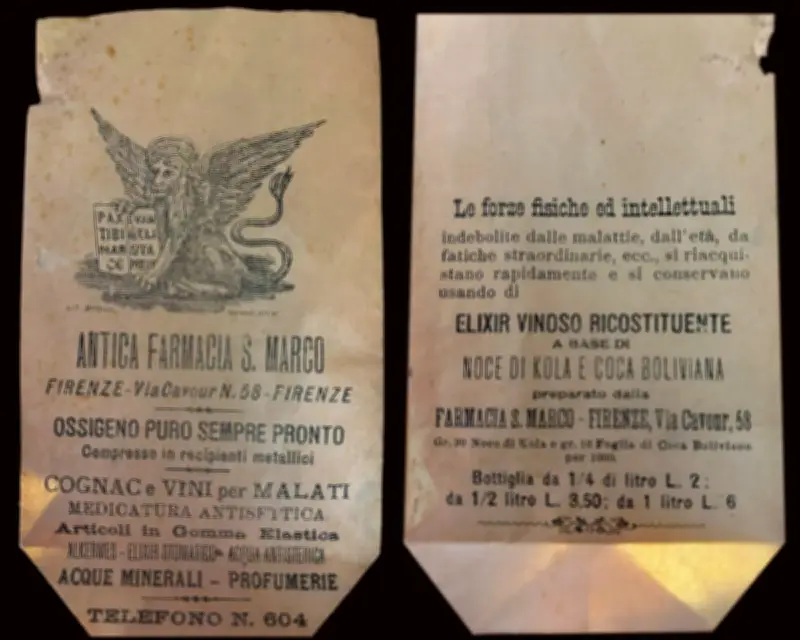
Father Manuel Russo, rector of the San Marco convent in Florence, Italy, uncovered a yellowed document from the convent's pharmacy archives that describes a medicinal potion made from Bolivian coca leaves and kola nuts. The discovery has led to speculation that the friars' creation might have been a precursor to the globally recognized soft drink, Coca-Cola.
Discovery of the Elixir Recipe
The document, a promotional flyer, details the recipe for an "elixir vinoso ricostituente," or restorative wine elixir. It consists of 10 grams of Bolivian coca leaves and 30 grams of kola nut, blended with wine. The friars promoted it as a tonic to combat fatigue caused by illness and aging. Although undated, the document is believed to be from the late 19th century, a time when the friars imported Bolivian coca leaves through missionaries, before their global ban in 1961 due to the alkaloid used in cocaine.
Comparison to Coca-Cola
The recipe bears similarity to that of American pharmacist John Pemberton, who in 1886 created a syrup from coca leaf extract and kola nuts. Unable to use wine due to local alcohol laws, Pemberton mixed the ingredients with carbonated water, eventually leading to the creation of Coca-Cola. After Russo's discovery, local media speculated that Coca-Cola's origins might lie in Florence rather than the United States. However, Russo cautions against drawing direct links, noting that others at the time produced similar coca-based medicines. "I don’t want to attract a lawsuit from Coca-Cola or something like that," he joked. "Mr Pemberton invented his own recipe, and without alcohol … Plus at that time other people were producing this kind of medicine with coca leaves. It was quite common in Italy and France. The only thing I can say is that San Marco’s pharmacy had its own recipe."
Historical Context and Popularity
Russo also found empty bottles that once contained the potion. The elixir's price ranged from 2 to 6 Italian lira—less than a cent in today's euro currency—and it was wildly popular among customers. "Because it had fantastic properties that fought against fatigue, and the fatigue that came with ageing," said Father Russo. "Up until Bolivian coca leaves were banned—because by that point it was understood that cocaine was a problem more than a cure—I would say that it was one of our bestsellers."
San Marco Convent and Pharmacy
The San Marco convent was founded in 1436 on Via Cavour in Florence, with its pharmacy opening in 1460 to serve the local poor. The pharmacy still operates today, though it moved to a different part of the city in 1995. The original premises remain intact, including a crocodile carcass brought from the Nile River, hanging from the ceiling since the 1600s. In 19th-century Europe, chemists often displayed crocodiles and other reptiles to signal access to rare ingredients. Russo also found labels for pure oxygen, cognac, and rectified petroleum spirit. "The inventory in the pharmacy’s archives is incredible," he said.