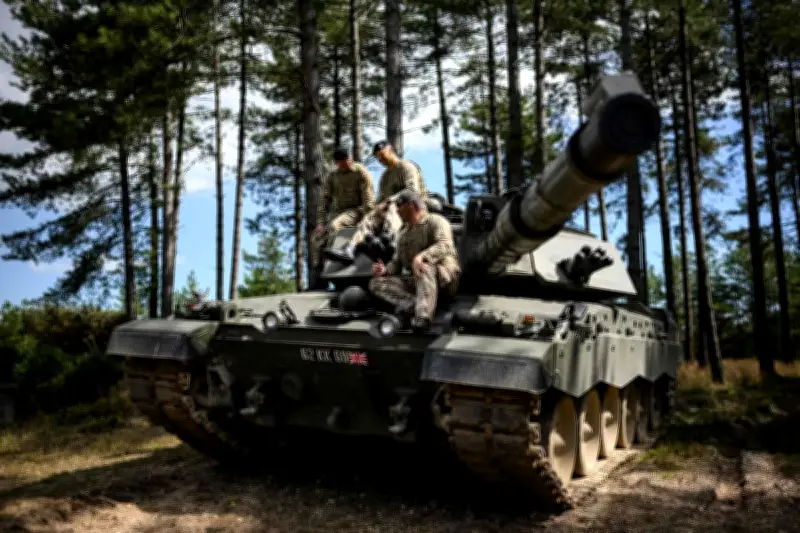
A training session at a Ministry of Defence base in southern England. Photograph: Daniel Leal/AFP/Getty Images
Letters: Defence spending: how to keep Britain safe without wasting money
Readers respond to coverage of the row over the defence investment plan and resignations of John Healey and Al Carns.

Your interview with Al Carns was welcome. Those of us who have visited the procurement headquarters at Abbey Wood in Bristol will recognise exactly what he is describing. But two questions went unasked.
First, given the £18bn defence funding gap, what ballpark contribution could genuinely reformed procurement make to closing it? A rough order of magnitude would sharpen the debate considerably.
Second, and perhaps more telling, Carns said nothing about the restructuring of procurement into the newly titled National Armaments Directorate, which came into being last year. From a former minister who found the system rotten, that silence was deafening.
By coincidence, this week’s honours list offered an instructive contrast. Sir Andy Mitchell received a knighthood for delivering the £5bn Thames Tideway tunnel on time and within budget – genuinely rare for a UK megaproject. Ministers may have gritted their teeth given the Thames Water associations. But Mitchell’s record speaks for itself: ringfenced accountability and hard-won delivery skills that the public sector rarely musters and all transferable to procurement. Would the government consider asking Sir Andy to lend an expert hand at the National Armaments Directorate?
Alan Coppin, Former non-executive director, Royal Air Force board
Al Carns homed in on the key issue about UK defence spending in his resignation speech: not just how much is spent, but whether it is spent effectively. Mr Carns showed he has learned the lessons of Ukraine: a radical shift towards relatively cheap mass drone warfare (air, land and naval), instead of squandering resources on obsolete military procurement strategies: expensive dinosaurs such as the Ajax armoured vehicle and Queen Elizabeth aircraft carriers, to name but two.
A new prime minister would have the chance to bang heads together in the Ministry of Defence to rapidly shift procurement priorities. Drones are cheap and can be manufactured at scale, drawing on Ukraine’s field-tested and pioneering expertise in this. It will also require an equally radical shift in military training, to encompass drone warfare; our Ukraine allies will, I’m sure, be happy to help. I’m sorry Mr Carns is no longer in the MoD to help push this through. I hope he will be brought back.
Dr Martin Treacy, Cardigan, Ceredigion
The fallout over the defence investment plan is rightly provoking a debate about how government money is spent. There are no easy choices when demands for spending keep going up and the country is struggling economically.
To face the current security threats, the UK needs well-funded and modernised armed forces. There is broad cross-party support for this. However, one large part of spending on defence is rarely discussed, namely the money spent on the nuclear deterrent.
In a world where demands on the public purse are only going to get bigger, should there not be a public debate over whether Britain can afford to have both modernised armed forces fit to defend the nation from the new threats posed by disruptive technologies, as well as a modernised nuclear deterrent?
Some will argue that the security environment requires both. Others will conclude that it cannot afford to have both. We should not be afraid to debate this, though. It is not being weak on national security to have a comprehensive discussion on how best to spend the country’s resources.
Simon Cleobury, Head of arms control and disarmament, Geneva Centre for Security Policy
All the focus on defence spending reminds me of when, about 15 years ago, we asked our tour guide in Costa Rica how they managed without an army. His reply: “We’ve got no oil and nobody wants our monkeys.” If only.
Tessa Doe, Seend Cleeve, Wiltshire
John Healey has rightly highlighted the need to properly fund UK defence in an increasingly uncertain world. But this is just one piece of the jigsaw. Labour’s 2024 manifesto affirmed a mission statement “to create a world free from poverty on a liveable planet”.

UK aid spending fell from 0.7% to 0.5% of gross national income (GNI) in 2021. In February 2025, the government announced a further planned cut to aid spending, from 0.5% to 0.3% of GNI by 2027. In November 2025, the UK cut its contribution to the Global Fund to Fight Aids, Tuberculosis and Malaria by 15%.
At the same time, the BBC World Service, which reaches 313 million people worldwide in 43 languages, has seen its budget decline by 21% since 2021. The British Council acts as a global beacon for cultural and educational links with the UK, operating in over one hundred countries and reaching 600 million people worldwide. Yet it too faces a funding crisis.
The late Prof Joseph Nye recognised that power is not just about missiles and tanks. Cultural and civic cooperation matters. He defined “soft power” as “the power to get what you want through attraction and persuasion rather than coercion or payment”.
In a turbulent geopolitical environment, the UK needs robust defence capabilities. But diplomacy and soft power are also key. These levers greatly reduce the potential for global conflict and help us build towards a better world for everyone. We need to ensure that the UK does not slowly and inadvertently lose its position in world diplomacy and global peacemaking through a thousand incremental cuts.
Catherine West, Labour MP for Hornsey and Friern Barnet
The debate about defence expenditure in fractions of percentages of GDP means very little to most people. Better to compare what we spend with what we get for that money. Take France, our closest neighbour, with which we have been entangled for centuries. If Russia is a threat to the UK, it is an equal threat to France. We both have nuclear weapons, although only the French nuclear force is truly independent. Perhaps the only significant difference is that the French have been a little more successful escaping from nostalgia for la gloire than we have been from post-imperial regret.
France spends less than us on defence – $68bn compared with $89bn (2025 figures). But it gets a lot more – 45% more military personnel, more than twice as many naval ships and 50% more aircraft. So, given we are spending $21bn more, if we matched France’s efficiency of spend, we could have more than 300,000 military personnel (not 180,000), more than 200 ships (not 70), and 1,250 aircraft (not 700). Enough to satisfy John Healey?
Why aren’t we? That seems a perfectly reasonable question to ask before piling in with more cash. The official reason is probably that the UK armed forces have a different mission – global Britain and all that. But there are several other possible reasons – a still amateurish Oxbridge-educated civil service compared with a more rigorously École Nationale d’Administration-trained French state bureaucracy; a private sector focused on short-term profit maximisation; long contracting/subcontracting/subsub-contracting chains ideal for profit extraction but beyond our capacity to manage.
Also it’s part of a pattern. The Ministry of Defence may be among the worst. But there are plenty of others – HS2, Scottish ferries etc. We simply don’t seem to be able to do stuff any longer. Marina Hyde summed it up superbly in her recent piece about the very special red box that Peter Mandelson suggested should be given to Donald Trump but would have taken up to two months to make. The whole country seems to be a victim of red-box syndrome.
Peter Scott, London