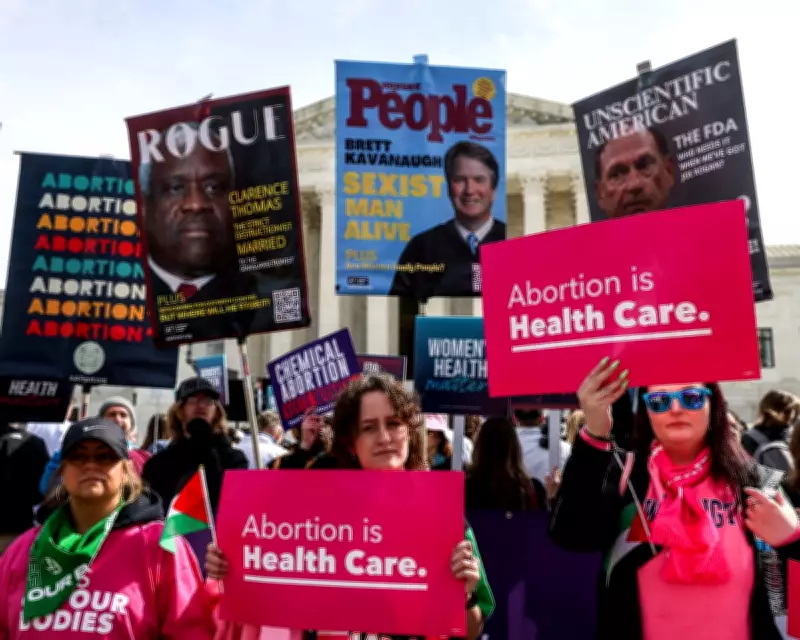
The Supreme Court has temporarily restored full access to the abortion drug mifepristone after a hard-right federal appeals court sought to ban its mailing nationwide. The ruling, issued on Monday morning, came just days after the Fifth Circuit Court of Appeals ordered a halt to telehealth prescriptions and mail delivery of the drug, a move that would have upended abortion access across the United States.
The Post-Dobbs Landscape
Four years after the Supreme Court overturned Roe v. Wade in the Dobbs decision, abortion has receded from the headlines, but the anti-choice movement continues its relentless push to restrict access. The Dobbs ruling fulfilled a decades-long project of the American right, leading to sporadic protests and a patchwork of state laws that have made abortion legal, then illegal, then legal again. Women have been forced to carry unwanted pregnancies, dropping out of school and work, while clinics that served communities for years have shut their doors. The new abortion bans, written in draconian language, often lack exceptions for rape or incest and provide only narrow permission for the life of the mother. As a result, women have died, their names briefly flashing across headlines before fading into obscurity.
The Role of Mifepristone
Mifepristone, a drug available in the US for nearly 30 years, has been a lifeline for women in states with abortion bans. The pill, which stops the development of a fetus by cutting off the pregnancy hormone progesterone, is used in combination with misoprostol to induce abortion. When properly used, the drugs are more than 90% effective during the first trimester and have a lower rate of serious complications than Tylenol. The regimen now accounts for more than 60% of abortions in the United States, many of which occur in Republican-controlled states where the procedure is banned. The pills are ordered online from providers in Democratic-controlled states, protected by shield laws, and mailed to women in Arkansas, Alabama, Idaho, Texas, and Missouri. This access has prevented the mass deaths that occurred in the pre-Roe era, when women sought black-market surgical abortions with high rates of infection and sexual violence.

The Fifth Circuit's Intervention
The Fifth Circuit's order, which temporarily banned the mailing or telehealth distribution of mifepristone nationwide, was an extreme move that would have overhauled how clinics use telehealth to meet demand. The Supreme Court's intervention on Monday morning means that abortion pills remain available by mail for now, but the battle is far from over. Many providers would have switched to a misoprostol-only protocol, which is still largely effective, but others would have stopped mailing pills altogether. The anti-choice movement, with powerful allies in the federal judiciary, continues to seek a nationwide ban.
The Political Silence
Despite the ongoing threats, the American political conversation has moved on from abortion. Democrats seem reluctant to make it a topic of debate in the 2026 midterms, perhaps sensing that the issue's political utility has been exhausted. Feminists, at a low point in their influence, appear out of ideas for expanding or restoring access. But the state-by-state patchwork of women's rights remains untenable, and the ferocity of the anti-choice movement's misogyny has not abated. The Supreme Court has kicked the can down the road, hoping to minimize the issue's salience before the elections. However, this uneasy political settlement will not last forever. The right will seek a nationwide ban, and with the federal judiciary on their side, they already have what they need to get it.