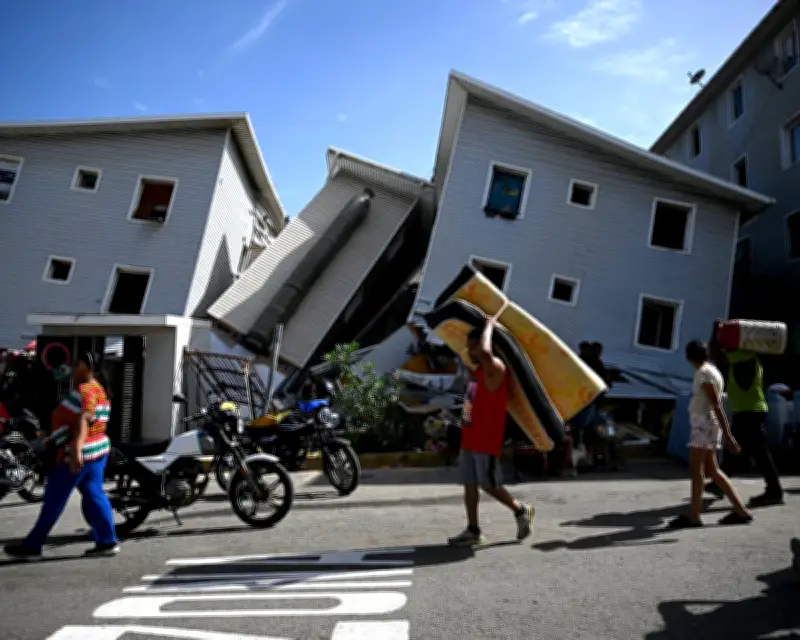
Two powerful earthquakes, measuring 7.2 and 7.5 in magnitude, struck Venezuela's northern coast on Wednesday evening, collapsing buildings and killing at least 164 people, with the death toll expected to rise. The quakes hit within a minute of each other shortly after 6 p.m. local time, sending panicked residents into the streets of Caracas and devastating coastal towns.
Buildings Collapse in Affluent Caracas Neighborhoods
In the affluent Los Palos Grandes and Altamira neighborhoods of Caracas, at least three residential buildings collapsed entirely, reducing them to piles of masonry and twisted steel. Emergency workers, volunteers, and relatives rushed to the scenes, hoping to find survivors. Jessica Galvis, 33, a critical care physician, waited outside a fallen six-floor building where she believed a female friend was buried. "There is so much rubble," she said.
José Morillo, 61, raced across town on his motorbike, praying his trapped family members would be found alive. "My brother, my son and nephews are all inside," he said. A female relative was later pulled from the ruins, seemingly still alive.
Residents Describe Fear and Devastation
Sebastián Rodríguez, 18, whose family runs a shop in the Centro Plaza commercial center in Los Palos Grandes, described the terror. "It was horrible. I felt like the house was moving to a different rhythm to the earth. I had to carry my mum out. She was paralysed by fear," he said. The robust concrete structure of Centro Plaza, built during Venezuela's 1970s oil boom, appeared spared, but surrounding areas were less fortunate.
In the working-class area of Catia, residents already struggling with a severe economic crisis faced further devastation. José Luis, a PE teacher who lost his home, said, "My walls have crumbled. There's water coming in through the roof. The quake lasted so long and it smashed everything." He was too frightened to return indoors and planned to sleep on the street.
Coastal Towns Hit Hard, Airport Closed
The situation was even worse in coastal areas north of Caracas. The international airport in La Guaira was closed after sustaining severe damage, hampering humanitarian efforts. Social media videos showed panicked travelers sprinting for cover as the terminal roof caved in. Dozens of tower blocks and buildings, including at least one beachfront hotel, collapsed in the port city and nearby Catia La Mar.
Catia La Mar had already been impacted by a U.S. missile strike on January 3, part of an operation to abduct President Nicolás Maduro. Several buildings there were damaged by air-to-surface missiles targeting defense systems. On Wednesday, the community again faced disaster. With phone lines down, the fate of many residents remained unclear.
Official Death Toll and Rescue Efforts
The official death toll stood at 164 on Thursday morning and was expected to rise. Former President Donald Trump, who had ordered the January invasion, warned of "a devastating number of deaths," adding, "We will be there for our new and great friends." Social media filled with photographs of the missing, including an eight-year-old boy named Brayne and a five-year-old girl named Miranda. In one dwelling, five members of the same family—Luisa, Ángel, Carmen, Yepxalit, and Andrea—disappeared.
Amid the despair, there were moments of hope. At about 1:30 a.m., rescue workers freed three siblings buried under a pancaked building in La Guaira. "God, you are great!" a local man exclaimed as the children were pulled from the concrete, shaken but alive.