From Albania to Portugal, privatisation of the coastline is bringing locals out on to the streets. For them, the economic benefits are few and far between. Recent protests are focusing on the financial backers of overtourism, rather than individual holidaymakers.
Protests in Portugal and Albania
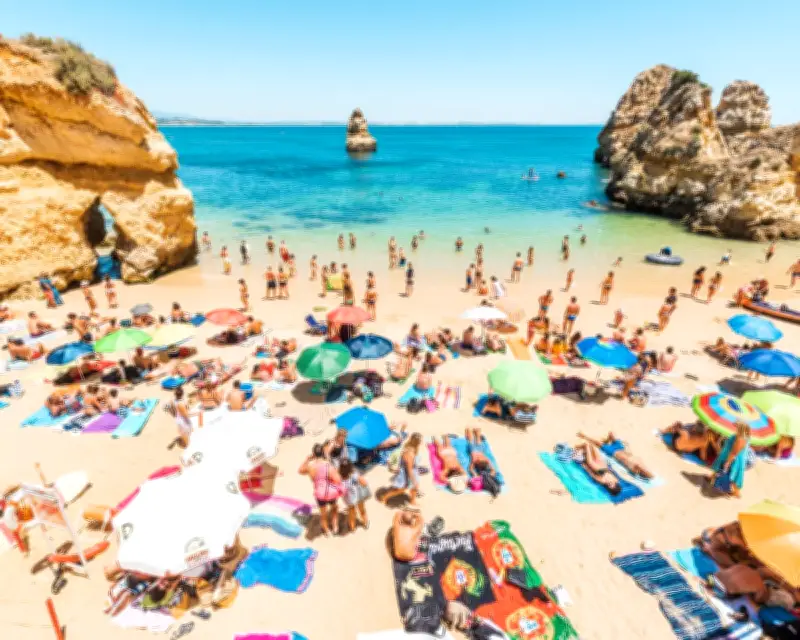
Two weeks ago in Portugal, hundreds of protesters marched along the winding roads of Parque Natural da Arrábida in an attempt to block the privatisation of five beaches by a luxury real-estate firm. Residents of Setúbal, a working-class coastal city just south of Lisbon, invoked their memories of learning to swim in Arrábida’s frigid waters and insisted their children should enjoy the same right. Demonstrators chanted that “Arrábida is not for sale” and held signs that read “No to new kings”.
The language clearly resembles that emerging from Albania, in response to Ivanka Trump and Jared Kushner’s plans to build a luxury hotel on the island of Sazan and develop the nearby Zvërnec peninsula. Trump’s wanderlust-laden ambitions have generated the country’s largest uprisings since the fall of communism, bringing tens of thousands on to the streets of Tirana in protest. What the media has termed the “flamingo revolution”, where environmentalists raised concerns over the planned disruption to the area’s natural habitat and delicate ecosystems, has transformed into a national debate about corruption, oligarchic interests and luxury tourism in the Adriatic nation.

Impact on local communities
These features map closely on to the scenes on Portugal’s Atlantic coastline. Arrábida was classified as a biosphere reserve by Unesco last year, recognising the interconnected beauty of its pine forests, long sandy beaches and intergenerational traditions of fishing, olive cultivation and wine production. Not unlike the Trump-Kushners, the Mirpuri family, reportedly behind the privatisation push, are a well-connected business dynasty. They made their fortune in commercial aviation and have been awarded Portuguese government contracts. Abroad, they have been accused by campaigners of having leased their fleet to carry out deportation orders, including for the UK Home Office.
A protester interviewed by TVI explained that many are drawn to this fight because they have already experienced the loss of Tróia – an adjacent peninsula now referred to as the “Hamptons of Portugal”, which reportedly hosts properties owned by Nicole Kidman, George Clooney and the Duke and Duchess of Sussex. The battle for Arrábida reflects many of the recent changes that now threaten Portugal’s way of life. Going to the local beach is an important ritual for Portuguese families in coastal areas. But while its surging economy and fiscal responsibility is lauded in the Economist and the Financial Times, more than a third of the population can no longer afford to go on a week-long holiday.
Broader economic issues in southern Europe
Other southern European nations are facing similar conditions. Cyprus typically welcomes more than a million British tourists every year, but has one of the highest emigration rates in the EU. In Greece, almost half of residents cannot afford a week’s holiday to their own picturesque islands. In Spain, youth unemployment stands at 24%, despite a growing economy. There is clearly a mismatch between the rosy economic outlooks trumpeted in the halls of Brussels and Frankfurt, the stream of budget flights and private jets landing on scorching runways, and the reality of what it is like to live in these holiday destinations.
It’s no accident that these nations are now more dependent than ever on foreign capital for survival. Albania’s experience of capitalist shock-therapy in the early 1990s laid the groundwork for what would later be rolled out across southern Europe. The mass privatisation and economic liberalisation prescribed by the International Monetary Fund was later administered again, this time with the help of the EU and the European Central Bank, to Nicosia, Athens, Madrid, Rome and Lisbon, in the form of conditional bailouts.

The real villain: big business
In some ways, the regimen worked. It is now the “Pigs” nations of Portugal, Italy, Greece and Spain that reign supreme, according to indices that matter only to technocrats. But these reforms have also made these places less adept at delivering infrastructure such as roads and hospitals, while deregulating their housing markets to allow for the inflow of private capital. These economies became more attractive to tourists with thousands to spend and investors with millions to shell out, but they are failing to develop the goods and services that local populations actually need.
The issue is not the tourists themselves, who are desperately in need of a break from the doom and gloom that besets much of present-day Europe. The problem is the private interests that have embedded themselves deep in our lives, and European governments prioritising those interests over the freedom and agency of local populations. Earlier this week, MEPs warned Albania that if it does not “change course” over Kushner’s luxury resort plans, its accession to the EU will be at risk. As actions in defence of coastal communities go, this is a good start. But unless there are further such interventions, sunny holidays to the southern peripheries will continue to be marked by fraught expressions of anger and resentment.