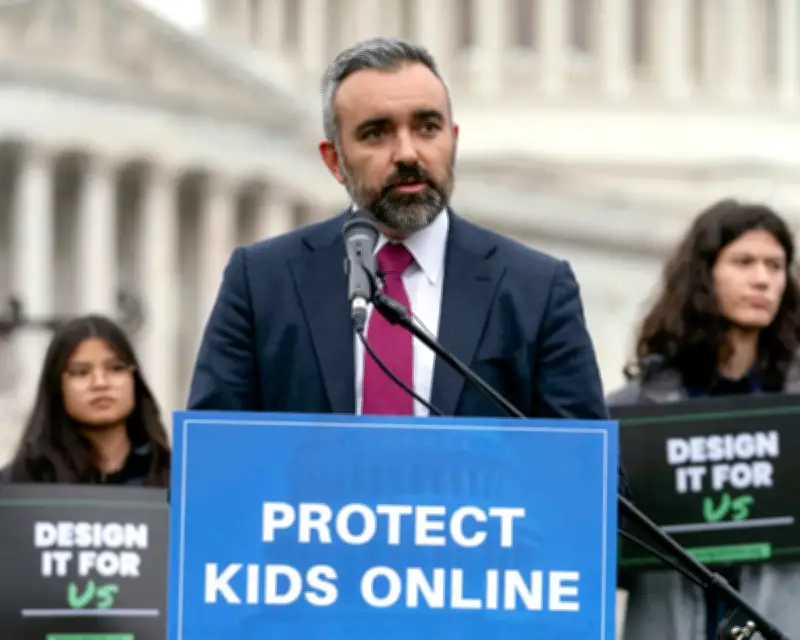
New Mexico's attorney general, Raúl Torrez, is working with state lawmakers to draft two new bills aimed at bolstering consumer protections and child safety online, capitalizing on a landmark court victory against Meta earlier this year. The legislation, expected to be announced in the coming weeks, will build on the state's case against the parent company of Facebook, WhatsApp and Instagram. A jury found in March that the company misled users about platform safety and enabled harm, including child sexual exploitation, resulting in a fine of nearly $1bn.
Landmark Case and Legislative Push
The trial was the first to hold Meta liable for harmful acts committed on its platforms. It followed a 2023 Guardian investigation that exposed how Facebook and Instagram had become marketplaces for child sex trafficking. Torrez is pursuing additional lawsuits, including a second case against Meta and one against an AI company whose chatbot has become a source of emotional attachment for children.
In an interview with the Guardian, Torrez said the proposed laws would go beyond social media, creating a broader consumer protection framework for emerging technologies, including artificial intelligence and chatbots. He has also had preliminary discussions about the legislation with Deb Haaland, the former US interior secretary and Democratic nominee for New Mexico governor, who expressed support for his efforts.
“I think there’s a lot of momentum coming out of our victory in court, and the idea is to build on that momentum,” said Torrez, who is running for re-election this year.
A Meta spokesperson said: “We have strict, longstanding rules against child exploitation and have invested billions to fight it, both through proactive detection technology and safety features designed to prevent harm.” The company cited its record on sharing the amount of child sexual exploitation content it removes, including 36m pieces from Facebook and Instagram in 2025. The spokesperson added that Meta had spent the last decade working to support young people using its apps, particularly through the introduction of “teen accounts”.
New Suits and Court Rulings
Earlier this month, a judge ordered the company to pay $567m as part of the second phase of the case. The money will primarily fund youth mental health treatment, with the remainder directed toward awareness, prevention and screening services. The court also imposed reforms lasting five years, including age verification, enhanced safeguards against child sexual exploitation, overnight limits on push notifications, and mandatory time-use limits for users under 18.
The judge’s ruling followed a seven-week trial in which a jury found that Meta knowingly harmed children’s mental health and concealed what it knew about child sexual exploitation. The jury imposed the maximum penalty available under state law, a $375m fine, bringing Meta’s total liability across the two phases to $942m.
“We disagree with the ruling and will appeal,” said a Meta spokesperson.
Torrez’s office is also pursuing another case against Meta, with a trial involving data privacy and civic harms expected to begin in September. Additionally, the attorney general’s office is filing a lawsuit against an AI company over a chatbot that children have been known to form bonds with, with the case likely to be filed in the “relatively near future”.
Evidence and Legal Battles
Reflecting on the first phase of the trial, Torrez said the evidence that most shocked him was “the depth of what they knew about not only the mental health problems that were occurring on the platform, but also the pervasiveness of child sexual exploitation”. The evidence came in part from internal emails obtained by the state during discovery. “A lot of times, when we are dealing with corporate misconduct and we start investigating, we rarely see that kind of history of and depth of knowledge that was apparent in Meta’s case,” he said.
Meta fought hard to prevent the disclosure of the emails, bringing “nearly 50 lawyers”, Torrez said. The legal battle also briefly raised the prospect of Meta withdrawing its services from New Mexico. In April, Meta threatened to block access to Instagram, Facebook and WhatsApp in New Mexico – a move that would have been unprecedented in the US. Torrez dismissed the threat as a negotiating tactic: “It seemed to me at the time to be a bluff that was intended to either shape the court’s determination or to bully the state of New Mexico.”
Potential Blueprint for Other States
The New Mexico lawsuit was the first of several the company faces. In March 2026, a Los Angeles jury found Meta and YouTube liable for designing intentionally addictive products that harmed a young user. Meta is now facing a separate federal trial in Oakland, California, as part of a 29-state multidistrict lawsuit filed in 2023. The trial involves California, Colorado, Kentucky and New Jersey, while eight other states, including Tennessee, have brought separate cases in state courts.
Torrez said the New Mexico case has generated interest from other potential plaintiffs. “There is substantial interest, not only in with state attorney generals, but in smaller municipalities, school districts, private plaintiffs and others to look at the work that we’ve done here and to try and replicate it,” said Torrez.
The potential damages in the broader state attorneys general litigation could exceed $1.4tn, according to a July court filing by Meta, putting the lawsuits on a scale that could potentially pose an existential threat to the company.
A Meta spokesperson said: “The State AGs may call this a landmark case, but their limited claims are unsubstantiated and their financial demands are vastly disproportionate. The AGs offer no proof anyone in their states was misled, claim benign features such as having an additional Instagram account somehow harmed their residents, and attempt to penalize Meta for industry-wide challenges like age verification.”
Despite the victory, the New Mexico ruling did not grant all remedies sought by the state. New Mexico had sought $3.7bn as part of an abatement plan to fund child mental health services. The judge declined several measures, including proposals to de-encrypt children’s messages and appoint a child safety monitor to oversee Meta for five years, finding that some measures were more appropriately considered by the legislative branch.
One of the bills state legislators are writing would remove caps on penalties for violating consumer protection laws in New Mexico, Torrez said. “And so, what we are going to do is, continue to lobby Congress for that, but also to work at the state level to try and build not only a comprehensive social media safety bill, but also to reform and update our consumer protection laws,” he said.
Torrez believes the issue ultimately requires federal legislation but argues that states cannot wait for Congress to act. “There hasn’t been any willingness by Speaker [Mike] Johnson to really put forward a forceful piece of legislation, a strong piece of legislation that would protect kids online,” said Torrez. “I think it’s a pretty straightforward case of the lobbying power of big tech on Capitol Hill.”
For phase two of the New Mexico trial, the state proposed actions Meta could take to “remedy the harms the company has created for users under 18”. The state sought to require Meta to deploy age-verification tools, delete personal identifying information collected during verification, block children under 13 from using its platforms, and require all users under 18 to have an associated guardian account. Requiring age verification is controversial due to privacy and free-speech concerns.
“The judge did not go as far as we would have liked on age verification,” said Torrez, who concedes that concerns about data privacy are valid. “My instinct is that this will be a process that evolves over time because it’s a five-year period that Meta is under the court’s jurisdiction in terms of compliance, and obviously we have to wait for the appellate process to play out before all of those terms are fully in effect,” said Torrez.