
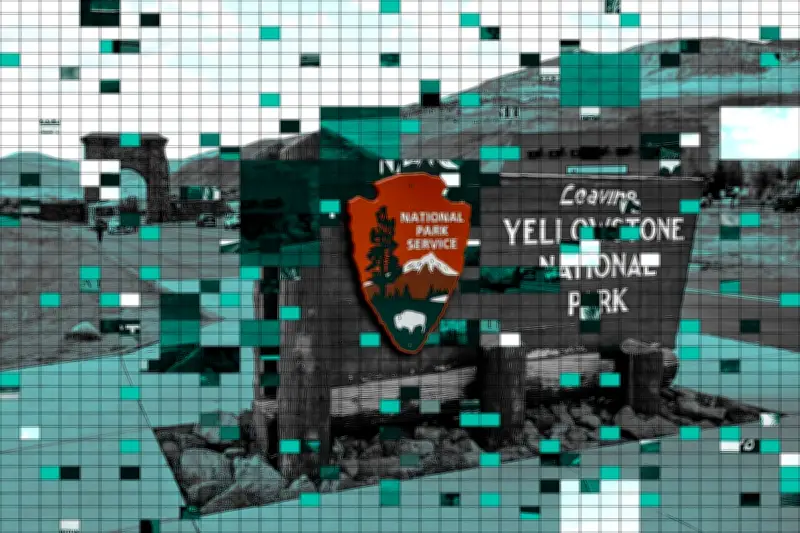
Sanitized history in national parks
The Trump administration has raced to reconstruct a version of US history they prefer across national parks and federal lands, removing scores of signs that mention slavery, Native American genocide, and climate change. Critics say the administration is trying to whitewash history, erasing the stories of anyone who is not white, wealthy, Christian, or male.
Jerry Bransford, a former US National Park Service (NPS) ranger, has a deep connection to Mammoth Cave in Kentucky, where his great-great-grandfather, Materson “Mat” Bransford, was an enslaved guide in the mid-19th century. Mat was rented out by enslavers for $100 a year and became an expert in the cave system, leading guests like Emperor Dom Pedro of Brazil. A sign at Mammoth Cave commemorating five generations of Bransford guides is now at risk of removal.
Leaked database reveals extent of censorship
The Guardian reviewed thousands of images and files from a leaked database of nearly 2,000 flagged park materials, submitted by NPS staff after a May 2024 executive order gave them three months to review all content. With little guidance, employees used methods like “put on [their] white supremacist hat” or asking “What would my bigoted neighbor not want to read about?” to flag items.
Examples include a sign at the National Mall referencing enslaved dock-workers, where the submitter asked, “is the word ‘enslaved’ ok here?” At Cape Hatteras, signs about sea level rise were flagged for reducing “focus on the grandeur, beauty and abundance.” At Little Bighorn battlefield, staff used ChatGPT to determine if signs mentioning US “harsher policies” and “hunger for land and gold” violated the order.
At least 60 signs removed across 38 parks
An official list, revealed after a court order, shows at least 60 signs removed across 38 parks, from Alaska to the Virgin Islands. Examples include a water bottle refilling station sign at Fort Sumter asking to reduce plastic waste, and a panel at Jamaica Bay wildlife refuge mentioning “events we hope never to repeat.” The Department of the Interior noted in a court filing that the list is incomplete.
“It’s pretty tragic what’s transpired,” said Bill Hayden, a former interpretive specialist at Glacier national park for 31 years. Developing signage was a deliberative process involving scientists and historians, he said. “I was never in a situation where I felt an administration was dictating what could or could not be shared with the public.”
Progress turned back on inclusion
Stories about slavery, racism, and climate change were most at risk, according to the Guardian’s review. The NPS began including more complete histories in the 1990s, such as slavery as a cause of the Civil War, and established parks like Manzanar (Japanese American incarceration, 1992) and Stonewall (LGBTQ+ history, 2016). In just one year, the Trump administration reversed much of that progress, said Gerry Seavo James of the Sierra Club’s Outdoors for All campaign. “The goal now is just to sell a whitewashed and sanitized view of that history.”
Shane Doyle, a member of the Crow tribe and Indigenous relations director for the Nature Conservancy, noted that Yellowstone’s history omitted Native peoples for over a century. “For Native people, this ain’t our first rodeo. We’ve endured racism, we’ve been dehumanized since the very beginning, we’ll ride out this storm.”
Pushback and legal challenges
Some parks staff turned the order on its head, reporting existing signage disparaging to Native Americans. At Padre Island, staff flagged an exhibit incorrectly stating the Karankawa people perished; at Horseshoe Bend, a monument “disparages and incorrectly honors destruction of the Muscogee (Creek) Nation.” Others submitted minor items, like a sign about a drunken lockkeeper, to comply.
A federal judge blocked further removals in June 2025, ordering restoration of all signs. “This Administration seeks to share a limited history by ordering the removal of all signs … thereby telling half-truths,” wrote US district judge Angel Kelley. The administration appealed, and the case continues. “We’ve won that particular battle, but I’m not sure we’ve won the war yet,” said Bill Wade of the Association of National Park Rangers.
A true American story at Mammoth Cave
At Mammoth Cave, the Bransford family’s history was nearly lost when the park expelled residents in 1941. Jerry Bransford became a ranger in the early 2000s to reclaim his heritage, restoring the Bransford Cemetery. “I’ve done my best to tell America a true American story of people of color,” he said. Reflecting on possible erasure, he added: “What more do you want to take away from them? … Haven’t they given enough?”




