
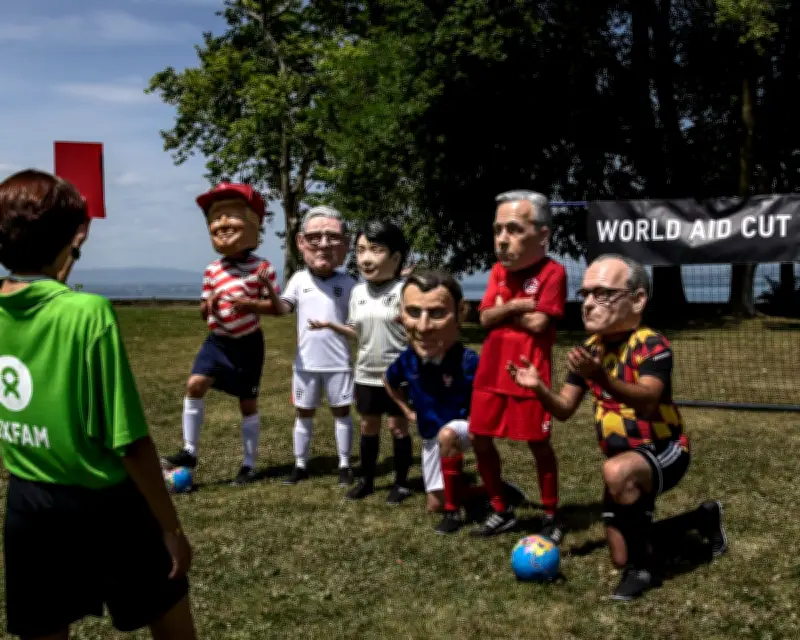
Oxfam activists dressed as G7 heads of state protest at the summit in Evian, France, on 15 June 2026. The image captures a moment of political theater, yet the underlying message is one of deep frustration with a system that seems to be unraveling on its own.
A Shift in Protest Tactics
Twenty-five years ago, 200,000 protesters gathered in Genoa for the G8 summit. Their message was clear: eight wealthy nations should not dictate global rules. The movement, part of a broader anti-globalization wave, had honed its tactics in Seattle in 1999. But authorities had also learned, leading to a heavily fortified red zone and police brutality that shocked the world's liberal media.
Genoa's no-fly zone, justified by terrorism concerns, seemed paranoid even before 9/11. The protesters, mostly anti-capitalists, posed no aerial threat. Yet the question remains: did subsequent G8 anti-poverty initiatives stem from this activism? The inside/outside coherence between street activists and NGOs insisted that a rules-based order must be pro-social or lose moral authority. The G8 would never admit influence, and protesters saw anti-poverty efforts as a neoliberal smokescreen.
The Modern G7: A Different Battle
Fast forward to the recent G7 summit. Protests were smaller—around 20,000—and met with police kettling overnight. The target was simpler: grotesque wealth inequality. Protesters burned a Tesla, a stark symbol given Elon Musk's rise as the world's first trillionaire, with wealth now at $1.4 trillion. The distance from the average person to Musk is greater than from the average person to the second-richest man.
National governments seem paralyzed. They bemoan Musk's calls for civil unrest but focus on banning social media for under-16s. Social media misrepresents truth for profit, but governments delay confronting concentrated private capital. Torching a Tesla highlights state weakness.
Germany's Friedrich Merz hailed the summit's common language on Ukraine, but Donald Trump remains a wild card. His opaque relations with Vladimir Putin and coercive stance toward Volodymyr Zelenskyy undermine unity. Trump's threats against Iran further expose disarray. A rules-based order cannot function when only most participants follow the rules—it's like football with a horse on the pitch.
Leaders appear personally insecure. Emmanuel Macron fretted about Trump leaving early; Keir Starmer wondered if he was excluded from a meeting. Each success statement is undercut by images of power unraveling. Their only unity is in pretending unity holds.
Protest remains vital, but the enemy is no longer strong, confident states. Instead, it is the richest man in the world—a trillionaire beyond national control.




