
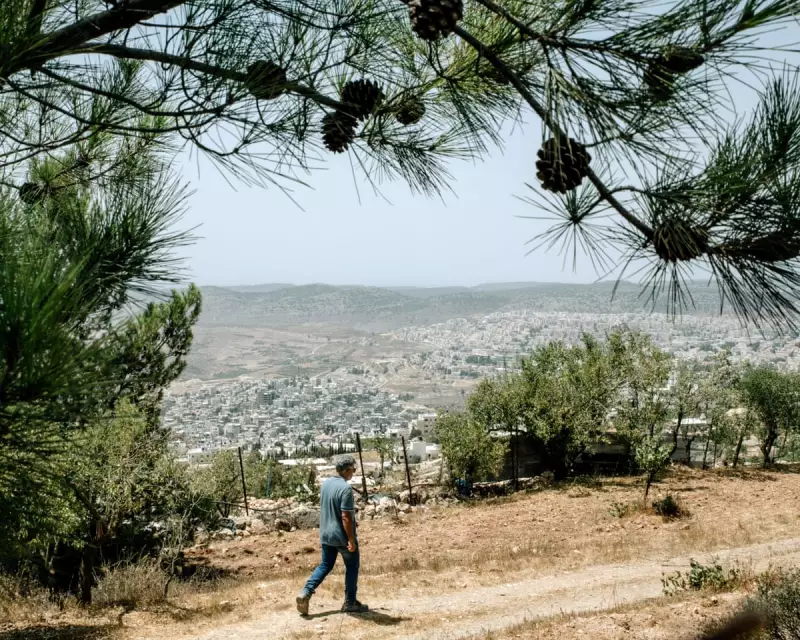
In the olive-clad hills near Nahalin in the occupied West Bank, a Palestinian family is engaged in one of the territory's longest-running legal battles. For more than 34 years, the Nassar family has fought Israeli authorities' attempts to reclassify their 42-hectare farm as 'state land', a move that would pave the way for its confiscation.
A Century-Old Deed and Unbroken Legacy
The family's claim rests on a formal deed of purchase from 1916, when Daher Nassar bought the land and registered it with the Ottoman authorities. In an unusual and prescient move, the title was subsequently re-registered under every successive administration: the British Mandate, the Jordanian government, and, after 1967, under Israeli occupation.
"I received this land as a gift," says Daoud Nassar, 55, the current owner and Daher's grandson. "My grandfather gave it to my father, who gave it to me and to my brothers and sisters. For us Palestinians, the land is a gift – and a gift cannot be sold or given away."
Life Under Siege in Area C
The farm lies in Area C of the West Bank, under full Israeli military and civil control. This status means the family cannot obtain permits to build any permanent structures. They live partly in natural caves on the property and have been without direct access to public water or electricity since 1991, when Israeli settlers cut the connections.
Hemmed in by five illegal settler outposts—one built directly against their boundary fence—the Nassars must water hundreds of olive trees by hand, carrying buckets under the harsh sun. Since the Hamas attack on 7 October 2023, land seizures and settlement expansion in the West Bank have accelerated dramatically.
"The settlers attack us constantly," Nassar reports. "They destroy our water tanks, build roads across our land, block our access, and uproot our trees." In 2002, settlers uprooted over 250 olive trees; in 2014, the entire apricot harvest was destroyed.
The Legal Labyrinth of 'State Land'
The family's struggle began in 1991 when Israeli authorities served notice to declare the farm 'state land'. Legal expert Sliman Shaheen explains that Israel has used the absence of continuous land registration from the Ottoman era to confiscate vast areas. Official data shows that of over 900,000 donams (approx. 900 sq km) declared state land, only 0.7% was allocated to Palestinians, while 37% went to settlers.
Despite the Nassars' unique position of holding a continuous, registered title (a 'tabu'), and despite the Israeli Supreme Court ruling twice in their favour, the military appeals continue. "We spent decades in front of a military court and years in front of the supreme court," says Nassar. "Ruling after ruling, the Israeli army is still appealing."
The Tent of Nations: Global Solidarity on the Ground
Farming under occupation is both a livelihood and an obligation; if cultivation stops, land can be seized. To maintain their claim, the Nassars launched the Tent of Nations project. Since 2000, hundreds of international volunteers from countries including Italy, the UK, France, Spain, and the US have travelled to the farm.
These volunteers provide a vital workforce and a protective presence. Gloria Ghetti, a schoolteacher from Italy, was one such volunteer. "When I read about the attacks by settlers, I felt I had to do something," she said. "I had to get my hands dirty."
The family's response to provocation is one of non-violent resistance. "They cut off our electricity, so we installed a solar system. They deny us water, and we rely on rainwater tanks," Nassar states. "We chose to believe in justice."
The Israeli Defence Forces did not respond to requests for comment on the case. Israel consistently rejects accusations of ethnic cleansing and maintains that settlement activity is not illegal under international law. For the Nassar family, the fight for their grandfather's gift continues, one bucket of water and one court hearing at a time.




