
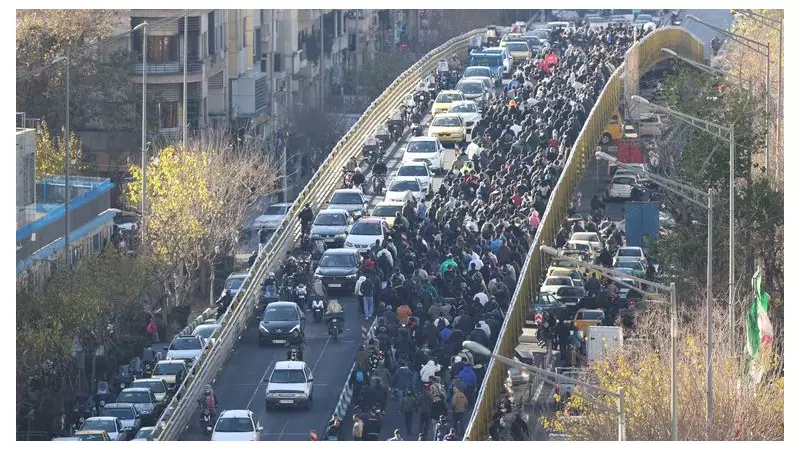
University students across Iran's capital have taken to the streets, joining a growing wave of public anger over the country's severe economic crisis and soaring cost of living. The demonstrations, which began with shopkeepers and bazaar merchants, escalated on Tuesday 30 December 2025, highlighting deep-seated public frustration.
Economic Freefall Fuels Public Anger
The protests are a direct response to a dramatic economic collapse. Iran's currency, the rial, has lost nearly half its value against the US dollar in 2025 alone. Official figures place the annual inflation rate at 42.5% in December, with the price of essential food items skyrocketing by as much as 72%. This economic turmoil is unfolding as Iran contends with the ongoing impact of US sanctions and persistent threats of military strikes from Israel.
Footage from the protests showed scores of people marching through central Tehran. Chants heard in the crowds included "rest in peace Reza Shah", a pointed reference to the founder of the Pahlavi dynasty overthrown in the 1979 Islamic Revolution. The semi-official Fars News Agency reported that hundreds of students held demonstrations at four separate universities in Tehran on Tuesday, with further gatherings documented in the city centre on Monday.
Government Response and Underlying Causes
In a notable move, the Iranian government has acknowledged the unrest. President Masoud Pezeshkian stated he instructed the interior minister to heed the "legitimate demands" of those protesting. A government spokesperson confirmed on Tuesday that a dialogue mechanism would be established to include talks with protest leaders. "We officially recognise the protests," the spokesperson said. "We hear their voices and we know that this originates from natural pressure arising from the pressure on people's livelihoods."
These are the first major public demonstrations since June 2025, when US and Israeli airstrikes on Iranian military and nuclear targets prompted a surge of national solidarity. The current economic distress has its roots in the 2018 decision by then-US President Donald Trump to reimpose crippling sanctions and abandon the international nuclear deal. The situation was exacerbated in September 2025 when United Nations sanctions were also reimposed.
A History of Unrest and Mounting Pressure
Iran's economy has been under severe strain for years, pushing basic goods beyond the reach of many citizens. The country witnessed significant nationwide protests in 2022 over sudden price hikes, including for bread. Later that year and into 2023, the clerical establishment faced its boldest challenge in years following the death of Mahsa Amini in morality police custody, which ignited waves of protest focused on social freedoms.
International pressure remains intense. On Monday 29 December, Donald Trump suggested he might support further Israeli airstrikes if Iran resumes work on its ballistic missile or nuclear weapons programme. Iran maintains its nuclear programme is entirely for peaceful purposes and denies seeking an atomic bomb.
The convergence of student activism with traditional merchant class protests signals a broadening of discontent, centred on the acute cost of living crisis that is severely impacting daily life for millions of Iranians.




